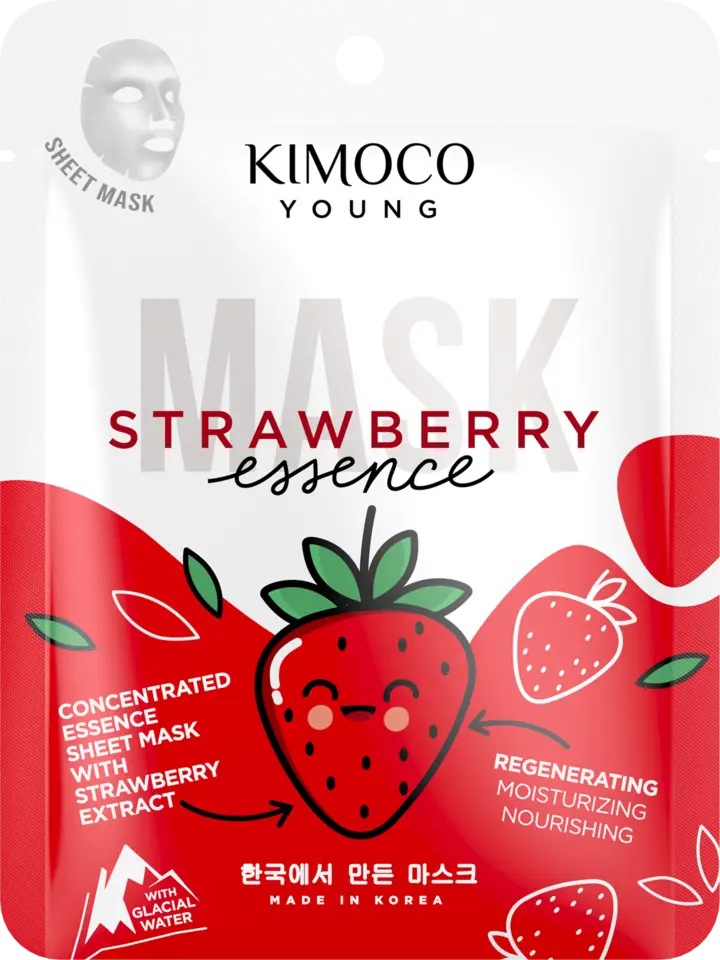
Kimoco Young Essence Mask
A sheet mask with 26 ingredients, including hyaluronic acid.
This hydrating sheet mask is formulated around Sodium Hyaluronate to hydrate skin and calm redness.
We independently verify ingredients, backed by peer-reviewed research. Suggest an update.
What's inside
Ingredients List
Water
Skin ConditioningGlycerin
Humectant


Fragaria Ananassa Fruit Extract
Skin Conditioning
Sodium Hyaluronate
Humectant


Rubus Idaeus Fruit Extract
AstringentRubus Fruticosus Fruit Extract
AstringentFragaria Chiloensis Fruit Extract
Skin Conditioning
Vaccinium Macrocarpon Fruit Extract
AstringentVaccinium Angustifolium Fruit Extract
Skin Protecting
Euterpe Oleracea Fruit Extract
PEG/PPG-17/6 Copolymer
SolventPPG-17
Skin ConditioningCarbomer
Emulsion StabilisingPEG-60 Hydrogenated Castor Oil
Emulsifying


Xanthan Gum
EmulsifyingPropylene Glycol
Humectant
Betaine
Humectant
Disodium EDTA
ChelatingButylene Glycol
Humectant
1,2-Hexanediol
Skin Conditioning
Ethylhexylglycerin
Skin ConditioningHydroxyacetophenone
Antioxidant
Triethanolamine
BufferingPhenoxyethanol
Preservative
Methylparaben
Preservative

Parfum
Masking


Water, Glycerin, Fragaria Ananassa Fruit Extract, Sodium Hyaluronate, Rubus Idaeus Fruit Extract, Rubus Fruticosus Fruit Extract, Fragaria Chiloensis Fruit Extract, Vaccinium Macrocarpon Fruit Extract, Vaccinium Angustifolium Fruit Extract, Euterpe Oleracea Fruit Extract, PEG/PPG-17/6 Copolymer, PPG-17, Carbomer, PEG-60 Hydrogenated Castor Oil, Xanthan Gum, Propylene Glycol, Betaine, Disodium EDTA, Butylene Glycol, 1,2-Hexanediol, Ethylhexylglycerin, Hydroxyacetophenone, Triethanolamine, Phenoxyethanol, Methylparaben, Parfum
Key Ingredients
Benefits
Concerns
Ingredients Explained
Water. It's the most common cosmetic ingredient of all. You'll usually see it at the top of ingredient lists, meaning that it makes up the largest part of the product.
So why is it so popular? Water most often acts as a solvent - this means that it helps dissolve other ingredients into the formulation.
You'll also recognize water as that liquid we all need to stay alive. If you see this, drink a glass of water. Remember to stay hydrated!
Learn more about WaterGlycerin (or glycerol) is a compound naturally found in your skin. It's a powerhouse humectant that pulls water into the stratum corneum.
Topically, glycerin does several things at once:
Your skin makes glycerin on its own (mostly from sebaceous oil breakdown) and shuttles it to your outermost layer of skin, or your epidermis, via aquaporin-3.
Aquaporin-3 is a transporter that is essential for normal skin hydration, elasticity, and repair. Interestingly, mice lacking in AQP3 have dry and less elastic skin that can be fully corrected with glycerin.
This ingredient is non-irritating, plays well with almost every ingredient, and works across all skin types. Typical use is anywhere between 3-10% but can go up to 79% in some leave-on products.
Just know very high concentrations (>40%) can feel tacky in low humidity.
Glycerin is the name for this ingredient in American English. British English uses Glycerol/Glycerine.
Learn more about GlycerinFragaria Ananassa Fruit extract comes from garden strawberry. It is a hybrid strawberry created from wild strawberries.
Strawberries have antioxidant and hydrating properties. They contain many compounds that are potent antioxidants, such as anthocyanins and Vitamin C.
The polysaccharides in strawberry help moisturize our skin.
Strawberries also contain acids such as ellagic acid, a compound that may protect our skin against UVB damage. Another acid present is citric acid.
This strawberry is the kind most commonly eaten and found at grocery stores.
Learn more about Fragaria Ananassa Fruit ExtractSodium Hyaluronate is the salt form of hyaluronic acid. It is a long sugar chain that is naturally found in your skin, joints, and connective tissue that maintains hydration and elasticity.
In skincare, it works as a humectant. It pulls water from the environment and deeper layers of skin and binds it to the surface.
Interestingly, the size of the molecule affects its behavior:
Some clinical evidence links low molecular weight versions to improved wrinkle depth, elasticity, anti-inflammatory effects, and barrier repair.
Many serums use a blend of both weights so you can get surface hydration plus longer-lasting and deeper effects.
You'll typically see concentrations between 0.1-2% for this ingredient.
Learn more about Sodium HyaluronateWe don't have a description for Rubus Idaeus Fruit Extract yet.
Blackberry extract is rich in antioxidants and Vitamin C. The majority of antioxidants include flavonoid, phenolic, and anthocyanins.
Antioxidants help fight free-radicals. Free-radicals are molecules that may damage your skin cells, such as pollution. This may help reduce the symptoms related to aging.
Vitamin C contains many skin benefits.
Learn more about Rubus Fruticosus Fruit ExtractFragaria Chiloensis Fruit Extract comes from the beach strawberry. This is a strawberry native to Pacific coasts of North America, South America, and Hawaii. It likes to grow on sandy beaches.
Beach strawberries have antioxidant and moisturizing properties. They contain many compounds that are potent antioxidants, such as anthocyanins and Vitamin C.
The sugar, or polysaccharides, in strawberries help hydrate the skin by increasing water retention.
Strawberries also contain acids such as ellagic acid, a compound that may protect our skin against UVB damage. Another acid present is citric acid.
Fun fact: The strawberry we buy and eat today was created as a hybrid from the beach strawberry.
Learn more about Fragaria Chiloensis Fruit ExtractVaccinium Macrocarpon Fruit Extract comes from the cranberry fruit. Vaccinium Macrocarpon is the North American species of cranberries native to eastern Canada.
As an astringent, cranberry extract helps tighten the pores by constricting the cells.
Cranberries contain Vitamin E and Vitamin C, both potent antioxidants. It also contains minerals such as manganese and copper.
Learn more about Vaccinium Macrocarpon Fruit ExtractThis extract comes from the blueberry native to North America. It has great antioxidant and skin soothing properties.
The antioxidant properties from blueberries come from its polyphenolic and vitamin C content. Polyphenols are a compound famous for their antioxidant properties and are commonly found in fruits.
A 2023 study found blueberries to protect skin from UV-B related inflammation. However, this ingredient should not replace your sunscreen.
Learn more about Vaccinium Angustifolium Fruit ExtractThis extract comes from the Cabbage Palm, AKA the Açaí berry! It has skin soothing and antioxidant properties.
Acai berries are rich in antioxidants, including ferulic acid (The famous vitamin C stabilizer). Antioxidants protect your skin against damaging free-radical molecules.
You can also find carbohydrates, lipids, proteins, minerals, vitamin A, and Vitamin C in these berries.
Learn more about Euterpe Oleracea Fruit ExtractWe don't have a description for PEG/PPG-17/6 Copolymer yet.
We don't have a description for PPG-17 yet.
Carbomer is a synthetic thickening and gelling agent. It's basically the ingredient that gives a lot of serums, gels, creams, and sunscreens their smooth, non-sticky texture.
Although legally permitted at very high levels, carbomers are normally used at concentrations below 1%.
It also needs to be neutralized to actually thicken, and because it is a large molecule, it doesn't really penetrate the skin barrier.
Allergy-wise, the risk is very low. Clinical studies show carbomers have low potential for skin irritation/sensitization even at concentrations up to 100%.
A 2024 UK study patch-tested 1,302 patients and found true allergy to the parent group of carbomer to be rare with no confirmed relevant reactions.
Learn more about CarbomerPeg-60 Hydrogenated Castor Oil comes from hydrogenated castor oil. It is a solubilizer and emulsifier.
As a solubilizer, it helps dissolve ingredients into a water-based version. It is also an emulsifer. Emulsifier help prevent oils and water from separating. Both these properties help create evenly-spread and uniform products.
Basically, Peg-60 Hydrogenated Castor Oil helps hold ingredients together.
Learn more about PEG-60 Hydrogenated Castor OilXanthan gum is used as a stabilizer and thickener within cosmetic products. It helps give products a sticky, thick feeling - preventing them from being too runny.
On the technical side of things, xanthan gum is a polysaccharide - a combination consisting of multiple sugar molecules bonded together.
Xanthan gum is a pretty common and great ingredient. It is a natural, non-toxic, non-irritating ingredient that is also commonly used in food products.
Learn more about Xanthan GumPropylene Glycol is a synthetic, colorless, odorless liquid that has been a staple in cosmetics for decades. It is a skin conditioning agent, humectant, and solvent.
As a humectant, it draw water to the skin to reduce flaking and restore suppleness. It's also a solvent that helps dissolve other actives and keeps formulas stable across temperature changes.
The CIR Expert Panel has confirmed this ingredient to be nontoxic and clinical studies show no sensitization at cosmetic use concentrations.
True allergic reactions are quite rare: a 15-year retrospective study of 6,751 patients found only 0.31% had a positive reaction (and less than half were considered clinically relevant).
It seemed that when sensitization does occur, it's most commonly linked to topical medication (like corticosteroids) and not cosmetics. Allergic contact dermatitis also appears largely limited to individuals with underlying skin conditions.
Overall, propylene glycol is a well-studied ingredient that most people can tolerate without issue.
Learn more about Propylene GlycolBetaine is a humectant. Like hyaluronic acid, it helps attract and retain moisture in the skin. It’s known for being gentle and for helping the skin maintain balanced hydration.
Betaine is mainly used to improve hydration and support calmer skin. It helps skin cells regulate water balance because it functions as an osmolyte.
Some studies suggest betaine may support making skin tone more even.
Fun fact: Betaine naturally exists in the skin and the body. In cosmetic products, it can be either plant-derived (most commonly from sugar beets) or synthetically produced for consistency and stability.
Betaine is also known as trimethylglycine.
Learn more about BetaineDisodium EDTA is a chelating agent. It grabs onto and deactivates metal ions that sneak into your products from water, packaging, or air.
This ingredient mainly works behind the scenes and helps with:
On top of that, this ingredient can counteract the effects of hard water by binding to the minerals in it.
One thing worth knowing is that Disodium EDTA has been shown to be a mild penetration enhancer. It can help other ingredients absorb into skin more effectively which can be a double-edged sword (great for actives, but can also make the active too strong if you have sensitive skin).
Clinical patch testing showed no significant skin irritation at typical use concentrations and minimal dermal absorption.
You'll most likely see this ingredient near the end of an ingredient list. It's typically found in concentrations less than 1%.
Learn more about Disodium EDTAButylene Glycol (or BG) is used within cosmetic products for a few different reasons:
Overall, Butylene Glycol is a safe and well-rounded ingredient that works well with other ingredients.
Though this ingredient works well with most skin types, some people with sensitive skin may experience a reaction such as allergic rashes, closed comedones, or itchiness.
Learn more about Butylene Glycol1,2-Hexanediol is a synthetic liquid and another multi-functional powerhouse.
It is a:
- Humectant, drawing moisture into the skin
- Emollient, helping to soften skin
- Solvent, dispersing and stabilizing formulas
- Preservative booster, enhancing the antimicrobial activity of other preservatives
Ethylhexylglycerin is created from glycerin. It is a multitasker ingredient that:
The CIR Expert Panel found minimal skin absorption or sensitization of any kind in a safety assessment. Though this ingredient is considered well-tolerated, a small number of cases of allergic dermatitis have been published since 2002. Just be sure to patch test if you are unsure.
Industry-reported use ranges from 8% in rinse-off products and 2% in leave-on formulations.
Learn more about EthylhexylglycerinHydroxyacetophenone is a small phenolic molecule that earns its place in a formulas as an antioxidant and preservative booster.
As a phenol, it is able to neutralize free radicals to protect both the product and the skin from oxidative stress.
Though it can't kill microbes on its own, it works as a good supporting agent when combined with other preservatives like Phenoxyethanol or 1,2-Hexanediol.
This ingredient naturally occurs as piceol in Norwegian spruce needles (~0.4-1.1% dry weight and in cloudberries). Though the cosmetic-grade material is synthesized for purity and consistency.
You'll usually see it used at low levels and suppliers recommend up to 1% added to a water phase.
Safety testing was done at concentrations like 0.05% in SPF products and 0.5% in a Human Repeated Insult Patch Test. The safety evidence is assuring; this ingredient is safe for cosmetics in current use and also holds safety status as a food flavoring as well.
An honest caveat: the "soothing" and "anti-inflammatory" claims come mostly from supplier marketing rather than published clinical trials. The Cosmetic Ingredient Review's own literature search found no useful efficacy studies on this ingredient.
So the antioxidant and preservative-boosting roles are the well supported ones while the calming benefit is plausible but thinly evidenced.
Overall, this is a well-tolerated, low-irritation multitasker that quietly helps a formula stay fresh and stable.
Learn more about HydroxyacetophenoneTriethanolamine (TEA) is an emulsifier and pH adjuster. It is created using ethylene oxide and ammonia. This gives Triethanolamine a nitrogen core and a similar scent to ammonia.
As an emulsifier, it prevents ingredients from separating and enhances texture by adding volume to a product.
PH adjusters are common in cosmetic products. The pH of a product can affect the effectiveness of other ingredients. A product with a high pH may also irritate the skin.
If you are looking for the tea leaf ingredient, click here.
Learn more about TriethanolaminePhenoxyethanol is one of the most widely used preservatives in skincare (and for good reason!).
It has a large spectrum of antimicrobial activity and especially effective bacteria, yeast, and mold while only having a weak effect on your skin's natural microbiome.
On a cellular level, it disrupts the cell membranes of microbes by poking holes that make the cell leak. This shuts down the chemical reactions the microbe needs to make energy so it can no longer survive.
Another perk of this ingredient is that it stays functional across a wide pH range (3-10).
You'll often see it paired with boosters like Ethylhexylglycerin; one study showed that a 1:9 ratio of Ethylhexylglycerin to Phenoxyethanol damages bacterial membranes as effectively as doubling the Phenoxyethanol concentration on its own.
Typical use concentrations range from 0.3-1% depending on the formula, and this ingredient is capped at 1% int the EU.
Safety-wise, the fear mongering does not hold up to the evidence. The EU's Scientific Committee on Consumer Safety and FDA consider it safe as a preservative at up to 1%, including for children of all ages.
Adverse systemic effects only showed up in animal studies at exposures roughly 200x higher than what people get from cosmetics. And despite its very widespread use, this ingredient is a rare sensitizer and allergic reactions are uncommon.
Learn more about PhenoxyethanolMethylparaben is a synthetic preservative and one of the most widely used in the world. It has a simple, but important job: prevent your products from going bad by stopping bacteria, yeast, and mold from growing.
Typical use levels are low, often 0.1-0.3%.
This is also one of the most heavily studied preservatives out there and major regulatory bodies have repeatedly given it the green light.
In 2023, the EU's Scientific Committee on Consumer Safety (SCCS) confirmed that this ingredient is safe up to 0.4% on its own, of up to 0.8% when mixed with other paraben esters.
Here's the science behind the noise behind parabens/hormones as well:
Methylparaben shows very weak estrogen-like activity in vitro tests (more than 1,000x weaker than your body's own estradiol). In vivo (live-organism) studies don't support a meaningful endocrine-disrupting effect either.
You get a stronger estrogenic effect from eating tofu, actually.
It's also a low sensitizer and allergic reactions are uncommon; they usually happen on damage or broken skin.
There is a caveat: France has proposed to formally re-examine its endocrine classification in 2025 so the regulatory conversation isn't fully closed as of yet.
But as it stands today, this ingredient is considered safe at permitted levels.
Learn more about MethylparabenParfum is a catch-all term for an ingredient or more that is used to give a scent to products.
Also called "fragrance", this ingredient can be a blend of hundreds of chemicals or plant oils. This means every product with "fragrance" or "parfum" in the ingredients list is a different mixture.
For instance, Habanolide is a proprietary trade name for a specific aroma chemical. When used as a fragrance ingredient in cosmetics, most aroma chemicals fall under the broad labeling category of “FRAGRANCE” or “PARFUM” according to EU and US regulations.
The term 'parfum' or 'fragrance' is not regulated in many countries. In many cases, it is up to the brand to define this term.
For instance, many brands choose to label themselves as "fragrance-free" because they are not using synthetic fragrances. However, their products may still contain ingredients such as essential oils that are considered a fragrance by INCI standards.
One example is Calendula flower extract. Calendula is an essential oil that still imparts a scent or 'fragrance'.
Depending on the blend, the ingredients in the mixture can cause allergies and sensitivities on the skin. Some ingredients that are known EU allergens include linalool and citronellol.
Parfum can also be used to mask or cover an unpleasant scent.
The bottom line is: not all fragrances/parfum/ingredients are created equally. If you are worried about fragrances, we recommend taking a closer look at an ingredient. And of course, we always recommend speaking with a professional.
Learn more about ParfumReviews
No written reviews yet. Be the first to review this product.
Recent searches
Search reviews by skin type, ingredient, or keyword.
Where it's from
Kimoco Young is a Polish brand


We're dedicated to providing you with the most up-to-date and science-backed ingredient info out there.
The data we've presented on this page has been verified by a member of the SkinSort Team.
Read more about us· Updated August 26, 2026 • Added by livia5


