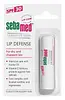
This barrier-repair lip moisturizer is formulated around Simmondsia Chinensis Seed Oil and Bisabolol to strengthen the lip barrier and hydrate lips.
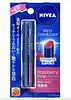
This barrier-repair lip moisturizer is formulated around Persea Gratissima Oil and Simmondsia Chinensis Seed Oil to strengthen the lip barrier and hydrate lips.

What's inside
What's inside
 Key Ingredients
Benefits
Concerns
Ingredients Side-by-side
Caprylic/Capric/Succinic Triglyceride
EmollientCera Alba
Emollient





Isoamyl P-Methoxycinnamate
UV Absorber
Ricinus Communis Seed Oil
Masking

Caprylic/Capric Triglyceride
Masking

Ethylhexyl Salicylate
UV Absorber
Tocopheryl Acetate
Antioxidant


C12-15 Alkyl Benzoate
AntimicrobialOryza Sativa Bran Wax
Skin Conditioning
Simmondsia Chinensis Seed Oil
Emollient
Glyceryl Ricinoleate
Emollient
Butyl Methoxydibenzoylmethane
UV Absorber
Bisabolol
Antioxidant

Parfum
Masking

Caprylic/Capric/Succinic Triglyceride, Cera Alba, Isoamyl P-Methoxycinnamate, Ricinus Communis Seed Oil, Caprylic/Capric Triglyceride, Ethylhexyl Salicylate, Tocopheryl Acetate, C12-15 Alkyl Benzoate, Oryza Sativa Bran Wax, Simmondsia Chinensis Seed Oil, Glyceryl Ricinoleate, Butyl Methoxydibenzoylmethane, Bisabolol, Parfum
Hydrogenated Polyisobutene
EmollientNeopentyl Glycol Dicaprate
EmollientPentaerythrityl Tetraisostearate
Emollient
Diisostearyl Malate
EmollientDiphenylsiloxy Phenyl Trimethicone
Skin Conditioning
Polyethylene
Abrasive
Dipentaerythrityl Hexahydroxystearate
EmulsifyingStearic Acid
Cleansing
Ethylhexyl Methoxycinnamate
UV Absorber
Phytosteryl/Octyldodecyl Lauroyl Glutamate
Skin ConditioningPersea Gratissima Oil
Skin Conditioning
Simmondsia Chinensis Seed Oil
Emollient
Macadamia Integrifolia Seed Oil
Skin Conditioning
Tocopherol
Antioxidant

Polyglyceryl-2 Triisostearate
Emulsifying
Microcrystalline Wax
Emulsion StabilisingButyl Methoxydibenzoylmethane
UV Absorber
Mica
Cosmetic ColorantIron Oxides
Titanium Dioxide
Cosmetic Colorant
Aluminum Hydroxide
EmollientBarium Sulfate
Cosmetic ColorantCI 19140
Cosmetic ColorantCI 15850
Cosmetic ColorantCI 73360
Cosmetic ColorantHydrogenated Polyisobutene, Neopentyl Glycol Dicaprate, Pentaerythrityl Tetraisostearate, Diisostearyl Malate, Diphenylsiloxy Phenyl Trimethicone, Polyethylene, Dipentaerythrityl Hexahydroxystearate, Stearic Acid, Ethylhexyl Methoxycinnamate, Phytosteryl/Octyldodecyl Lauroyl Glutamate, Persea Gratissima Oil, Simmondsia Chinensis Seed Oil, Macadamia Integrifolia Seed Oil, Tocopherol, Polyglyceryl-2 Triisostearate, Microcrystalline Wax, Butyl Methoxydibenzoylmethane, Mica, Iron Oxides, Titanium Dioxide, Aluminum Hydroxide, Barium Sulfate, CI 19140, CI 15850, CI 73360
Reviews
Ingredients Explained
These ingredients are found in both products.
Ingredients higher up in an ingredient list are typically present in a larger amount.
Also known as Avobenzone, this ingredient is an oil-soluble used to absorb the full spectrum of UVA rays (peak 357 nm).
It's one of the most effective UVA filters available but has a major caveat of photostability: avobenzone is susceptible to photodegradation.
This means it can lose efficacy when exposed to sunlight without the help of a stabilizing agent.
Studies show antioxidants (like vitamin E or vitamin C) and some UV filters (like octocrylene and Tinosorb S) can meaningfully improve its stability in a formulation.
The maximum allowable concentration according to regulation is 3% in the US + Canada, and 5% in the EU, Australia, China, Korea, and ASEAN countries.
It has a well-support safety profile: a comprehensive 2025 review found minimal toxicity with no evidence of carcinogenicity.
Overall, avobenzone is a safe and regulated ingredient used in sunscreen for over 40 years.
Learn more about Butyl MethoxydibenzoylmethaneJojoba oil is one of the most well-studied plant-derived ingredients in cosmetics. It is an emollient with a special structure.
Because it is made up of 97-98% wax esters, it closely mirrors the linear monoesters found in human sebum. This makes it skin compatible, non-greasy, and lightweight.
Unlike other plant oils, jojoba wax doesn't easily penetrate skin. It mostly works in the uppermost layers as an emollient. This just means it forms a light barrier on the skin to help retain moisture.
Formulations with jojoba esters up to 90% reduced transepidermal water loss (TEWL) and increased barrier recovery by 81% (outperforming bisabolol at 47%).
Besides barrier support, the science also suggests jojoba to have anti-inflammatory effects and potential applications for skin infections, aging, and wound healing.
Fun fact: Indigenous cultures have used jojoba as a moisturizer and to help treat burns for centuries.
Fungal acne: The Malassezia yeast is known to metabolize fatty acids in the C11-24 range and jojoba's dominant fatty acid components fall into this range. This ingredient may not be fungal acne safe.
Learn more about Simmondsia Chinensis Seed Oil

