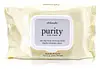
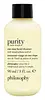
Philosophy Purity Made Simple One-Step Facial Cleansing Cloths Versus Philosophy Purity Made Simple One-Step Facial Cleanser
This cleansing wipe is made to dissolve makeup, sunscreen, and daily buildup.

What's inside
What's inside
 Key Ingredients
Benefits
Concerns
Ingredients Side-by-side
Water
Skin ConditioningButylene Glycol
Humectant

Sodium Citrate
BufferingGluconolactone
Chelating







Cetearyl Isononanoate
Emollient
Ceteareth-20
Cleansing

Cetearyl Alcohol
Emollient



Phenoxyethanol
Preservative
Sodium Benzoate
Masking
Glycerin
Humectant
Glyceryl Stearate
Emollient
Benzoic Acid
Masking
Ceteareth-12
EmulsifyingCetyl Palmitate
Emollient
Ethylhexylglycerin
Skin ConditioningParfum
Masking


Linalool
Perfuming
Calcium Gluconate
HumectantGeraniol
Perfuming
Sodium Hydroxide
BufferingLimnanthes Alba Seed Oil
Skin Conditioning
Tocopherol
Antioxidant



Water, Butylene Glycol, Sodium Citrate, Gluconolactone, Cetearyl Isononanoate, Ceteareth-20, Cetearyl Alcohol, Phenoxyethanol, Sodium Benzoate, Glycerin, Glyceryl Stearate, Benzoic Acid, Ceteareth-12, Cetyl Palmitate, Ethylhexylglycerin, Parfum, Linalool, Calcium Gluconate, Geraniol, Sodium Hydroxide, Limnanthes Alba Seed Oil, Tocopherol
Water
Skin ConditioningSodium Lauroamphoacetate
CleansingSodium Trideceth Sulfate
Cleansing
Limnanthes Alba Seed Oil
Skin Conditioning
Coco-Glucoside
Cleansing
Coconut Alcohol
Emollient
PEG-120 Methyl Glucose Dioleate
Emulsifying
Glycerin
Humectant
Phenoxyethanol
Preservative
Isopropyl Alcohol
Solvent

Carbomer
Emulsion StabilisingPolysorbate 20
Emulsifying
Chlorphenesin
Antimicrobial
Citric Acid
Buffering
Disodium Phosphate
BufferingAniba Rosaeodora Wood Oil
Astringent
Linalool
Perfuming
Ethylhexylglycerin
Skin ConditioningXanthan Gum
EmulsifyingSodium Citrate
BufferingBulnesia Sarmientoi Wood Oil
Masking
Pelargonium Graveolens Flower Oil
Masking
Sodium Hydroxide
BufferingAmyris Balsamifera Bark Oil
Masking
Cymbopogon Martini Oil
Masking
Rosa Damascena Flower Oil
Masking
Tocopherol
Antioxidant
Daucus Carota Sativa Seed Oil
Emollient
Mimosa Tenuiflora Bark Extract
Skin ProtectingOrmenis Multicaulis Oil
Masking
Piper Nigrum Fruit Extract
Perfuming
Salvia Sclarea Oil
Masking
Santalum Album Oil
Masking
CI 19140
Cosmetic ColorantWater, Sodium Lauroamphoacetate, Sodium Trideceth Sulfate, Limnanthes Alba Seed Oil, Coco-Glucoside, Coconut Alcohol, PEG-120 Methyl Glucose Dioleate, Glycerin, Phenoxyethanol, Isopropyl Alcohol, Carbomer, Polysorbate 20, Chlorphenesin, Citric Acid, Disodium Phosphate, Aniba Rosaeodora Wood Oil, Linalool, Ethylhexylglycerin, Xanthan Gum, Sodium Citrate, Bulnesia Sarmientoi Wood Oil, Pelargonium Graveolens Flower Oil, Sodium Hydroxide, Amyris Balsamifera Bark Oil, Cymbopogon Martini Oil, Rosa Damascena Flower Oil, Tocopherol, Daucus Carota Sativa Seed Oil, Mimosa Tenuiflora Bark Extract, Ormenis Multicaulis Oil, Piper Nigrum Fruit Extract, Salvia Sclarea Oil, Santalum Album Oil, CI 19140
Reviews
Ingredients Explained
These ingredients are found in both products.
Ingredients higher up in an ingredient list are typically present in a larger amount.
Ethylhexylglycerin is created from glycerin. It is a multitasker ingredient that:
The CIR Expert Panel found minimal skin absorption or sensitization of any kind in a safety assessment. Though this ingredient is considered well-tolerated, a small number of cases of allergic dermatitis have been published since 2002. Just be sure to patch test if you are unsure.
Industry-reported use ranges from 8% in rinse-off products and 2% in leave-on formulations.
Learn more about EthylhexylglycerinGlycerin (or glycerol) is a compound naturally found in your skin. It's a powerhouse humectant that pulls water into the stratum corneum.
Topically, glycerin does several things at once:
Your skin makes glycerin on its own (mostly from sebaceous oil breakdown) and shuttles it to your outermost layer of skin, or your epidermis, via aquaporin-3.
Aquaporin-3 is a transporter that is essential for normal skin hydration, elasticity, and repair. Interestingly, mice lacking in AQP3 have dry and less elastic skin that can be fully corrected with glycerin.
This ingredient is non-irritating, plays well with almost every ingredient, and works across all skin types. Typical use is anywhere between 3-10% but can go up to 79% in some leave-on products.
Just know very high concentrations (>40%) can feel tacky in low humidity.
Glycerin is the name for this ingredient in American English. British English uses Glycerol/Glycerine.
Learn more about GlycerinLimnanthes Alba Seed Oil is from the seeds of the meadowfoam plant. It is a skin conditioning agent and emollient that sits on top of skin to soften and hydrate it.
Over 98% of the oil is made up of long-chain fatty acids, mostly aachidic acid (61%), docosenoic acid (~16%), and docosadienoic acid (~18%).
This combination is not really found in any other plant oil and is the reason this is one of the most stable botanical oils available.
Some studies show it to be more stable than jojoba oil, helps a product resist going rancid, and can help extend the shelf life of a formula.
It also naturally contains vitamin E and phytosterols that give it a mild antioxidant benefit.
This ingredient is typically used from around 1% to fairly high levels since it's gentle; it's well-tolerated and low on the irritation scale.
Learn more about Limnanthes Alba Seed OilLinalool is a small, naturally occurring scent molecule found in plants like lavender, coriander, bergamot, and more.
It is one of the two most-used fragrance ingredients in cosmetics and added purely for smell. Since it's not used for a skin benefit, there's no "effective dose". Concentration depends on the fragrance load of the product.
The EU requires it to be named on the label above 0.001% in leave-on and 0.01% in rinse-off products.
Fresh linalool is a weak sensitizer but air exposure turns some of it into hydroperoxides, which are strong sensitizers. Those oxidation products are the actual allergy concern.
Patch-test clinics see positive reactions to linalool hydroperoxides in about 4% to 12% of dermatitis patients depending on country and test concentration.
Resassuringly, one analytical study found hydroperoxide levels in real fragranced products to be orders of magnitude below what induced sensitization in animal studies with no evidence of oxidation building up during normal storage.
The practical takeaway is that linalool is fine for most people but worth avoiding if you have a confirmed fragrance contact allergy or a badly compromised barrier.
Products stored a long time after opening are also the high-risk scenario since that is when oxidation happens.
The scent of linalool is described as floral, spicy tropical, and citrus-like.
Learn more about LinaloolPhenoxyethanol is one of the most widely used preservatives in skincare (and for good reason!).
It has a large spectrum of antimicrobial activity and especially effective bacteria, yeast, and mold while only having a weak effect on your skin's natural microbiome.
On a cellular level, it disrupts the cell membranes of microbes by poking holes that make the cell leak. This shuts down the chemical reactions the microbe needs to make energy so it can no longer survive.
Another perk of this ingredient is that it stays functional across a wide pH range (3-10).
You'll often see it paired with boosters like Ethylhexylglycerin; one study showed that a 1:9 ratio of Ethylhexylglycerin to Phenoxyethanol damages bacterial membranes as effectively as doubling the Phenoxyethanol concentration on its own.
Typical use concentrations range from 0.3-1% depending on the formula, and this ingredient is capped at 1% int the EU.
Safety-wise, the fear mongering does not hold up to the evidence. The EU's Scientific Committee on Consumer Safety and FDA consider it safe as a preservative at up to 1%, including for children of all ages.
Adverse systemic effects only showed up in animal studies at exposures roughly 200x higher than what people get from cosmetics. And despite its very widespread use, this ingredient is a rare sensitizer and allergic reactions are uncommon.
Learn more about PhenoxyethanolSodium Citrate is the sodium salts of citric acid. In skincare, it is used to alter pH levels and acts as a preservative.
Its main functions are to maintain the pH of a product and neutralize metal ions.
The acidity of our skin is maintained by our glands and skin biome; normal pH level of skin is slightly acidic (~4.75-5.5).
Being slightly acidic allows our skin to create an "acid mantle". This acid mantle is a thin barrier that protects our skin from bacteria and contaminants.
Learn more about Sodium CitrateSodium Hydroxide is also known as lye or caustic soda. It is used to adjust the pH of products; many ingredients require a specific pH to be effective.
In small amounts, sodium hydroxide is considered safe to use. However, large amounts may cause chemical burns due to its high alkaline.
Your skin has a natural pH and acid mantle. This acid mantle helps prevent harmful bacteria from breaking through. The acid mantle also helps keep your skin hydrated.
"Alkaline" refers to a high pH level. A low pH level would be considered acidic.
Learn more about Sodium HydroxideTocopherol is a fat-soluble antioxidant known as Vitamin E.
You'll find this ingredient in the vast majority of skincare (for good reason). It works to neutralize free radicals, or unstable molecules generated by UV exposure, pollution, and other environmental stressors, before they can cause oxidative damage to your skin cells.
Topically applied tocopherol has been shown to protect against UV damage by ramping up the skin's own natural defense enzymes.
It also acts as a skin conditioning agent; some studies show that regular topical use can improve the skin's water-binding capacity over 2-4 weeks.
This ingredient is especially loved for being a team player. When combined with Vitamin C, the photoprotective effect of both ingredients roughly doubles and the combo also helps reduce UV-induced DNA damage.
This ingredient has some brightening potential but it's more of a prevention ingredient than spot-fader. Cell studies show it can slow down melanin production but it's worth noting that it's not the most powerful brightener out there.
In formulations, it also serves as a stabilizer that helps protect other oxidation-prone ingredients from degrading.
Concentrations usually range from 0.1-1% in most leave-on products.
Learn more about TocopherolWater. It's the most common cosmetic ingredient of all. You'll usually see it at the top of ingredient lists, meaning that it makes up the largest part of the product.
So why is it so popular? Water most often acts as a solvent - this means that it helps dissolve other ingredients into the formulation.
You'll also recognize water as that liquid we all need to stay alive. If you see this, drink a glass of water. Remember to stay hydrated!
Learn more about Water

