ECOOKING Sun Balm For The Lips SPF 50
A lip moisturizer with 19 ingredients, including spf and vitamin E.
This barrier-repair lip moisturizer is formulated around Butyrospermum Parkii Butter and Argania Spinosa Kernel Oil to strengthen the lip barrier and hydrate lips.
We independently verify ingredients, backed by peer-reviewed research. Suggest an update.
What's inside
Ingredients List
Butyrospermum Parkii Butter
Skin Conditioning






Glyceryl Oleate
Emollient

Dibutyl Adipate
EmollientDiethylamino Hydroxybenzoyl Hexyl Benzoate
UV Filter
Diethylhexyl Butamido Triazone
UV Absorber
Diisostearoyl Polyglyceryl-3 Dimer Dilinoleate
Emollient
Ethylhexyl Triazone
UV Absorber
Prunus Amygdalus Dulcis Oil
Skin Conditioning
Ricinus Communis Seed Oil
Masking
Zinc Oxide
Cosmetic Colorant

Olea Europaea Oil Unsaponifiables
Skin Conditioning
Olea Europaea Fruit Oil
Masking
Oryza Sativa Cera
Skin ConditioningArgania Spinosa Kernel Oil
Emollient

Tocopherol
Antioxidant




Helianthus Annuus Seed Oil
Emollient
Parfum
Masking
Limonene
Perfuming
Linalool
Perfuming
Butyrospermum Parkii Butter, Glyceryl Oleate, Dibutyl Adipate, Diethylamino Hydroxybenzoyl Hexyl Benzoate, Diethylhexyl Butamido Triazone, Diisostearoyl Polyglyceryl-3 Dimer Dilinoleate, Ethylhexyl Triazone, Prunus Amygdalus Dulcis Oil, Ricinus Communis Seed Oil, Zinc Oxide, Olea Europaea Oil Unsaponifiables, Olea Europaea Fruit Oil, Oryza Sativa Cera, Argania Spinosa Kernel Oil, Tocopherol, Helianthus Annuus Seed Oil, Parfum, Limonene, Linalool
Key Ingredients
Benefits
Concerns
Ingredients Explained
This ingredient is also known as shea butter. It is a plant-derived extract from the nuts of the Africa shea tree and one of the most well-studied emollients.
Because it has a high concentration of fatty acids (primarily oleic, stearic, and linoleic) it is able to form a protective barrier on the skin's surface. This helps seal in moisture and prevents transepidermal water loss (TEWL).
In vitro research found an increase in skin hydration by 58% and a decrease in TEWL by 37.8% after 24 hours of applying this ingredient (pretty impressive for a single ingredient!).
Besides hydration, shea butter also contains triterpenes that have anti-inflammatory potential. In particule, lupeol cinnamate has shown the highest anti-inflammatory activity in vivo.
Shea butter also contains vitamins A and E which may contribute to antioxidant activity.
While Shea Butter has an SPF rating of about 3-4, it is not a sunscreen replacement.
This ingredient may not be fungal acne safe because its fatty acids fall within the C11-C24 range that the Malassezia yeast can metabolize.
This ingredient shows up on a lot of "pore-clogging" lists but there's no real evidence behind that. It doesn't even have a comedogenic rating from an actual study; the numbers you'll find online come from blogs citing other blogs.
Ratings for other ingredients mostly come from a 1980s rabbit ear test. This test doesn't translate well to human skin or to real products because the ingredient sits at a much lower percentage.
Some people still find it breaks them out. So if that's you, definitely trust your skin. Just know this one's based on experience and not evidence.
Learn more about Butyrospermum Parkii ButterGlyceryl Oleate is the monoester of glycerin and oleic acid. It is a skin-conditioning emollient that also helps form emulsions.
What makes glyceryl oleate special is its "re-fatting" effect.
When you wash your hair and skin with a surfactant-based cleanser, the surfactants grab onto everything. This includes your skin's natural lipids, or the fats that live in your skin barrier and sebum. Once you rinse these surfactants away, it leaves your skin feeling tight, dry, and clean (in a not-good way).
Re-fatting is essentially putting some of these lipids back. Glyceryl oleate deposits a thin layer of emollient lipids back on the skin or hair surface reduce some of the barrier damage.
Also, glyceryl oleate isn't a foreign molecule to your skin. It's chemically identical to something your skin already produces and manages naturally. This is why it tends to be well-tolerated with low risk of irritation.
Typical use levels range from 0.5-5%.
Glyceryl Oleate has a function of "perfuming" in the CosIng database. This just means that the ingredient has some scent character that can contribute to the product's overall smell.
The scent of this ingredient is described as "waxy".
As an ester of oleic acid, this ingredient may not be fungal acne safe. This is because oleic acid falls into the carbon-chain length that Malassezia can use as a substrate.
Learn more about Glyceryl OleateDibutyl Adipate is a lightweight, oil-soluble ester that acts as an emollient and solvent. It helps products spread more easily and leaves a soft, silky, dry-touch finish without being greasy.
You'll likely see this ingredient in sunscreens because it does a nice job dissolving UV filters and keeping them evenly distributed.
This ingredient has been found to be safe as used in cosmetics, wasn't a skin or eye irritant in clinical patch testing, and wasn't phototoxic.
In a clinical comedogenicity test, this ingredient tested negative so it isn't likely to clog pores.
Typical use levels are about 5-8% for sunscreens + nail products, but can range from 0.005%-8% depending on the product.
Learn more about Dibutyl AdipateDiethylamino Hydroxybenzoyl Hexyl Benzoate (DHHB) is a chemical UV-A absorber. It is formulated for high UVA protection (320-400 nm).
DHHB is well-liked for:
DHHB has been approved by the EU, Japan, Taiwan, and South America for use up to 10%. Unfortunately, it has not been approved for use in the US or Canada due to slow regulatory processes.
This ingredient is soluble in oils, fats, and lipids.
Learn more about Diethylamino Hydroxybenzoyl Hexyl BenzoateDiethylhexyl Butamido Triazone (aka Iscotrizinol) is an oil-soluble organic UV filter that mainly absorbs UVB and a bit of UVA II light.
This ingredient is great at preventing sunburn but doesn't cover the deep UVA I range. This is why it's often paired with a UVA filter like Avobenzone or Bemotrizinol.
Two of its biggest selling points are efficiency and stability:
Most of the other chemical filters are considered "photostable" if they can last for two hours.
Because this ingredient is oil-loving, it can sit neatly into the oil phase of emulsions and shines in water-repellent/water-resistant formulations.
The EU and Canada allow it to be used up to 10% and Japan allows it up to 5%.
Unfortunately, it's not yet an FDA approved sunscreen agent so you won't be able to find it in sunscreens in the US.
Safety-wise, it has a pretty solid record: the EU's Scientific Committee on Consumer Safety (SCCS) has reviewed it and found low skin absorption, no capacity to produce skin irritation or photo-irritation.
In vitro testing has found less than 0.1% of the applied dose is absorbed by the skin over 24 hours (mostly due to its large molecule size).
Fun fact: This ingredient even has anti-inflammatory properties similar to those of ketoprofe, an anti-inflammatory medication.
Learn more about Diethylhexyl Butamido TriazoneDiisostearoyl Polyglyceryl-3 Dimer Dilinoleate isn't fungal acne safe.
Ethylhexyl Triazone (aka Octyl Triazone) is an oil-soluble organic UVB filter. It has peak absorption around 314 nm, right in the middle of the UVB range.
This ingredient is described as one of the most effective UVB filters available and small concentrations are enough to deliver a high SPF thanks to its strong UV absorbing power.
Formulators love it for its stability; its ability to filter UV stays practically unchanged even under intense radiation and it can also help boost the photostability of less stable filters like avobenzone.
It's also a great pick for water resistant products because it's insoluble in water and has a good affinity for keratin.
Because it's a big, heavy molecule, the European Scientific Committee has found to to have very low dermal penetration and negative results for allergenicity.
In vitro testing also showed a low absorption rate and clean results on irritation.
Typical use levels are 1-5% with 5% being the maximum in the EU, Japan, and other markets that allow it. However, this ingredient is not approved yet in the US or Canada.
Learn more about Ethylhexyl TriazoneThis ingredient is also known as sweet almond oil. It is a lightweight, cold-pressed oil from the ripe seeds of the sweet almond tree.
Sweet almond oil is rich in skin-nourishing fatty acids such as oleic acid (55-86%) and linolenic acid (7-35%).
As an emollient, it softens and hydrates skin by forming a thin barrier that locks in moisture.
Clinical studies have found it to be non-irritating and non-sensitizing. The CIR Expert Panel has evaluated the available safety data and concluded it is safe for topical use.
Because of the oleic acid content, this ingredient may not be fungal acne safe.
Learn more about Prunus Amygdalus Dulcis OilThis ingredient is also known as castor oil. It is a skin conditioning ingredient.
The star component of castor oil is ricinoleic acid, an unusual fatty acid that makes up ~80-92% of its composition.
In skincare, it is an emollient that dries down to a solid film with water-binding properties. This helps keep skin hydrated and helps reduce transepidermal water loss (TEWL).
A 2026 dermatology review pulls together its broader uses:
Human clinical testing found this ingredient to be non-irritating and non-sensitizing.
Because castor oil contains fatty acids in the C11-24 range, this ingredient may not be fungal acne safe.
At this time, the literature does not support castor oil in regrowing hair. A 2022 systematic review found no strong evidence that it supports hair growth and only weak evidence that it improves hair shine.
Castor oil itself carries "perfuming" and "masking" function tags according to the official CosIng database. This is because of its mild odor and odor-dampening properties.
Learn more about Ricinus Communis Seed OilZinc Oxide (ZO) is a mineral broad-spectrum UV filter and the broadest-spectrum filter recognized by the FDA. It covers everything from UVB through to long-wave UVA.
On top of sun protection, it has skin protectant and skin-soothing properties too.
Here's a myth worth busting: mineral filters are usually described as working by "reflecting" or "bouncing" UV off your skin.
That's mostly not true: when researchers actually measured it, ZO and Titanium Dioxide reflect only about 4-5% of UV (less than SPF 2 worth of protection).
The vast majority of the work (~95%) is done by absorption, similar to chemical UV filters. ZO is a semiconductor that absorbs UV photos through its energy band gap.
So the old "physical blocker vs. chemical absorber" framing is really an oversimplification.
Zinc Oxide is one of the most effective broad-spectrum UV filters out there. It protects across UVB, UVA2, and UVA1 with a flat, even absorption curve across the whole UVA-UVB range.
That uniform UVA coverage is its standout feature; titanium dioxide skews more toward UVB as its particle size drops so ZO gives more consistent and extended UVA protection.
It's also very photostable. As an inorganic oxide, ZO doesn't break down in sunlight the way some organic filters can, so it holds up over a day of wear.
This ingredient is gentle and soothing, making it go-to for sunscreens aimed at sensitive skin, rosacea, or ecezma-prone skin, babies, and children.
It's also unlikely to cause the "eye sting" that some sunscreen ingredients are known for, and regulatory agencies broadly consider it non-toxic and safe for topical use.
Beyond sun protection, ZO is also a recognized OTC skin protectant. It forms a breathable barrier that shields skin from moisture and irritation while supporting healing. This is why you'll see it as a classic active in diaper rash creams.
The only downside to ZO is that it can leave a visible white cast, especially on deeper skin tones. This is the main reason mineral sunscreens have historically felt less cosmetically elegant than chemical or hybrid formulas.
Zinc Oxide comes in both non-nano and nano forms. The dividing line is 100nm and anything under is classified as a nanomaterial by the EU.
The nano version scatters less visible light which cuts down white case and gives a lighter, more wearable texture.
Another thing worth understanding about formulation:
Uncoated ZO has some inherent photocatalytic activity. This just means it can generate reactive oxygen species under UV. It's exactly why cosmetic-grade ZO is almost always surface-coated; this coating suppresses that reactivity and improves how the powder disperses and feels.
A well-formulated coated ZO largely sidesteps this issue.
Zinc Oxide is commonly used anywhere from 10% up to the regulatory maximum in sunscreens (25%).
Mineral-only broad-spectrum products often land in the 15-25% range to hit higher SPF and UVA values. Keep in mind SPF performance depends heavily on particle size, dispersion, and the rest of the formula, and not just the percentage.
As an OTC skin protectant like diaper creams, ZO typically runs higher at roughly 10-40%.
This ingredient is generally easy to work with and doesn't photodegrade.
The only thing to know is that uncoated ZO can be a bit reactive in a formula.
Under UV, it can break down sensitive ingredients like other actives or UV filters. This is another reason coated versions are standard. ZO can also react with very acidic ingredients or throw off stability of some creams. A good formula will get around this with the right coatings and dispersion.
The EU's Scientific Committee on Consumer Safety has concluded that ZO nanoparticles "can be considered to not pose any risk of adverse effects in humans after application on healthy, intact or sunburnt skin".
You might hear that ZO is "toxic"; this is because an in-vitro (test tube) study suggested micronized ZO had potential phototoxicity. In vivo (human) investigations have disputed this and the results have come back reassuring.
So does ZO penetrate skin? The short answer is no, not in any way that matters.
The most relevant evidence comes from real-world human studies: in one, volunteers applied ZO nanoparticle sunscreen hourly for six hours and daily for five days. The advanced imaging showed the particles stayed on the surface and never reached the living epidermis, and no cellular toxicity was found.
Other in-vivo and ex-vivo work agree; ZO nanoparticles don't cross the stratum corneum, even on flexed, massaged, or barrier-impaired skin.
A small amount of solubilized zinc ions can dissolve off the particles and enter the upper skin. But the quantities are tiny compared to the zinc already naturally present in your body, and studies haven't found this to cause local toxicity.
The sunscreen bans you've heard of (like Hawaii's) are aimed at two chemical filters, Oxybenzone and Octinoxate. ZO itself it not banned and is often recommended instead.
So far, there's no solid evidence that any form of ZO harms reefs. It is an ongoing and active area of study, and worth keeping an eye on.
If you're traveling somewhere with these rules, a non-nano mineral sunscreen is the safe bet.
Learn more about Zinc OxideOlive oil unsaponifiables is the part of olive oil that doesn't turn into soap.
This ingredient is rich in bioactive compounds like squalene, phytosterols, and polyphenols that make it a great skin conditioner.
Its fatty acid composition mimics that of the hydrolipidic film covering the surface of the epidermis.
This allows it to diffuse into the upper layers of the skin and integrate with the lipid matrix of the stratum corneum to improve barrier function without being greasy.
Studies have shown that it increases hydration of stratum corneum and the squalene component specifically contributes emollient properties and barrier-restoring effects.
A 2025 narrative review also highlighted olive-derived bioactives in:
Typical use levels for this ingredient run from 3-10%.
Fungal acne:
Whole olive oil contains significant triglycerides and free oleic acid that Malassezia can readily metabolize; the unsaponifiables fraction has had these fatty glycerides removed.
However, certain batches of this ingredient may contain sterol esters or free fatty acids depending on the refinement quality. These trace amounts of C12-24 fatty acids could be metabolized by Malassezia.
This ingredient may not be fungal acne safe but not everyone will react to it. It's best to patch test if you're unsure.
Learn more about Olea Europaea Oil UnsaponifiablesThis ingredient is also known as olive oil. It has been used in skincare for centuries and science largely backs up its reputation as a nourishing emollient.
The main components of olive oil are oleic acid (55-83%), linoleic acid (3.5-20%), and palmitic acid (7-20%). Oleic acid promotes skin regeneration and helps regulate inflammatory responses.
Squalene is also naturally present in olive oil and exhibits moisturizing and antioxidant properties.
The polyphenols in olive oil also show anti-aging promise; one clinical study found a measurable improvement in skin appearance after 30 days of topical serum use.
Just be aware that applying olive oil directly to skin can weaken the barrier and cause redness. One study with volunteers found even people without sensitive skin experienced a significant reduction in stratum corneum integrity and induced mild erythema.
It's best to use this ingredient as part of a carefully crafted formula (instead of putting it on skin directly from the bottle).
Because it has a 0-2 on the comedogenic scale, it is low risk for acne-prone skin. Just remember the overall formulation of a product matters more than a few ingredients with comedogenic ratings.
This ingredient may not be fungal acne safe because of the oleic and palmitic acid content. These fall within the C11-24 fatty acid range that the Malassezia yeast can metabolize to grow.
Overall, olive oil is a well-studied and nourishing skincare ingredient.
Learn more about Olea Europaea Fruit OilWe don't have a description for Oryza Sativa Cera yet.
You may know this ingredient as argan oil. It has emollient and skin conditioning properties that help soften skin and reinforce the lipid barrier.
The fatty acid profile of argan oil is roughly 45-55% oleic acid, 28-36% linoleic acid, 10-15% palmitic acid, and 5-7% stearic acid. It also contains vitamin E, sterols, squalene, and polyphenols like ferulic acid.
Two clinical studies in postmenopausal women found that applying argan oil for 60 days significantly improved skin elasticity and moisturization (reduced transepidermal water loss and increased epidermal water content).
Since it is high in oleic and linoleic acid, this ingredient may not be fungal acne safe. Both of these fall in the C11-C24 range that Malassezia yeast can metabolize.
Learn more about Argania Spinosa Kernel OilTocopherol is a fat-soluble antioxidant known as Vitamin E.
You'll find this ingredient in the vast majority of skincare (for good reason). It works to neutralize free radicals, or unstable molecules generated by UV exposure, pollution, and other environmental stressors, before they can cause oxidative damage to your skin cells.
Topically applied tocopherol has been shown to protect against UV damage by ramping up the skin's own natural defense enzymes.
It also acts as a skin conditioning agent; some studies show that regular topical use can improve the skin's water-binding capacity over 2-4 weeks.
This ingredient is especially loved for being a team player. When combined with Vitamin C, the photoprotective effect of both ingredients roughly doubles and the combo also helps reduce UV-induced DNA damage.
This ingredient has some brightening potential but it's more of a prevention ingredient than spot-fader. Cell studies show it can slow down melanin production but it's worth noting that it's not the most powerful brightener out there.
In formulations, it also serves as a stabilizer that helps protect other oxidation-prone ingredients from degrading.
Concentrations usually range from 0.1-1% in most leave-on products.
Learn more about TocopherolHelianthus Annuus Seed Oil is a plant oil derived from the seeds of a sunflower.
It is rich in fatty acids, primarily linoleic acid and oleic acid. This gives it emollient and skin conditioning properties.
The reason this ingredient is so effective is because it forms a thin film on the skin that reduces transepidermal water loss (TEWL) while supplying linoleic acid to the stratum corneum to improve barrier strength.
The high linoleic acid content is particularly noteworthy for acne-prone skin.
Research suggests that acne-prone skin tends to be deficient in linoleic acid in sebum. Topical application may help replenish this to support a healthier follicular environment and less comedone-promoting sebum.
One randomized study found sunflower seed oil preserved skin barrier integrity in adult volunteers with and without atopic dermatitis (outperforming olive oil).
This ingredient is well-studied, gentle, and an effective emollient suitable for most skin types.
On fungal acne: This ingredient may not be Fungal acne (Malassezia folliculitis) safe. This is because it contains fatty acids with carbon chain lengths in the C11-C24 range.
Learn more about Helianthus Annuus Seed OilParfum is a catch-all term for an ingredient or more that is used to give a scent to products.
Also called "fragrance", this ingredient can be a blend of hundreds of chemicals or plant oils. This means every product with "fragrance" or "parfum" in the ingredients list is a different mixture.
For instance, Habanolide is a proprietary trade name for a specific aroma chemical. When used as a fragrance ingredient in cosmetics, most aroma chemicals fall under the broad labeling category of “FRAGRANCE” or “PARFUM” according to EU and US regulations.
The term 'parfum' or 'fragrance' is not regulated in many countries. In many cases, it is up to the brand to define this term.
For instance, many brands choose to label themselves as "fragrance-free" because they are not using synthetic fragrances. However, their products may still contain ingredients such as essential oils that are considered a fragrance by INCI standards.
One example is Calendula flower extract. Calendula is an essential oil that still imparts a scent or 'fragrance'.
Depending on the blend, the ingredients in the mixture can cause allergies and sensitivities on the skin. Some ingredients that are known EU allergens include linalool and citronellol.
Parfum can also be used to mask or cover an unpleasant scent.
The bottom line is: not all fragrances/parfum/ingredients are created equally. If you are worried about fragrances, we recommend taking a closer look at an ingredient. And of course, we always recommend speaking with a professional.
Learn more about ParfumLimonene is the compound that gives citrus peel its smell.
In skincare, it shows up as a standalone fragrance ingredient or as a natural compound of citrus and other essential oils.
You'll typically see this ingredient used in very small amounts; anything above 0.001% in a leave-on product or 0.01% in a rinse-off has to be named on the label in the EU. The citrus oils that carry it sit around 0.5-1% in a finished formula.
Fresh limonene is a weak allergen; the real issue is that it slowly reacts with air and then breaks down from oxidation to create hydroperoxides (which are strong sensitizers). This is why suppliers are required to keep the peroxide value below 20 mmol.
Positive reactions in people being investigated for eczema vary:
It's worth skipping if you have a known fragrance allergy or a compromised barrier, but the risk is low for most people.
Older or long-opened products are also more likely to bother you than fresh ones due to oxidation.
Learn more about LimoneneLinalool is a small, naturally occurring scent molecule found in plants like lavender, coriander, bergamot, and more.
It is one of the two most-used fragrance ingredients in cosmetics and added purely for smell. Since it's not used for a skin benefit, there's no "effective dose". Concentration depends on the fragrance load of the product.
The EU requires it to be named on the label above 0.001% in leave-on and 0.01% in rinse-off products.
Fresh linalool is a weak sensitizer but air exposure turns some of it into hydroperoxides, which are strong sensitizers. Those oxidation products are the actual allergy concern.
Patch-test clinics see positive reactions to linalool hydroperoxides in about 4% to 12% of dermatitis patients depending on country and test concentration.
Resassuringly, one analytical study found hydroperoxide levels in real fragranced products to be orders of magnitude below what induced sensitization in animal studies with no evidence of oxidation building up during normal storage.
The practical takeaway is that linalool is fine for most people but worth avoiding if you have a confirmed fragrance contact allergy or a badly compromised barrier.
Products stored a long time after opening are also the high-risk scenario since that is when oxidation happens.
The scent of linalool is described as floral, spicy tropical, and citrus-like.
Learn more about LinaloolReviews
No written reviews yet. Be the first to review this product.
Recent searches
Search reviews by skin type, ingredient, or keyword.
Where it's from
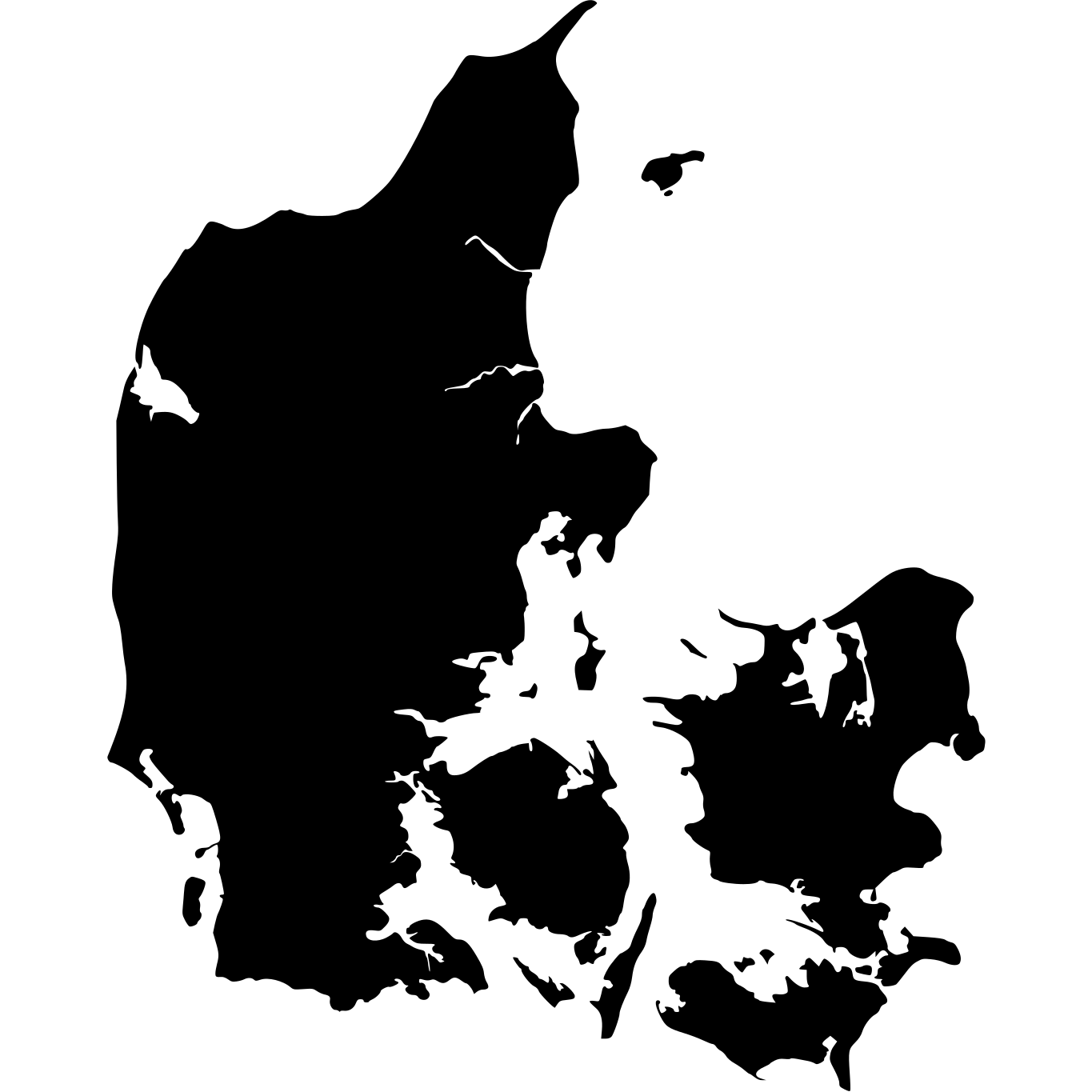
ECOOKING is a Danish brand
50 SPF Rating
With an SPF rating of 50, this product protects against 98.0% of UVB rays

We're dedicated to providing you with the most up-to-date and science-backed ingredient info out there.
The data we've presented on this page has been verified by a member of the SkinSort Team.
Read more about us· Updated April 28, 2026 • Added by FIQ130


