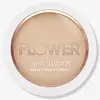
Flower Beauty by Drew Light Illusion Perfecting Powder Versus Fenty Beauty Bright Fix Instant Brightening + Blurring Powder

What's inside
What's inside
 Key Ingredients
Benefits
Concerns
Ingredients Side-by-side
Talc
Abrasive
Aluminum Starch Octenylsuccinate
Absorbent
Synthetic Fluorphlogopite
Nylon-12

Magnesium Myristate


Octyldodecyl Stearoyl Stearate
Emollient

Diisostearyl Malate
EmollientHdi/Trimethylol Hexyllactone Crosspolymer
Water
Skin ConditioningHydrogenated Polyisobutene
EmollientPhenoxyethanol
Preservative
Caprylyl Glycol
Emollient
Dimethicone
Emollient

Benzyl Alcohol
Perfuming




Hexylene Glycol
EmulsifyingSilica
Abrasive
Dehydroacetic Acid
Preservative
CI 77891
Cosmetic ColorantIron Oxides
CI 77742
Cosmetic ColorantTalc, Aluminum Starch Octenylsuccinate, Synthetic Fluorphlogopite, Nylon-12, Magnesium Myristate, Octyldodecyl Stearoyl Stearate, Diisostearyl Malate, Hdi/Trimethylol Hexyllactone Crosspolymer, Water, Hydrogenated Polyisobutene, Phenoxyethanol, Caprylyl Glycol, Dimethicone, Benzyl Alcohol, Hexylene Glycol, Silica, Dehydroacetic Acid, CI 77891, Iron Oxides, CI 77742
Mica
Cosmetic ColorantSynthetic Fluorphlogopite
Magnesium Myristate
Polymethyl Methacrylate
Silica
Abrasive
Tapioca Starch
Lauroyl Lysine
Skin Conditioning
Saccharomyces Ferment
Skin Conditioning
Octyldodecyl Stearoyl Stearate
Emollient
Boron Nitride
Absorbent
Diisostearyl Malate
EmollientSqualane
Emollient

Water
Skin Conditioning1,2-Hexanediol
Skin Conditioning
Caprylyl Glycol
Emollient
Stearoyl Glutamic Acid
CleansingPolymethylsilsesquioxane
Iron Oxides
Mica, Synthetic Fluorphlogopite, Magnesium Myristate, Polymethyl Methacrylate, Silica, Tapioca Starch, Lauroyl Lysine, Saccharomyces Ferment, Octyldodecyl Stearoyl Stearate, Boron Nitride, Diisostearyl Malate, Squalane, Water, 1,2-Hexanediol, Caprylyl Glycol, Stearoyl Glutamic Acid, Polymethylsilsesquioxane, Iron Oxides
Reviews
Ingredients Explained
These ingredients are found in both products.
Ingredients higher up in an ingredient list are typically present in a larger amount.
Caprylyl Glycol is a humectant, skin conditioner, emollient, and preservative booster derived from either caprylic acid or synthetically created.
Typical use levels vary from 0.3-1% as a preservative booster and go up to 2% to condition skin.
Because it is not a free-fatty acid, this ingredient is fungal acne safe (there's nothing for Malassezia to feed on).
Learn more about Caprylyl GlycolDiisostearyl Malate is an emollient and most often used in lip products. It comes from isostearyl alcohol, a fatty acid, and malic acid, an AHA.
As an emollient, Diisostearyl Malate helps create a thin film on your skin to trap moisture in. This helps keep your skin soft and smooth.
Magnesium Myristate is the magnesium salt of myristic acid, a saturated fatty acid that is naturally found in coconut and palm kernel oil.
In formulas, it's used as an anticaker, opacifier, and viscosity controller; it improves adhesion and glide in pressed mineral makeup, works as a non-gelling thickener in eyeliners/mascaras/lipsticks, and doubles as a white opacifier.
There's no published concentration use from surveys so the best available numbers are supplier guidance: 5-10% for loose powders and 2-5% for creamy cosmetics + pressed powder binding.
The CIR Expert Panel reviewed Magnesium Myristate as part of its assessment of myristic acid and its salts and esters, and concluded the whole group is safe as used in cosmetics.
In human studies, Myristic Acid was non-irritating up to 50% and 100% Magnesium Stearate was non-irritating and non-corrosive on skin and non-irritating to the eye.
There are no published contact allergy case reports for this ingredient so allergy risk is low, but not zero for any ingredient.
There is no comedogenic data for Magnesum Myristate. The comedogenic ratings that circulate for "myristates" come from Isopropyl Myristate which is a structurally different ester.
The rabbit-ear models those comedogenic ratings come from have been shown to be unreliable for predicting whether a finished product will clog pores.
Human testing has proved that any finished product with a comedogenic ingredient won't automatically make you break out; it really comes down to concentration, formula, and your skin.
Some people still find it breaks them out. So if that's you, definitely trust your skin.
Learn more about Magnesium MyristateOctyldodecyl Stearoyl Stearate is an emollient ester that mostly shows up in color cosmetics.
Functionally, it works as a skin-conditioning agent and a viscosity-increasing agent. This just means it helps soften skin while also thickening water-free formulas (like powders).
Despite being a "stearate", it has a lightweight, cushiony, and non-greasy slip.
This ingredient has shown no adverse effects in testing and is deemed safe in cosmetics at current use levels.
Typical concentrations range from 0.7-23%.
Because it is made of C-18 fatty acids (like stearic acid), this ingredient may not be fungal acne safe.
Learn more about Octyldodecyl Stearoyl StearateSilica, also known as silicon dioxide, is a naturally occurring mineral. It is used as a fine, spherical, and porous powder in cosmetics.
Though it has exfoliant properties, the function of silica varies depending on the product.
The unique structure of silica enhances the spreadability and adds smoothness, making it a great texture enhancer.
It is also used as an active carrier, emulsifier, and mattifier due to its ability to absorb excess oil.
In some products, tiny microneedles called spicules are made from silica or hydrolyzed sponge. When you rub them in, they lightly polish away dead skin layers and enhance the penetration of active ingredients.
Learn more about SilicaSynthetic Fluorphlogopite is the synthethic version of mica. It consists of fluorine, aluminum and silicate.
Synthetic Fluorphlogopite is used to add volume to products.
It is considered non-irritating on the skin.
Learn more about Synthetic FluorphlogopiteWater. It's the most common cosmetic ingredient of all. You'll usually see it at the top of ingredient lists, meaning that it makes up the largest part of the product.
So why is it so popular? Water most often acts as a solvent - this means that it helps dissolve other ingredients into the formulation.
You'll also recognize water as that liquid we all need to stay alive. If you see this, drink a glass of water. Remember to stay hydrated!
Learn more about WaterThis ingredient is a combination of red, black, and yellow iron oxide pigments. This combination of colors is usually found in foundation, because it results in a "skin" color.
The EU typically uses CI numbers for colorants when applicable, such as CI 77489. In the US, iron oxides are regulated as color additives and "iron oxides" is the most commonly used name in US cosmetic practice.
A 2021 paper looked at skincare formulations containing iron oxides and found that they reduced transmission of blue light when measured optically. In simple terms, the pigment particles helped block or scatter part of the visible light spectrum in lab testing and the authors suggest this could translate into better protection against blue-light-related skin effects.
There is also clinical and experimental research showing that tinted products containing iron oxides can reduce visible light-induced pigmentation:
Please note, whether a product reduces visible or blue light depends on things like:
In the EU's CosIng database, iron oxides are only listed as a colorant. CosIng groups ingredients by their main cosmetic role, such as colorant, preservative, or UV filter.
Though studies say iron oxides can "attenuate blue light", they're describing an optical property and not an officially recognized cosmetic function.
So CosIng isn’t contradicting the research. It’s just classifying iron oxides by what they officially are: pigments that add color.
Learn more about Iron Oxides

