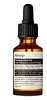
This hydrating oil is formulated around Macadamia Ternifolia Seed Oil and Oenothera Biennis Oil to hydrate skin and calm redness.

What's inside
What's inside
 Key Ingredients
Benefits
Concerns
Ingredients Side-by-side
Macadamia Ternifolia Seed Oil
Emollient



Prunus Amygdalus Dulcis Oil
Skin Conditioning

Camellia Japonica Seed Oil
Emollient
Oenothera Biennis Oil
Emollient


Cananga Odorata Flower Oil
Masking



Triticum Vulgare Germ Oil
Emollient
Juniperus Communis Fruit Oil
Masking
Corylus Avellana Seed Oil
Emollient
Helianthus Annuus Seed Oil
Emollient
Tocopherol
Antioxidant




Jasminum Officinale Oil
Masking
Linalool
Perfuming
Benzyl Benzoate
Antimicrobial
Limonene
Perfuming
Farnesol
Perfuming
Benzyl Salicylate
Perfuming
Geraniol
Perfuming
Eugenol
Perfuming
Benzyl Alcohol
Perfuming

Macadamia Ternifolia Seed Oil, Prunus Amygdalus Dulcis Oil, Camellia Japonica Seed Oil, Oenothera Biennis Oil, Cananga Odorata Flower Oil, Triticum Vulgare Germ Oil, Juniperus Communis Fruit Oil, Corylus Avellana Seed Oil, Helianthus Annuus Seed Oil, Tocopherol, Jasminum Officinale Oil, Linalool, Benzyl Benzoate, Limonene, Farnesol, Benzyl Salicylate, Geraniol, Eugenol, Benzyl Alcohol
Water
Skin ConditioningKaolin
Abrasive



Bentonite
Absorbent
Alcohol Denat.
Antimicrobial
Glycerin
Humectant
Phenoxyethanol
Preservative
Oenothera Biennis Oil
Emollient
Rosa Canina Fruit Oil
Emollient
Citrus Medica Peel Oil
Limonene
Perfuming
Ormenis Multicaulis Oil
Masking
Rosmarinus Officinalis Leaf Oil
Masking
Melaleuca Alternifolia Leaf Oil
Antioxidant
Salvia Officinalis Oil
Masking
Citral
Perfuming
Leptospermum Petersonii Oil
Masking
Ingredients Explained
These ingredients are found in both products.
Ingredients higher up in an ingredient list are typically present in a larger amount.
Limonene is the compound that gives citrus peel its smell.
In skincare, it shows up as a standalone fragrance ingredient or as a natural compound of citrus and other essential oils.
You'll typically see this ingredient used in very small amounts; anything above 0.001% in a leave-on product or 0.01% in a rinse-off has to be named on the label in the EU. The citrus oils that carry it sit around 0.5-1% in a finished formula.
Fresh limonene is a weak allergen; the real issue is that it slowly reacts with air and then breaks down from oxidation to create hydroperoxides (which are strong sensitizers). This is why suppliers are required to keep the peroxide value below 20 mmol.
Positive reactions in people being investigated for eczema vary:
It's worth skipping if you have a known fragrance allergy or a compromised barrier, but the risk is low for most people.
Older or long-opened products are also more likely to bother you than fresh ones due to oxidation.
Learn more about LimoneneOenothera Biennis Oil (aka Evening Primrose Oil) is a non-fragrant oil from the evening primrose. Like other botanical oils, it is an emollient that helps hydrate and nourish skin.
It has an interesting fatty acid profile: linoleic (70-74%) and γ-linolenic (8-10%), with some amounts ofoleic palmitic, and stearic acids.
The gamma-linoleic acid (GLA) is the headliner here; it's relatively rare in plant oils and acts as a precursor for anti-inflammatory signaling molecules in the skin.
There's a mixed body of clinical research with this ingredient as well, mostly on eczema/atopic dermatitis skin.
Some controlled trials showed improvement in inflammation, dryness, scaling, and overall severity. Other studies and large meta-analysis failed to show a significant effect; the honest takeaway here is "promising but inconsistent" rather than "miracle oil".
On the safety front, this ingredient is found to be safe as used in cosmetics and even has a history of safe food use.
This ingredient does have a comedogenic rating of 3, but this doesn't mean a formula with this ingredient will clog pores. Human testing has proved that any finished product with this ingredient won't automatically make you break out; it really comes down to concentration, formula, and your skin.
Since this oil is contains oleic acid and palmitic acid, it may not be fungal acne safe. The Malassezia yeast feeds on fatty acids with carbon chain lengths between C11-C24. Oleic Acid sits at C18 and Palmitic acid sits at C16.
In vitro studies have shown that oleic acid and palmitic acid are some of the fatty acids that induce rapid Malassezia growth in lab settings.
Learn more about Oenothera Biennis Oil

