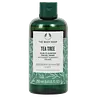
The Body Shop Tea Tree Skin Clearing Facial Wash Versus Thursday Plantation Tea Tree Face Wash for Acne
This salicylic acid foaming cleanser is formulated around Salicylic Acid to clear breakouts and unclog pores.
This gel cleanser uses mild cleansing ingredients, but contains alcohol that may feel drying for some.


What's inside
What's inside
 Key Ingredients
Benefits
Concerns
Ingredients Side-by-side
Water
Skin ConditioningSodium Laureth Sulfate
Cleansing



Glycerin
Humectant


Cocamidopropyl Betaine
Cleansing

Coco-Betaine
Cleansing
Decyl Glucoside
Cleansing
PEG-40 Hydrogenated Castor Oil
Emulsifying

PEG-7 Glyceryl Cocoate
Emulsifying
Citric Acid
Buffering

Sodium Chloride
MaskingSodium Benzoate
Masking
Melaleuca Alternifolia Leaf Oil
Antioxidant




Coco-Glucoside
Cleansing
Glyceryl Oleate
Emollient
PEG-120 Methyl Glucose Dioleate
Emulsifying
Sodium Gluconate
ChelatingCalophyllum Inophyllum Seed Oil
Antimicrobial

Allantoin
Skin Conditioning
Menthol
Masking
Panthenol
Skin Conditioning
Salicylic Acid
Masking


Sodium Hydroxide
BufferingLimonene
Perfuming
Leptospermum Petersonii Oil
Masking
Tocopherol
Antioxidant


Hydrogenated Palm Glycerides Citrate
Emollient
CI 19140
Cosmetic ColorantCI 42090
Cosmetic ColorantWater, Sodium Laureth Sulfate, Glycerin, Cocamidopropyl Betaine, Coco-Betaine, Decyl Glucoside, PEG-40 Hydrogenated Castor Oil, PEG-7 Glyceryl Cocoate, Citric Acid, Sodium Chloride, Sodium Benzoate, Melaleuca Alternifolia Leaf Oil, Coco-Glucoside, Glyceryl Oleate, PEG-120 Methyl Glucose Dioleate, Sodium Gluconate, Calophyllum Inophyllum Seed Oil, Allantoin, Menthol, Panthenol, Salicylic Acid, Sodium Hydroxide, Limonene, Leptospermum Petersonii Oil, Tocopherol, Hydrogenated Palm Glycerides Citrate, CI 19140, CI 42090

Reviews
Ingredients Explained
These ingredients are found in both products.
Ingredients higher up in an ingredient list are typically present in a larger amount.
Cocamidopropyl Betaine is a fatty acid created by mixing similar compounds in coconut oil and dimethylaminopropylamine, a compound with two amino groups.
This ingredient is a surfactant and cleanser. It helps gather the dirt, pollutants, and other impurities in your skin to be washed away. It also helps thicken a product and make the texture more creamy.
Being created from coconut oil means Cocamidopropyl Betaine is hydrating for the skin.
While Cocamidopropyl Betaine was believed to be an allergen, a study from 2012 disproved this. It found two compounds in unpure Cocamidopropyl Betaine to be the irritants: aminoamide and 3-dimethylaminopropylamine. High-grade and pure Cocamidopropyl Betaine did not induce allergic reactions during this study.
Learn more about Cocamidopropyl BetaineDecyl Glucoside is a plant-derived surfactant and emulsion stabilizer. It is created by reacting glucose with the fatty acids from plants.
Like all surfactants, it works by lowering the surface tension between water and oil. This makes it so that dirt, sebum, and makeup can be lifted off your skin and rinsed away. It also produces a dense and creamy foam.
Because it has a neutral charge, it is compatible with a wide range of ingredients and stays stable across a broad pH range/water hardiness conditions.
Patch testing has shown it to have the lowest irritation potential among common cleansing surfactants (like SLS).
Typical use levels range from 5-20% in rinse-off cleansers.
One thing worth knowing: The American Contact Dermatitis Society named the parent family, alkyl glucosides, "Allergen of the Year" in 2017. The prevalence of allergy is pretty low but be sure to patch test if you've reacted to "gentle" or sulfate-free cleansers before.
This ingredient is fungal acne safe because the fatty alcohol portion of this ingredient is not within the C11-24 chain length that Malassezia can metabolize.
Learn more about Decyl GlucosideLimonene is the compound that gives citrus peel its smell.
In skincare, it shows up as a standalone fragrance ingredient or as a natural compound of citrus and other essential oils.
You'll typically see this ingredient used in very small amounts; anything above 0.001% in a leave-on product or 0.01% in a rinse-off has to be named on the label in the EU. The citrus oils that carry it sit around 0.5-1% in a finished formula.
Fresh limonene is a weak allergen; the real issue is that it slowly reacts with air and then breaks down from oxidation to create hydroperoxides (which are strong sensitizers). This is why suppliers are required to keep the peroxide value below 20 mmol.
Positive reactions in people being investigated for eczema vary:
It's worth skipping if you have a known fragrance allergy or a compromised barrier, but the risk is low for most people.
Older or long-opened products are also more likely to bother you than fresh ones due to oxidation.
Learn more about LimoneneThis ingredient is also known as tea tree oil. It has antioxidant, anti-inflammatory, and antimicrobial properties.
Tea tree oil is a complex lipophilic (fat-loving) oil that contains around 100 compounds with terpinen-4-ol being the most abundant (~40%).
Terpinen-4-ol is responsible for tea tree oil's broad-spectrum antimicrobial activity and makes it a well-researched option for acne.
Clinical studies support 5% tea tree oil as an effective topical treatment for mild to moderate acne. A study with 124 patients compared 5% tea tree oil gel to 5% benzoyl peroxide and both reduced acne (though tea tree oil worked more slowly).
Besides acne, it is also seen in anti-dandruff shampoos and scalp treatments for it's antimicrobial and anti-seborrheic properties.
Safety-wise, the allergic potential of low concentrations on healthy skin is considered low. However, oxidized (old or improperly stored) tea tree oil is a stronger sensitizer.
Irritation can also occur if using the undiluted oil on skin; it's best to use this ingredient as part of a carefully crafted cosmetic formula. This is because regulations require tea tree oil in cosmetics to be stabilized to prevent degradation.
This ingredient has been deemed safe up to 2% in shampoo, 1% in cleansers, and 0.1% in face cream by the EU's Scientific Committee on Consumer Safety (SCCS).
There is some lab evidence that tea tree oil is antifungal against Malassezia, but it is a supportive option at best and not a replacement for proven antifungal treatments.
Learn more about Melaleuca Alternifolia Leaf OilWater. It's the most common cosmetic ingredient of all. You'll usually see it at the top of ingredient lists, meaning that it makes up the largest part of the product.
So why is it so popular? Water most often acts as a solvent - this means that it helps dissolve other ingredients into the formulation.
You'll also recognize water as that liquid we all need to stay alive. If you see this, drink a glass of water. Remember to stay hydrated!
Learn more about Water

