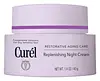
Curel Restorative Aging Care Replenishing Night Cream Versus Calecim Professional Recovery Night Complex
This barrier-repair night moisturizer is formulated around Squalane and Zingiber Officinale Root Extract to strengthen the skin barrier and soften the look of wrinkles.
This barrier-repair night moisturizer is formulated around Saccharide Isomerate and Niacinamide to strengthen the skin barrier and calm redness.


What's inside
What's inside
 Key Ingredients
Benefits
Concerns
Ingredients Side-by-side
Water
Skin ConditioningDimethicone
Emollient

Glycerin
Humectant

Cetyl-Pg Hydroxyethyl Palmitamide
Skin ConditioningSqualane
Emollient
Butylene Glycol
Humectant
Phytosteryl/Isostearyl/Cetyl/Stearyl/Behenyl Dimer Dilinoleate
Skin Conditioning

Polyglyceryl-2 Diisostearate
Emulsifying
Phytosteryl/Octyldodecyl Lauroyl Glutamate
Skin ConditioningPEG-3 Dimethicone
Skin Conditioning
Dimethicone/Vinyl Dimethicone Crosspolymer
Skin Conditioning
Cholesteryl/Octyldodecyl Lauroyl Glutamate
Skin ConditioningMagnesium Sulfate
Allantoin
Skin Conditioning

Dextrin Palmitate
Emulsifying
Isostearyl Glyceryl Ether
Skin ConditioningSuccinic Acid
BufferingPEG-10 Dimethicone
Skin Conditioning
Zingiber Officinale Root Extract
Masking
Sodium Hydroxide
BufferingThujopsis Dolabrata Branch Extract
Skin ConditioningEucalyptus Globulus Leaf Extract
Perfuming
Tocopherol
Antioxidant



Methylparaben
Preservative



Water, Dimethicone, Glycerin, Cetyl-Pg Hydroxyethyl Palmitamide, Squalane, Butylene Glycol, Phytosteryl/Isostearyl/Cetyl/Stearyl/Behenyl Dimer Dilinoleate, Polyglyceryl-2 Diisostearate, Phytosteryl/Octyldodecyl Lauroyl Glutamate, PEG-3 Dimethicone, Dimethicone/Vinyl Dimethicone Crosspolymer, Cholesteryl/Octyldodecyl Lauroyl Glutamate, Magnesium Sulfate, Allantoin, Dextrin Palmitate, Isostearyl Glyceryl Ether, Succinic Acid, PEG-10 Dimethicone, Zingiber Officinale Root Extract, Sodium Hydroxide, Thujopsis Dolabrata Branch Extract, Eucalyptus Globulus Leaf Extract, Tocopherol, Methylparaben
Water
Skin ConditioningPropylene Glycol
Humectant
Glycerin
Humectant
Saccharide Isomerate
Humectant
Butylene Glycol
Humectant
Niacinamide
Smoothing




1,2-Hexanediol
Skin Conditioning
Glycoproteins
Skin Conditioning
Cucumis Sativus Extract
Skin Conditioning
Soluble Collagen
Humectant
Carbomer
Emulsion StabilisingSerum Albumin
HumectantPhenoxyethanol
Preservative
Sodium Hydroxide
BufferingHydrolyzed Sodium Hyaluronate
Skin Conditioning
Sodium Hyaluronate
Humectant
Hydroxyethylcellulose
Emulsion StabilisingEthylhexylglycerin
Skin ConditioningAcetyl Dipeptide-1 Cetyl Ester
Skin Conditioning
Water, Propylene Glycol, Glycerin, Saccharide Isomerate, Butylene Glycol, Niacinamide, 1,2-Hexanediol, Glycoproteins, Cucumis Sativus Extract, Soluble Collagen, Carbomer, Serum Albumin, Phenoxyethanol, Sodium Hydroxide, Hydrolyzed Sodium Hyaluronate, Sodium Hyaluronate, Hydroxyethylcellulose, Ethylhexylglycerin, Acetyl Dipeptide-1 Cetyl Ester
Ingredients Explained
These ingredients are found in both products.
Ingredients higher up in an ingredient list are typically present in a larger amount.
Butylene Glycol (or BG) is used within cosmetic products for a few different reasons:
Overall, Butylene Glycol is a safe and well-rounded ingredient that works well with other ingredients.
Though this ingredient works well with most skin types, some people with sensitive skin may experience a reaction such as allergic rashes, closed comedones, or itchiness.
Learn more about Butylene GlycolGlycerin (or glycerol) is a compound naturally found in your skin. It's a powerhouse humectant that pulls water into the stratum corneum.
Topically, glycerin does several things at once:
Your skin makes glycerin on its own (mostly from sebaceous oil breakdown) and shuttles it to your outermost layer of skin, or your epidermis, via aquaporin-3.
Aquaporin-3 is a transporter that is essential for normal skin hydration, elasticity, and repair. Interestingly, mice lacking in AQP3 have dry and less elastic skin that can be fully corrected with glycerin.
This ingredient is non-irritating, plays well with almost every ingredient, and works across all skin types. Typical use is anywhere between 3-10% but can go up to 79% in some leave-on products.
Just know very high concentrations (>40%) can feel tacky in low humidity.
Glycerin is the name for this ingredient in American English. British English uses Glycerol/Glycerine.
Learn more about GlycerinSodium Hydroxide is also known as lye or caustic soda. It is used to adjust the pH of products; many ingredients require a specific pH to be effective.
In small amounts, sodium hydroxide is considered safe to use. However, large amounts may cause chemical burns due to its high alkaline.
Your skin has a natural pH and acid mantle. This acid mantle helps prevent harmful bacteria from breaking through. The acid mantle also helps keep your skin hydrated.
"Alkaline" refers to a high pH level. A low pH level would be considered acidic.
Learn more about Sodium HydroxideWater. It's the most common cosmetic ingredient of all. You'll usually see it at the top of ingredient lists, meaning that it makes up the largest part of the product.
So why is it so popular? Water most often acts as a solvent - this means that it helps dissolve other ingredients into the formulation.
You'll also recognize water as that liquid we all need to stay alive. If you see this, drink a glass of water. Remember to stay hydrated!
Learn more about Water

