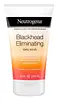
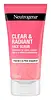
Neutrogena Blackhead Eliminating Salicylic Acid Daily Face Scrub Versus Neutrogena Clear & Radiant Face Scrub
This acne exfoliator is formulated around Salicylic Acid to clear breakouts and refine the look of pores.
This smoothing exfoliator is formulated around Cellulose and Sodium Ascorbyl Phosphate to refine skin texture and brighten dull-looking skin.

What's inside
What's inside
 Key Ingredients
Benefits
Concerns
Ingredients Side-by-side
Salicylic Acid 2%
Masking










Water
Skin ConditioningCetyl Alcohol
Emollient


PPG-15 Stearyl Ether
EmollientPolyethylene
Abrasive
Methyl Gluceth-20
Humectant
Steareth-21
CleansingCoco-Glucoside
Cleansing
Steareth-2
EmulsifyingPolysorbate 60
Emulsifying
Linoleamidopropyl Pg-Dimonium Chloride Phosphate
Neopentyl Glycol Dicaprylate/Dicaprate
EmollientMenthol
Masking
Disodium EDTA
ChelatingXanthan Gum
EmulsifyingPotassium Cetyl Phosphate
EmulsifyingAgar
MaskingMica
Cosmetic ColorantTitanium Dioxide
Cosmetic Colorant

Iron Oxides
CI 15850
Cosmetic ColorantParfum
Masking

Salicylic Acid 2%, Water, Cetyl Alcohol, PPG-15 Stearyl Ether, Polyethylene, Methyl Gluceth-20, Steareth-21, Coco-Glucoside, Steareth-2, Polysorbate 60, Linoleamidopropyl Pg-Dimonium Chloride Phosphate, Neopentyl Glycol Dicaprylate/Dicaprate, Menthol, Disodium EDTA, Xanthan Gum, Potassium Cetyl Phosphate, Agar, Mica, Titanium Dioxide, Iron Oxides, CI 15850, Parfum
Glycerin
Humectant

Sodium Laureth Sulfate
Cleansing
Cellulose
Absorbent
Lauryl Glucoside
CleansingAcrylates/C10-30 Alkyl Acrylate Crosspolymer
Emulsion StabilisingCitrus Grandis Fruit Extract
Astringent
Propylene Glycol
Humectant
Sodium Benzotriazolyl Butylphenol Sulfonate
UV AbsorberDisodium EDTA
ChelatingCitric Acid
Buffering
Sodium Hydroxide
BufferingSodium Ascorbyl Phosphate
Antioxidant



Sodium Benzoate
Masking
Parfum
Masking
CI 16035
Cosmetic ColorantCI 60725
Cosmetic ColorantGlycerin, Sodium Laureth Sulfate, Cellulose, Lauryl Glucoside, Acrylates/C10-30 Alkyl Acrylate Crosspolymer, Citrus Grandis Fruit Extract, Propylene Glycol, Sodium Benzotriazolyl Butylphenol Sulfonate, Disodium EDTA, Citric Acid, Sodium Hydroxide, Sodium Ascorbyl Phosphate, Sodium Benzoate, Parfum, CI 16035, CI 60725
Ingredients Explained
These ingredients are found in both products.
Ingredients higher up in an ingredient list are typically present in a larger amount.
Disodium EDTA is a chelating agent. It grabs onto and deactivates metal ions that sneak into your products from water, packaging, or air.
This ingredient mainly works behind the scenes and helps with:
On top of that, this ingredient can counteract the effects of hard water by binding to the minerals in it.
One thing worth knowing is that Disodium EDTA has been shown to be a mild penetration enhancer. It can help other ingredients absorb into skin more effectively which can be a double-edged sword (great for actives, but can also make the active too strong if you have sensitive skin).
Clinical patch testing showed no significant skin irritation at typical use concentrations and minimal dermal absorption.
You'll most likely see this ingredient near the end of an ingredient list. It's typically found in concentrations less than 1%.
Learn more about Disodium EDTAParfum is a catch-all term for an ingredient or more that is used to give a scent to products.
Also called "fragrance", this ingredient can be a blend of hundreds of chemicals or plant oils. This means every product with "fragrance" or "parfum" in the ingredients list is a different mixture.
For instance, Habanolide is a proprietary trade name for a specific aroma chemical. When used as a fragrance ingredient in cosmetics, most aroma chemicals fall under the broad labeling category of “FRAGRANCE” or “PARFUM” according to EU and US regulations.
The term 'parfum' or 'fragrance' is not regulated in many countries. In many cases, it is up to the brand to define this term.
For instance, many brands choose to label themselves as "fragrance-free" because they are not using synthetic fragrances. However, their products may still contain ingredients such as essential oils that are considered a fragrance by INCI standards.
One example is Calendula flower extract. Calendula is an essential oil that still imparts a scent or 'fragrance'.
Depending on the blend, the ingredients in the mixture can cause allergies and sensitivities on the skin. Some ingredients that are known EU allergens include linalool and citronellol.
Parfum can also be used to mask or cover an unpleasant scent.
The bottom line is: not all fragrances/parfum/ingredients are created equally. If you are worried about fragrances, we recommend taking a closer look at an ingredient. And of course, we always recommend speaking with a professional.
Learn more about Parfum

