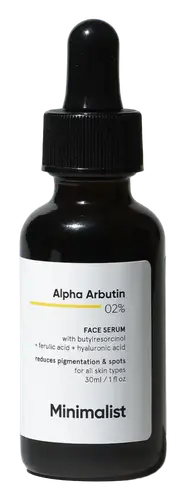
What's inside
What's inside
 Key Ingredients
Benefits
Concerns
Ingredients Side-by-side


Water
Skin ConditioningDimethyl Isosorbide
SolventEthoxydiglycol
HumectantAlpha-Arbutin
Antioxidant




Lactic Acid
Buffering






Pentylene Glycol
Skin Conditioning
Ferulic Acid
Antimicrobial
Sodium Hyaluronate
Humectant


4-Butylresorcinol
Antioxidant
Hydroxyethylcellulose
Emulsion StabilisingTriethanolamine
BufferingPEG/PPG-17/6 Copolymer
SolventIsoceteth-20
EmulsifyingXanthan Gum
EmulsifyingLecithin
Emollient
Sclerotium Gum
Emulsion StabilisingPullulan
Phenoxyethanol
Preservative
Ethylhexylglycerin
Skin ConditioningTrisodium Ethylenediamine Disuccinate
Water, Dimethyl Isosorbide, Ethoxydiglycol, Alpha-Arbutin, Lactic Acid, Pentylene Glycol, Ferulic Acid, Sodium Hyaluronate, 4-Butylresorcinol, Hydroxyethylcellulose, Triethanolamine, PEG/PPG-17/6 Copolymer, Isoceteth-20, Xanthan Gum, Lecithin, Sclerotium Gum, Pullulan, Phenoxyethanol, Ethylhexylglycerin, Trisodium Ethylenediamine Disuccinate
Reviews
Ingredients Explained
These ingredients are found in both products.
Ingredients higher up in an ingredient list are typically present in a larger amount.
Ethoxydiglycol is a synthetic solvent.
Solvents are used to keep ingredients together in a product. They can help dissolve ingredients to stable bases or help evenly distribute ingredients throughout the product.
Ethoxydiglycol also helps deliver other key ingredients into the skin.
Learn more about EthoxydiglycolEthylhexylglycerin is created from glycerin. It is a multitasker ingredient that:
The CIR Expert Panel found minimal skin absorption or sensitization of any kind in a safety assessment. Though this ingredient is considered well-tolerated, a small number of cases of allergic dermatitis have been published since 2002. Just be sure to patch test if you are unsure.
Industry-reported use ranges from 8% in rinse-off products and 2% in leave-on formulations.
Learn more about EthylhexylglycerinPhenoxyethanol is a preservative that has germicide, antimicrobial, and aromatic properties. Studies show that phenoxyethanol can prevent microbial growth. By itself, it has a scent that is similar to that of a rose.
It's often used in formulations along with Caprylyl Glycol to preserve the shelf life of products.
Sodium Hyaluronate is the salt form of hyaluronic acid. It is a long sugar chain that is naturally found in your skin, joints, and connective tissue that maintains hydration and elasticity.
In skincare, it works as a humectant. It pulls water from the environment and deeper layers of skin and binds it to the surface.
Interestingly, the size of the molecule affects its behavior:
Some clinical evidence links low molecular weight versions to improved wrinkle depth, elasticity, anti-inflammatory effects, and barrier repair.
Many serums use a blend of both weights so you can get surface hydration plus longer-lasting and deeper effects.
You'll typically see concentrations between 0.1-2% for this ingredient.
Learn more about Sodium HyaluronateTriethanolamine (TEA) is an emulsifier and pH adjuster. It is created using ethylene oxide and ammonia. This gives Triethanolamine a nitrogen core and a similar scent to ammonia.
As an emulsifier, it prevents ingredients from separating and enhances texture by adding volume to a product.
PH adjusters are common in cosmetic products. The pH of a product can affect the effectiveness of other ingredients. A product with a high pH may also irritate the skin.
If you are looking for the tea leaf ingredient, click here.
Learn more about TriethanolamineTrisodium Ethylenediamine Disuccinate is used to help stabilize a product.
It is a chelating agent, meaning it helps prevent metal ions from binding to other ingredients. This prevents unwanted reactions in products. Metal ions can come into a product via the water ingredient. They are found in trace amounts and are not known to be harmful.