Ekopharma Raspberry Glow Micellar Water
A makeup remover with 17 ingredients.
This micellar makeup remover is made to dissolve makeup, sunscreen, and daily buildup.
Worth noting
Contains EU-listed fragrance allergens, including Limonene and Benzyl Salicylate.
We independently verify ingredients, backed by peer-reviewed research. Suggest an update.
What's inside
Ingredients List
Water
Skin ConditioningGlycerin
Humectant


Caprylyl/Capryl Glucoside
CleansingRubus Idaeus Fruit Extract
AstringentSodium PCA
Humectant
Betaine
Humectant
Sweet Almond Oil Polyglyceryl-4 Esters
Solvent
Babassu Oil Polyglyceryl-4 Esters
Surfactant

Polyglyceryl-10 Laurate
Skin Conditioning
Phenethyl Alcohol
MaskingSodium Phytate
ChelatingAlcohol
Antimicrobial



Citrus Sinensis Peel Oil Expressed
Perfuming

Parfum
Masking
Limonene
Perfuming
Benzyl Salicylate
Perfuming
Citric Acid
Buffering

Water, Glycerin, Caprylyl/Capryl Glucoside, Rubus Idaeus Fruit Extract, Sodium PCA, Betaine, Sweet Almond Oil Polyglyceryl-4 Esters, Babassu Oil Polyglyceryl-4 Esters, Polyglyceryl-10 Laurate, Phenethyl Alcohol, Sodium Phytate, Alcohol, Citrus Sinensis Peel Oil Expressed, Parfum, Limonene, Benzyl Salicylate, Citric Acid
Benefits
Concerns
Ingredients Explained
Water. It's the most common cosmetic ingredient of all. You'll usually see it at the top of ingredient lists, meaning that it makes up the largest part of the product.
So why is it so popular? Water most often acts as a solvent - this means that it helps dissolve other ingredients into the formulation.
You'll also recognize water as that liquid we all need to stay alive. If you see this, drink a glass of water. Remember to stay hydrated!
Learn more about WaterGlycerin (or glycerol) is a compound naturally found in your skin. It's a powerhouse humectant that pulls water into the stratum corneum.
Topically, glycerin does several things at once:
Your skin makes glycerin on its own (mostly from sebaceous oil breakdown) and shuttles it to your outermost layer of skin, or your epidermis, via aquaporin-3.
Aquaporin-3 is a transporter that is essential for normal skin hydration, elasticity, and repair. Interestingly, mice lacking in AQP3 have dry and less elastic skin that can be fully corrected with glycerin.
This ingredient is non-irritating, plays well with almost every ingredient, and works across all skin types. Typical use is anywhere between 3-10% but can go up to 79% in some leave-on products.
Just know very high concentrations (>40%) can feel tacky in low humidity.
Glycerin is the name for this ingredient in American English. British English uses Glycerol/Glycerine.
Learn more about GlycerinThis ingredient is a mild surfactant made by sticking glucose onto a blend of fatty acids.
It does two jobs because it has a sugar head that loves water and a fatty tail that loves oil:
Typical use levels range from 10-20% in cleansers and 15-30% in shower products.
Once on your skin, your skin's glucoside hydrolases breaks it down into glucose and the parent fatty alcohols.
This ingredient is considered fungal acne safe because its fatty alcohol portion sits outside the Malassezia yeast's metabolization range.
Learn more about Caprylyl/Capryl GlucosideWe don't have a description for Rubus Idaeus Fruit Extract yet.
Sodium PCA (the salt of PCA) is one of the most well-established humectants in skincare.
Why is it so special? Your skin already makes it naturally; it's a natural component of your skin's Natural Moisturizing Factor (NMF), or the mix of water-binding compounds inside your skin cells that keeps things soft and hydrated.
As a cosmetic ingredient, it grabs water and holds it in the upper layers of skin to smooth roughness and ease dehydration.
There's some clinical support for the NMF approach with a study showing that a cream built to mimic the skin's NMF significantly boosted hydration.
Safety-wise, this ingredient non-irritating, non-comedogenic, and non-phototoxic in testing, with minimal skin absorption.
It also works really well with other hydrators like glycerin or hyaluronic acid, and typical usage is somewhere between 0.2-4%.
Learn more about Sodium PCABetaine is a humectant. Like hyaluronic acid, it helps attract and retain moisture in the skin. It’s known for being gentle and for helping the skin maintain balanced hydration.
Betaine is mainly used to improve hydration and support calmer skin. It helps skin cells regulate water balance because it functions as an osmolyte.
Some studies suggest betaine may support making skin tone more even.
Fun fact: Betaine naturally exists in the skin and the body. In cosmetic products, it can be either plant-derived (most commonly from sugar beets) or synthetically produced for consistency and stability.
Betaine is also known as trimethylglycine.
Learn more about BetaineSweet Almond Oil Polyglyceryl-4 Esters is an oil.
Babassu Oil Polyglyceryl-4 Esters is an oil and isn't fungal acne safe.
Polyglyceryl-10 Laurate is a cleansing agent and emulsifier.
It rounds up dirt, oil, and grime, so they can be rinsed off easily as a cleanser.
On the emulsifier side, it keeps your formula smooth and well-mixed by playing peacekeeper for ingredients that don't naturally get along (like oil and water).
Because it has a C12 (lauric acid) fatty acid chain, this ingredient can potentially feed the Malassezia yeast that causes fungal acne. The Malassezia yeast prefers esters with C11-C24 fatty acids.
This ingredient is an ester of lauric acid and Polyglycerin-10.
Learn more about Polyglyceryl-10 LauratePhenethyl Alcohol is a colorless and aromatic alohol. It is naturally occuring in essential oils.
The scent of this ingredient is floral and often compared to rose.
Like other alcohols, this ingredient helps prevent the growth of bacteria. However, its main purpose is to impact a fragrance.
Learn more about Phenethyl AlcoholSodium Phytate is the sodium salt of Phytic acid, a compound that plants store phosphorus in. It's the plant-derived alternative to ingredients like Disodium EDTA.
In skincare, this ingredient is a chelator that grabs onto trace metal ions like iron and copper that sneak into formulas through water/raw materials.
Those metals speed up oxidation so binding them keeps oils, fragrance, and actives from going off, stops color changes, and helps the preservative system work harder.
Survey data shows usage levels range from 0.0099%-0.5% in leave-on products, 0.025%-0.3% in rinse-off, and up to 0.05% in eye-area products. Suppliers typically recommend a range between 0.05-0.5%.
Learn more about Sodium PhytateThis ingredient is also called ethanol or ethyl alcohol. It is denatured, meaning made undrinkable for cosmetic use.
In formulas, it:
Is it bad for your skin?
The answer comes down to concentration. Patch and wash studies have found highly concentrated alcohol-based hand rubs (60-100%) cause less barrier disruption than washing with a basic detergent like SLS. The only measurable effect in these studies was a temporary dip in skin hydration.
Concentrations below 12-15% in leave-on cosmetics is generally well-tolerated. Concentrations above start to see increased transepidermal water loss (TEWL) and reduced hydration.
In concentrations about 58%, it creates temporary channels in your skin's lipid layers to become more permeable and allow other ingredients to slip through easily.
This ingredient can be up to 80% of the formula in alcohol-based perfumes.
Overall, this ingredient is probably harmless if found lower down an ingredients list but worth side-eyeing if it's high up (especially if your barrier is already struggling).
Alcohol can worsen dry skin, eczema, and oily skin, especially at higher concentrations. This is because it can increase transepidermal water loss and decrease hydration to disrupt the skin barrier.
According to the National Rosacea Society based in the US, you should be mindful of products with these alcohols in the top half of ingredients.
True allergic contact dermatitis to ethanol is uncommon, but be sure to patch test if you have dry or sensitive skin.
Learn more about AlcoholSweet orange peel oil is made by cold-pressing the peel of a sweet orange to squeeze out its naturally fragrant oil. In skincare, it's mostly used to give products a fresh, citrusy scent.
It's generally considered safe, but citrus peel naturally contains compounds called furocoumarins. These become phototoxic when exposed to UV - meaning they react with sunlight in a way that can irritate or damage skin.
At higher concentrations, that reaction can lead to sun sensitivity, irritation, or dermatitis (red, inflamed skin). If your skin is sensitive, it's worth being a little cautious with fragrant citrus oils like this one.
Learn more about Citrus Sinensis Peel Oil ExpressedParfum is a catch-all term for an ingredient or more that is used to give a scent to products.
Also called "fragrance", this ingredient can be a blend of hundreds of chemicals or plant oils. This means every product with "fragrance" or "parfum" in the ingredients list is a different mixture.
For instance, Habanolide is a proprietary trade name for a specific aroma chemical. When used as a fragrance ingredient in cosmetics, most aroma chemicals fall under the broad labeling category of “FRAGRANCE” or “PARFUM” according to EU and US regulations.
The term 'parfum' or 'fragrance' is not regulated in many countries. In many cases, it is up to the brand to define this term.
For instance, many brands choose to label themselves as "fragrance-free" because they are not using synthetic fragrances. However, their products may still contain ingredients such as essential oils that are considered a fragrance by INCI standards.
One example is Calendula flower extract. Calendula is an essential oil that still imparts a scent or 'fragrance'.
Depending on the blend, the ingredients in the mixture can cause allergies and sensitivities on the skin. Some ingredients that are known EU allergens include linalool and citronellol.
Parfum can also be used to mask or cover an unpleasant scent.
The bottom line is: not all fragrances/parfum/ingredients are created equally. If you are worried about fragrances, we recommend taking a closer look at an ingredient. And of course, we always recommend speaking with a professional.
Learn more about ParfumLimonene is the compound that gives citrus peel its smell.
In skincare, it shows up as a standalone fragrance ingredient or as a natural compound of citrus and other essential oils.
You'll typically see this ingredient used in very small amounts; anything above 0.001% in a leave-on product or 0.01% in a rinse-off has to be named on the label in the EU. The citrus oils that carry it sit around 0.5-1% in a finished formula.
Fresh limonene is a weak allergen; the real issue is that it slowly reacts with air and then breaks down from oxidation to create hydroperoxides (which are strong sensitizers). This is why suppliers are required to keep the peroxide value below 20 mmol.
Positive reactions in people being investigated for eczema vary:
It's worth skipping if you have a known fragrance allergy or a compromised barrier, but the risk is low for most people.
Older or long-opened products are also more likely to bother you than fresh ones due to oxidation.
Learn more about LimoneneBenzyl Salicylate is a solvent and fragrance additive. It is an ester of benzyl alcohol and salicylic acid. This ingredient can be naturally found in some plants and plant extracts.
In fragrances, Benzyl Salicylate may be a solvent or a fragrance component. In synthetic musk scents, it is used as a solvent. For floral fragrances such as lilac and jasmine, it is used as a fragrance component. The natural scent of Benzyl Salicylate is described as "lightly-sweet, slightly balsamic".
While Benzyl Salicylate has been associated with contact dermatitis and allergies, emerging studies show it may not be caused by this ingredient alone.
However, this ingredient is often used with fragrances and other components that may cause allergies. It is still listed as a known allergen in the EU. We recommend speaking with a professional if you have concerns.
Another study from 2021 shows Benzyl Salicylate may have anti-inflammatory properties.
Learn more about Benzyl SalicylateCitric Acid is an alpha hydroxy acid (AHA) naturally found in citrus fruits like oranges, lemons, and limes.
Like other AHAs, citric acid can exfoliate skin by breaking down the bonds that hold dead skin cells together. This helps reveal smoother and brighter skin underneath.
However, this exfoliating effect only happens at high concentrations (20%) which can be hard to find in cosmetic products.
Due to this, citric acid is usually included in small amounts as a pH adjuster. This helps keep products slightly more acidic and compatible with skin's natural pH.
In skincare formulas, citric acid can:
While it can provide some skin benefits, research shows lactic acid and glycolic acid are generally more effective and less irritating exfoliants.
Most citric acid used in skincare today is made by fermenting sugars (usually from molasses). This synthetic version is identical to the natural citrus form but easier to stabilize and use in formulations.
Rosacea skin has a lower threshold for acids generally, with 62.5% of rosacea subjects in one study reacting to lactic acid in a sting test. This is why we mark citric acid as a potential rosacea trigger.
However, this ingredient shows up as a pH adjuster or chelator at roughly 0.1-1% in many products. These low levels are unlikely to be an issue for rosacea skin and becomes a potential trigger at exfoliating concentrations (20%). Because everybody's skin is unique, we recommend a patch test if you are unsure.
Learn more about Citric AcidReviews
No written reviews yet. Be the first to review this product.
Recent searches
Search reviews by skin type, ingredient, or keyword.
Where it's from
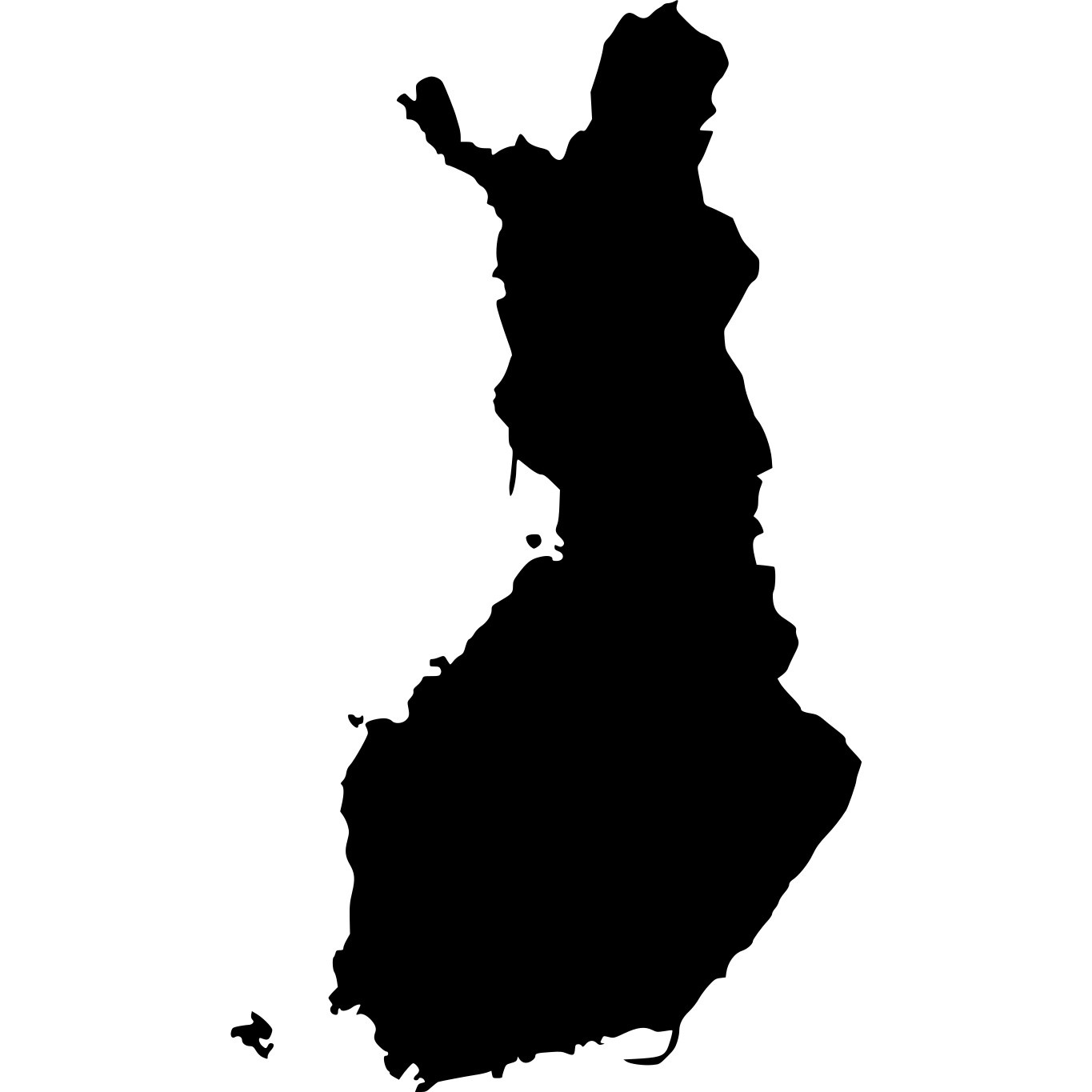
Ekopharma is a Finnish brand

We're dedicated to providing you with the most up-to-date and science-backed ingredient info out there.
The data we've presented on this page has been verified by a member of the SkinSort Team.
Read more about us· Updated May 30, 2026 • Added by noorawulff


