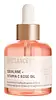
This brightening oil is formulated around Squalane and Tetrahexyldecyl Ascorbate to brighten dull-looking skin and hydrate skin.
This brightening oil is formulated around Simmondsia Chinensis Seed Oil and Oryza Sativa Bran Oil to fade the look of dark spots and hydrate skin.

What's inside
What's inside
 Key Ingredients
No key ingredients
Benefits
Concerns
Ingredients Side-by-side






Simmondsia Chinensis Seed Oil
Emollient





Caprylic/Capric Triglyceride
Masking
Oryza Sativa Bran Oil
Emollient

Glycine Soja Lipids
Skin ConditioningAlcohol
Antimicrobial



Camellia Oleifera Seed Oil
Skin Conditioning
Ximenia Americana Seed Oil
Emollient
Glycine Soja Oil
Emollient


Macadamia Ternifolia Seed Oil
Emollient
Rosa Canina Fruit Oil
Emollient
Daucus Carota Sativa Seed Oil
Emollient
Rosa Damascena Flower Oil
Masking


Adansonia Digitata Seed Oil
Emollient
Limnanthes Alba Seed Oil
Skin Conditioning
Vaccinium Macrocarpon Seed Oil
Skin Conditioning
Nigella Sativa Seed Oil
Emollient
Raspberry Seed Oil/Tocopheryl Succinate Aminopropanediol Esters
Skin Conditioning
Helianthus Annuus Seed Oil
Emollient
Rosmarinus Officinalis Leaf Extract
AntimicrobialOryzanol
Skin ConditioningCitronellol
Perfuming
Geraniol
Perfuming
Eugenol
Perfuming
Simmondsia Chinensis Seed Oil, Caprylic/Capric Triglyceride, Oryza Sativa Bran Oil, Glycine Soja Lipids, Alcohol, Camellia Oleifera Seed Oil, Ximenia Americana Seed Oil, Glycine Soja Oil, Macadamia Ternifolia Seed Oil, Rosa Canina Fruit Oil, Daucus Carota Sativa Seed Oil, Rosa Damascena Flower Oil, Adansonia Digitata Seed Oil, Limnanthes Alba Seed Oil, Vaccinium Macrocarpon Seed Oil, Nigella Sativa Seed Oil, Raspberry Seed Oil/Tocopheryl Succinate Aminopropanediol Esters, Helianthus Annuus Seed Oil, Rosmarinus Officinalis Leaf Extract, Oryzanol, Citronellol, Geraniol, Eugenol
Reviews
Ingredients Explained
These ingredients are found in both products.
Ingredients higher up in an ingredient list are typically present in a larger amount.
Caprylic/Capric Triglyceride (aka MCT Oil) is a lightweight emollient, solvent, and texture enhancer. It is considered a skin-softener by helping to prevent moisture loss.
Though it behaves like an oil, it is not technically one due to its chemical composition. One perk of this ingredient is that it is very stable, resistant to oxidation, and unlikely to go rancid.
In practice, that translates to a long shelf life and a consistently elegant skin feel.
While there is an assumption Caprylic Triglyceride can clog pores due to it being derived from coconut oil, there is no research supporting this. Just patch test if you have concerns.
Fractionated coconut oil and MCT Oil are both listed as Caprylic/Capric Triglyceride according to INCI. This is because INCI names are based on the ingredient’s final chemical composition and not its marketing name or source.
This ingredient is treated as the gold standard fungal acne safe oil. Even though it is coconut derived, the problematic lauric acid is stripped out.
This leaves just caprylic (C8) and capric (C10) acid. These chain lengths actually trend antifungal; a 2020 study found caprylic acid was enough to disrupt Malassezia furfur cell membrane, with a caprylic acid derivative damaging membrane structures at concentrations as low as 0.2%.
Learn more about Caprylic/Capric TriglycerideCitronellol is used to add fragrance/parfum to a product. It is often derived from plants such as roses. In fact, it can be found in many essential oils including geranium, lavender, neroli, and more. The scent of Citronellol is often described as "fresh, grassy, and citrus-like".
Since the Citronellol molecule is already unstable, Citronellol becomes irritating on the skin when exposed to air.
Citronellol is a modified terpene. Terpenes are unsaturated hydrocarbons found in plants. They make up the primary part of essential oils.
Citronellol is not able to be absorbed into deeper layers of the skin. It has low permeability,
Citronellol is also a natural insect repellent.
Learn more about CitronellolGeraniol is used to add fragrance/parfum to a product. It is the main component of citronellol. It is a monoterpenoid and an alcohol.
Monoterpenes are naturally found in many parts of different plants.
Geraniol can be found in many essential oils including Rose Oil and Citronella Oil. The scent of Geraniol is often described as "rose-like". Many foods also contain Geraniol for fruit flavoring.
Geraniol can irritate the skin when exposed to air. However, irritation depends on the ability of geraniol to penetrate into the skin. In general, geraniol is not able to penetrate skin easily.
Geraniol is colorless and has low water-solubility. However, it is soluble in common organic solvents.
Like citronellol, it is a natural insect repellent.
2,6-Octadien-1-ol, 3,7-dimethyl-, (2E)-
Learn more about Geraniol

