Little Dream Garden Whitening Fragrance Scrub Cream
A body scrub with 18 ingredients, including exfoliants.
Body scrub with 18 ingredients that contains exfoliants
We independently verify ingredients, backed by peer-reviewed research. Suggest an update.
What's inside
Ingredients List
Water
Skin ConditioningSodium Cocoyl Glycinate
Cleansing
Glycerin
Humectant


Hydrotalcite
Sodium Cocoyl Isethionate
Cleansing
Sodium Chloride
MaskingPEG-150 Distearate
Emulsifying

PEG-75 Lanolin
Emollient
Parfum
Masking



Sodium Lauroyl Oat Amino Acids
CleansingPhenoxyethanol
Preservative
Sodium Lauryl Hydroxyacetamide Sulfate
Cleansing
Juglans Regia Shell Powder
Abrasive
Hydroquinone
Stabilising
Sodium Citrate
BufferingBrassica Alba Seed Oil
Skin Protecting
Dimethyl Mea
BufferingAllantoin
Skin Conditioning

Water, Sodium Cocoyl Glycinate, Glycerin, Hydrotalcite, Sodium Cocoyl Isethionate, Sodium Chloride, PEG-150 Distearate, PEG-75 Lanolin, Parfum, Sodium Lauroyl Oat Amino Acids, Phenoxyethanol, Sodium Lauryl Hydroxyacetamide Sulfate, Juglans Regia Shell Powder, Hydroquinone, Sodium Citrate, Brassica Alba Seed Oil, Dimethyl Mea, Allantoin
Key Ingredients
Benefits
Concerns
Ingredients Explained
Water. It's the most common cosmetic ingredient of all. You'll usually see it at the top of ingredient lists, meaning that it makes up the largest part of the product.
So why is it so popular? Water most often acts as a solvent - this means that it helps dissolve other ingredients into the formulation.
You'll also recognize water as that liquid we all need to stay alive. If you see this, drink a glass of water. Remember to stay hydrated!
Learn more about WaterSodium Cocoyl Glycinate is a cleansing agent. It can be naturally derived or synthetically-created.
As a surfactant, it helps clean your skin by gathering dirt, oil, and other pollutants to be rinsed away more easily.
Glycerin (or glycerol) is a compound naturally found in your skin. It's a powerhouse humectant that pulls water into the stratum corneum.
Topically, glycerin does several things at once:
Your skin makes glycerin on its own (mostly from sebaceous oil breakdown) and shuttles it to your outermost layer of skin, or your epidermis, via aquaporin-3.
Aquaporin-3 is a transporter that is essential for normal skin hydration, elasticity, and repair. Interestingly, mice lacking in AQP3 have dry and less elastic skin that can be fully corrected with glycerin.
This ingredient is non-irritating, plays well with almost every ingredient, and works across all skin types. Typical use is anywhere between 3-10% but can go up to 79% in some leave-on products.
Just know very high concentrations (>40%) can feel tacky in low humidity.
Glycerin is the name for this ingredient in American English. British English uses Glycerol/Glycerine.
Learn more about GlycerinWe don't have a description for Hydrotalcite yet.
Sodium cocoyl isethionate is a natural ingredient from coconut oil. It is an ultra gentle cleanser that gives a nice foam without drying the skin or impacting the skin barrier.
The amount of foam created depends on the amount of sodium cocoyl isethionate used in the product.
This ingredient also helps improve the spreadability of a product.
This ingredient hasn’t been shown in studies to feed fungal acne yeast.
Learn more about Sodium Cocoyl IsethionateChances are, you eat sodium chloride every day. Sodium Chloride is also known as table salt. This ingredient has many purposes in skincare: thickener, emulsifier, and exfoliator.
You'll most likely find this ingredient in cleansers where it is used to create a gel-like texture. As an emulsifier, it also prevents ingredients from separating.
You might see people debate whether Sodium Chloride is comedogenic, but there actually haven't been any comedogenic tests done on it. Either way, the overall formulation of a product matters a lot more than any single ingredient.
You might see this ingredient used in scrubs as a primary exfoliating ingredient.
Learn more about Sodium ChloridePEG-150 Distearate is a hardworking ingredient that is usually found at the end of a lot of cleansers whose main job is to act as a micellar thickening agent for surfactant-based cleansers.
It works by physically linking up surfactant micelles already in a formula to bump up viscosity and gives products a pourable-but-not-runny body.
Safety-wise, it's been found safe in cosmetics with minimal skin irritation and no evidence of toxicity.
This ingredient may not be fungal acne safe; it's a diester of stearic acid (C18) that falls into the C11-24 range that the Malassezia yeast feeds on. In vitro studies have also shown the Malassezia can metabolize PEG stearates by cleaving the ester bond to release the fatty acid.
Learn more about PEG-150 DistearatePeg-75 Lanolin is created from lanolin, a wax derived from animals with wool.
It is an emollient and emulsifier.
The 75 refers to the average number of ethylene oxide used to create this ingredient. (75 mol EO average molar ratio)
This ingredient may not be Malassezia folliculitis, or fungal-acne safe.
Learn more about PEG-75 LanolinParfum is a catch-all term for an ingredient or more that is used to give a scent to products.
Also called "fragrance", this ingredient can be a blend of hundreds of chemicals or plant oils. This means every product with "fragrance" or "parfum" in the ingredients list is a different mixture.
For instance, Habanolide is a proprietary trade name for a specific aroma chemical. When used as a fragrance ingredient in cosmetics, most aroma chemicals fall under the broad labeling category of “FRAGRANCE” or “PARFUM” according to EU and US regulations.
The term 'parfum' or 'fragrance' is not regulated in many countries. In many cases, it is up to the brand to define this term.
For instance, many brands choose to label themselves as "fragrance-free" because they are not using synthetic fragrances. However, their products may still contain ingredients such as essential oils that are considered a fragrance by INCI standards.
One example is Calendula flower extract. Calendula is an essential oil that still imparts a scent or 'fragrance'.
Depending on the blend, the ingredients in the mixture can cause allergies and sensitivities on the skin. Some ingredients that are known EU allergens include linalool and citronellol.
Parfum can also be used to mask or cover an unpleasant scent.
The bottom line is: not all fragrances/parfum/ingredients are created equally. If you are worried about fragrances, we recommend taking a closer look at an ingredient. And of course, we always recommend speaking with a professional.
Learn more about ParfumWe don't have a description for Sodium Lauroyl Oat Amino Acids yet.
Phenoxyethanol is one of the most widely used preservatives in skincare (and for good reason!).
It has a large spectrum of antimicrobial activity and especially effective bacteria, yeast, and mold while only having a weak effect on your skin's natural microbiome.
On a cellular level, it disrupts the cell membranes of microbes by poking holes that make the cell leak. This shuts down the chemical reactions the microbe needs to make energy so it can no longer survive.
Another perk of this ingredient is that it stays functional across a wide pH range (3-10).
You'll often see it paired with boosters like Ethylhexylglycerin; one study showed that a 1:9 ratio of Ethylhexylglycerin to Phenoxyethanol damages bacterial membranes as effectively as doubling the Phenoxyethanol concentration on its own.
Typical use concentrations range from 0.3-1% depending on the formula, and this ingredient is capped at 1% int the EU.
Safety-wise, the fear mongering does not hold up to the evidence. The EU's Scientific Committee on Consumer Safety and FDA consider it safe as a preservative at up to 1%, including for children of all ages.
Adverse systemic effects only showed up in animal studies at exposures roughly 200x higher than what people get from cosmetics. And despite its very widespread use, this ingredient is a rare sensitizer and allergic reactions are uncommon.
Learn more about PhenoxyethanolSodium Lauryl Hydroxyacetamide Sulfate is a type of sulfate.
You might know this ingredient as walnut shell powder. It is an abrasive used as a physical exfoliator.
Abrasives are physical exfoliants used to get rid of dead cell buildup on your skin. Physical exfoliators have a bad reputation due to the myth that they give your face tiny cuts. This is untrue.
Like any exfoliant, using this ingredient can disrupt your skin barrier. This can lead to breakouts, irritation, and dryness. It is critical to be gentle when using any type of exfoliator.
If you want to use a chemical exfoliator instead, check out glycolic acid.
Learn more about Juglans Regia Shell PowderHydroquinone is a classic ingredient dermatologists use to fade dark spots (things like melasma, acne marks, sun spots, and freckles).
It works in two ways:
1. By blocking an enzyme called tyrosinase; your skin uses this to make melanin, or the pigment that causes dark spots.
2. By interfering with the pigment making cells themselves so less pigment shows up over time
Just know this ingredient fades spots near the surface of skin and not the deeper ones. It's usually used at 2-4% / twice a day for 3 months, and ALWAYS with sunscreen.
This ingredient is usually well tolerated with short-term use under medical guidance. But possible reactions include irritation, contact dermatitis, and lightening of the skin around the spot you're treating.
You might hear hydroquinone called "cancer-causing". That concern comes from studies where rats were fed high oral doses; no skin cancer cases have been linked to it after more than 50 years of people putting it on their skin.
Long-term, high-strength, and unsupervised use can lead to a condition called ochronosis. This is where the skin turns blue-grey color and sometimes causes nails to turn dark as well.
The rules around it vary by country.
The EU bans it in regular cosmetics and it is prescription only in the US, EU, Japan, Canada, and Australia. Anything you see on the shelf without a prescription is technically not allowed.
Check out the European alternative to hydroquinone here.
SkinSort would like to remind friends from around the world that all skin tones are beautiful!
Learn more about HydroquinoneSodium Citrate is the sodium salts of citric acid. In skincare, it is used to alter pH levels and acts as a preservative.
Its main functions are to maintain the pH of a product and neutralize metal ions.
The acidity of our skin is maintained by our glands and skin biome; normal pH level of skin is slightly acidic (~4.75-5.5).
Being slightly acidic allows our skin to create an "acid mantle". This acid mantle is a thin barrier that protects our skin from bacteria and contaminants.
Learn more about Sodium CitrateBrassica Alba Seed Oil is an oil.
We don't have a description for Dimethyl Mea yet.
Allantoin is a soothing ingredient known for its protective and moisturizing properties; it's basically a quiet workhorse ingredient you can find in a huge range of cosmetics.
Though it can be derived from the comfrey plant, allantoin is produced synthetically for cosmetic products to ensure purity.
Research shows it can encourage your skin cells to turn over and renew by stimulating keratinocyte and fibroblast proliferation.
It also has mild keratolytic properties to help loosen and shed dead skin cells without being harsh.
Studies also suggest allantoin can help calm inflammation by dialing down some of the chemical signals your skin sends out when it is irritated.
This ingredient is typically used in the 0.1-0.5% range, and the FDA recognizes it as a skin protectant in OTC products up to 2%.
Overall, allantoin is a wonderful addition to most routines; it is stable across a wide pH range (~4-8), works well with other ingredients, and is considered non-sensitizing/non-irritating.
Fun fact: Allantoin is naturally occurring in comfrey root, beets, chamomile, and wheat sprouts. Our bodies even produce it as a byproduct of uric acid metabolism.
Learn more about AllantoinReviews
No written reviews yet. Be the first to review this product.
Recent searches
Search reviews by skin type, ingredient, or keyword.
Where it's from
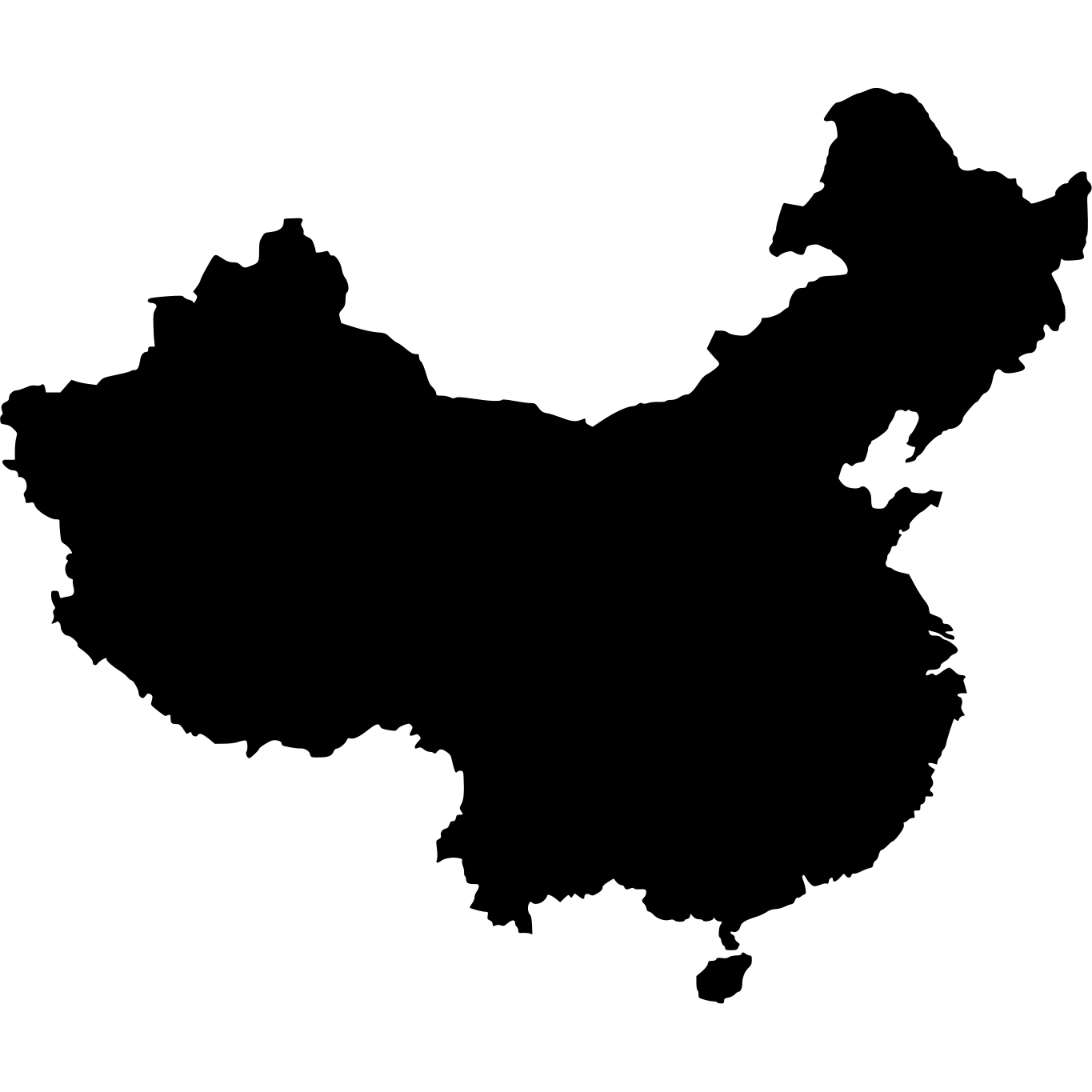
Little Dream Garden is a Chinese brand

We're dedicated to providing you with the most up-to-date and science-backed ingredient info out there.
The data we've presented on this page has been verified by a member of the SkinSort Team.
Read more about us· Updated April 24, 2026 • Added by ritachin


