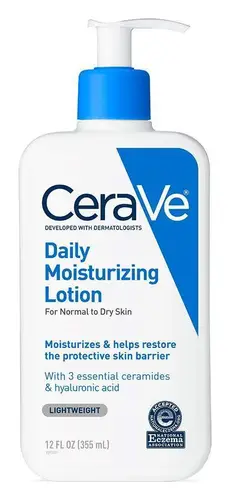
This moisturizer is formulated around Olea Europaea Fruit Oil to hydrate skin.
This barrier-repair moisturizer is formulated around Hyaluronic Acid to strengthen the skin barrier and hydrate skin.


What's inside
What's inside
 Key Ingredients
Benefits
Concerns
Ingredients Side-by-side
Water
Skin ConditioningGlycerin
Humectant


Olea Europaea Fruit Oil
Masking





Cetearyl Alcohol
Emollient


Dimethicone
Emollient
Paraffinum Liquidum
Emollient
Sodium Lauryl Sulfate
Cleansing

Sodium Cetearyl Sulfate
Cleansing
BHT
Antioxidant
Disodium EDTA
ChelatingMethylparaben
Preservative


Imidazolidinyl Urea
Preservative
Propylparaben
Preservative
Parfum
Masking
Limonene
Perfuming
Linalool
Perfuming


Ingredients Explained
These ingredients are found in both products.
Ingredients higher up in an ingredient list are typically present in a larger amount.
Cetearyl alcohol is a waxy mixture of two fatty alcohols: cetyl alcohol and stearyl alcohol. It is an emollient and emulsifier.
Despite having "alcohol" in its name, it has nothing to do with drying solvent alcohols; the FDA also allows "alcohol-free" products to contain fatty alcohols like this ingredient.
It plays several roles in a formula:
Typical use levels for this ingredient sit around 1-10% and the Cosmetic Ingredient Review Expert Panel has affirmed safety at concentrations up to 25% in leave-on products.
Multiple assessments have found it to be non-irritating and non-sensitizing to most people.
However, there have been some cases of allergic contact dermatitis in patients with chronically compromised skin barriers.
Cetearyl alcohol has a comedogenic rating of 2 and irritancy rating of 1. Both of these numbers come from the 1989 study that used rabbit ears; a "2" means mildly comedogenic and a "1" means low irritancy.
Here's the catch: rabbit skin is more sensitive than human skin and throws a lot of false positives. A 1996 reappraisal found that ingredients rated 1-2 in the rabbit ear tests are generally safe for humans.
Remember comedogenic ratings are unable to assess the entire formula of a product or how it will react on your skin. Just be sure to patch test if you are unsure about certain ingredients.
This ingredient is not fungal acne safe. Cetearyl alcohol is a fatty alcohol with chain lengths that fall within the range that Malassezia can metabolize.
A 2019 study has also observed Malassezia growth in the presence of this ingredient, confirming it to be not-fungal acne safe.
Learn more about Cetearyl AlcoholGlycerin (or glycerol) is a compound naturally found in your skin. It's a powerhouse humectant that pulls water into the stratum corneum.
Topically, glycerin does several things at once:
Your skin makes glycerin on its own (mostly from sebaceous oil breakdown) and shuttles it to your outermost layer of skin, or your epidermis, via aquaporin-3.
Aquaporin-3 is a transporter that is essential for normal skin hydration, elasticity, and repair. Interestingly, mice lacking in AQP3 have dry and less elastic skin that can be fully corrected with glycerin.
This ingredient is non-irritating, plays well with almost every ingredient, and works across all skin types. Typical use is anywhere between 3-10% but can go up to 79% in some leave-on products.
Just know very high concentrations (>40%) can feel tacky in low humidity.
Glycerin is the name for this ingredient in American English. British English uses Glycerol/Glycerine.
Learn more about GlycerinPropylparaben is a preservative and one of the most widely used members of the paraben family (it's been used in cosmetics for over a century now).
It works by disrupting microbial cell membranes and enzymes, and is a broad-spectrum protector that works exceptionally well against molds, yeasts, and gram-positive bacteria.
You'll likely see it paired with methylparaben to cover the full range (including gram-negative bacteria).
This ingredient is effective at low concentrations (~0.2-0.5%) and stable across a wide pH range (4.5-7.5 pH). It's effectiveness drops off above pH 8 and it can lose potency when combined with non-ionic surfactants like polysorbate 80 due to micellization.
The regulatory bodies have concluded this ingredient to be safe as used in cosmetics. The EU has capped it at 0.14% and combined parabens are not to exceed 0.8%.
While parabens do cross the stratum corneum, only about 1% remains for absorption into the body. This is because most of it is metabolized within living skin.
Learn more about PropylparabenSodium Cetearyl Sulfate is a type of sulfate.
Sodium Lauryl Sulfate (SLS) is a surfactant, cleansing agent, and foaming agent. You'll find it in a wide range of products from shampoos to face cleansers.
SLS has two main roles:
The Cosmetic Ingredient Review Panel has assessed it in 1983, 2002, and 2005 and found it to be safe in formulations at low concentrations.
SLS is a well-documented skin irritant at higher concentrations or with prolonged exposure. It's actually the gold standard positive control used in dermatological patch testing, meaning doctors use it because they know it will cause a reaction in people.
In one large study of 43,000 patiences tested with 0.25% SLS, about 22% showed some level of reactivity. It increases transepidermal water loss that disrupts your outermost layer of skin.
Face cleansers often pair this ingredient with mild co-surfactants like Cocamidopropyl Betaine to buffer its harshness.
Just so you know, SLS does not trigger true allergic contact dermatitis. This just means it can irritate your skin but doesn't cause your immune system to develop a lasting allergy to it.
Despite internet rumors, SLS is not considered a carcinogen by any major regulatory body.
Learn more about Sodium Lauryl SulfateWater. It's the most common cosmetic ingredient of all. You'll usually see it at the top of ingredient lists, meaning that it makes up the largest part of the product.
So why is it so popular? Water most often acts as a solvent - this means that it helps dissolve other ingredients into the formulation.
You'll also recognize water as that liquid we all need to stay alive. If you see this, drink a glass of water. Remember to stay hydrated!
Learn more about Water