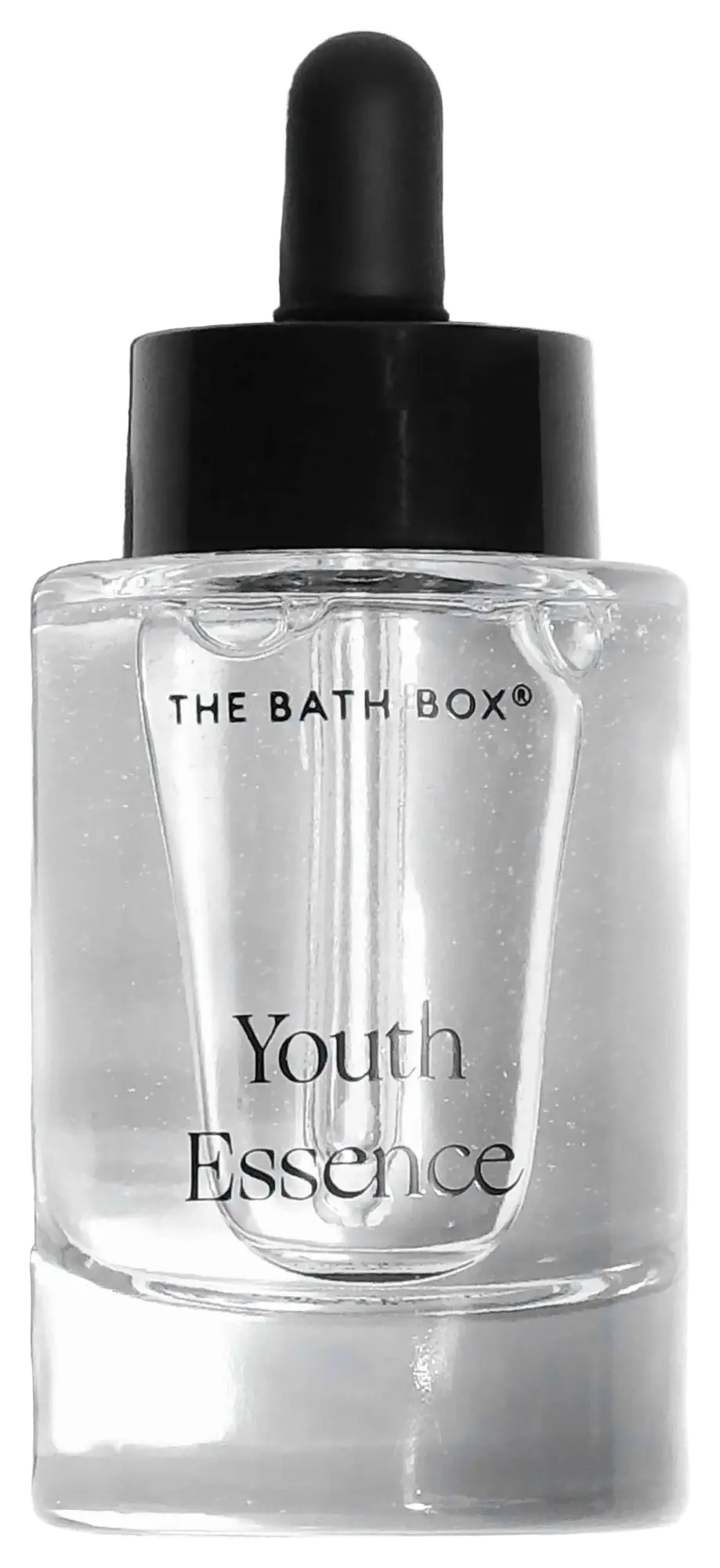
The Bath Box Youth
A essence with 17 ingredients, including hyaluronic acid, peptides, and snail mucin.
This anti-aging essence is formulated around Snail Secretion Filtrate and Panthenol to soften the look of wrinkles and hydrate skin.
We independently verify ingredients, backed by peer-reviewed research. Suggest an update.
What's inside
Ingredients List
Snail Secretion Filtrate
Skin Conditioning





1,2-Hexanediol
Skin Conditioning
Water
Skin ConditioningGlycerin
Humectant
Panthenol
Skin Conditioning
Propanediol
Solvent
Nicotiana Benthamiana Hexapeptide-40 Sh-Polypeptide-47


Sodium Hyaluronate Crosspolymer
Humectant
Hydrolyzed Glycosaminoglycans
HumectantSodium Hyaluronate
Humectant
Hydrolyzed Hyaluronic Acid
Humectant
Hyaluronic Acid
Humectant
Xanthan Gum
EmulsifyingSodium Polyacrylate
Absorbent
Trisodium Ethylenediamine Disuccinate
ChelatingPentylene Glycol
Skin Conditioning
Citric Acid
Buffering


Snail Secretion Filtrate, 1,2-Hexanediol, Water, Glycerin, Panthenol, Propanediol, Nicotiana Benthamiana Hexapeptide-40 Sh-Polypeptide-47, Sodium Hyaluronate Crosspolymer, Hydrolyzed Glycosaminoglycans, Sodium Hyaluronate, Hydrolyzed Hyaluronic Acid, Hyaluronic Acid, Xanthan Gum, Sodium Polyacrylate, Trisodium Ethylenediamine Disuccinate, Pentylene Glycol, Citric Acid
Key Ingredients
Benefits
Ingredients Explained
Snail Secretion Filtrate (the slimy mucus that garden snails produce) is a multitasking ingredient that shows up in "skin repair" formulas.
This ingredient works because it's a grab bag of skin-friendly stuff like:
In a formula, it acts as a humectant and barrier-supporting soother and the research backs this up as well.
A 2025 systematic review of human clinical trials found that snail-derived ingredients improved signs of aging, increased skin hydration, decreased transepidermal water loss, and improved healing after radiation therapy/fractional laser treatment.
Lab studies have also shown the secretion promotes the proliferation, migration, and survival of the cells that rebuild skin (keratinocytes and dermal fibroblasts).
There's also a placebo-controlled study where a serum containing it helped with mask-related acne.
Overall, this is a gentle, water-based multitasker that works great for hydrating and supporting the skin barrier. However, please see the section below if you have dust mite or shellfish allergies.
You'll see snail filtrate listed at very different percentages depending on the product. Some Korean serums list it near the top of the ingredients at 90% or more while other products use just a few percent.
This doesn't mean the high-percentage ones are far stronger. Raw snail filtrate is mostly water to begin with so using a lot of it isn't the same thing as using a lot of the active ingredients.
Other products use a concentrated version so a small amount goes a long way. Either approach can work well. Just know the percentage on the label isn't a reliable way to judge how effective a snail product will be.
Being cruelty-free means a brand does not experiment on animals. If you're worried about the well-being of the snails, we recommend looking more into the company of the product. Many brands claim to have developed humane methods to collect snail mucin.
There is much debate on this subject. On one hand, this ingredient comes from an animal. On the other hand, many will argue the ingredient is naturally secreted (like a natural by-product) and therefore vegan. If you have reservations, you can look into Galactomyces Ferment Filtrate or Centella Asiatica Extract as alternatives.
This ingredient is fungal acne safe. Its core composition lacks the fatty acid/ester triggers that Malassezia depends on.
True allergy to Snail Secretion Filtrate is uncommon and most documented cases are linked to a dust mite allergy.
Snail proteins (including Tropomyosin) are similar enough to dust mite proteins that the immune system can confuse them.
In most documented cases, the dust mite was the original trigger and tropomyosin turned out to be only a minor player in some studies (so this has not been fully confirmed).
Another thing to know is that nearly all the evidence comes from eating snails or inhaling the protein and not from cosmetics.
However, the allergenic proteins can survive filtration into a finished product; a topical reaction is biologically plausible but there's little published evidence of it actually happening.
People who are allergic to dust mites (or sometimes shellfish) are the most likely to react.
Learn more about Snail Secretion Filtrate1,2-Hexanediol is a synthetic liquid and another multi-functional powerhouse.
It is a:
- Humectant, drawing moisture into the skin
- Emollient, helping to soften skin
- Solvent, dispersing and stabilizing formulas
- Preservative booster, enhancing the antimicrobial activity of other preservatives
Water. It's the most common cosmetic ingredient of all. You'll usually see it at the top of ingredient lists, meaning that it makes up the largest part of the product.
So why is it so popular? Water most often acts as a solvent - this means that it helps dissolve other ingredients into the formulation.
You'll also recognize water as that liquid we all need to stay alive. If you see this, drink a glass of water. Remember to stay hydrated!
Learn more about WaterGlycerin (or glycerol) is a compound naturally found in your skin. It's a powerhouse humectant that pulls water into the stratum corneum.
Topically, glycerin does several things at once:
Your skin makes glycerin on its own (mostly from sebaceous oil breakdown) and shuttles it to your outermost layer of skin, or your epidermis, via aquaporin-3.
Aquaporin-3 is a transporter that is essential for normal skin hydration, elasticity, and repair. Interestingly, mice lacking in AQP3 have dry and less elastic skin that can be fully corrected with glycerin.
This ingredient is non-irritating, plays well with almost every ingredient, and works across all skin types. Typical use is anywhere between 3-10% but can go up to 79% in some leave-on products.
Just know very high concentrations (>40%) can feel tacky in low humidity.
Glycerin is the name for this ingredient in American English. British English uses Glycerol/Glycerine.
Learn more about GlycerinPanthenol is a common ingredient that helps hydrate and soothe the skin. It is found naturally in our skin and hair.
There are two forms of panthenol: D and L.
D-panthenol is also known as dexpanthenol. Most cosmetics use dexpanthenol or a mixture of D and L-panthenol.
Panthenol is famous due to its ability to go deeper into the skin's layers. Using this ingredient has numerous pros (and no cons):
Like hyaluronic acid, panthenol is a humectant. Humectants are able to bind and hold large amounts of water to keep skin hydrated.
This ingredient works well for wound healing. It works by increasing tissue in the wound and helps close open wounds.
Once oxidized, panthenol converts to pantothenic acid. Panthothenic acid is found in all living cells.
This ingredient is also referred to as pro-vitamin B5.
Learn more about PanthenolPropanediol is an all-star ingredient. It softens, hydrates, and smooths the skin.
It’s often used to:
Propanediol is not likely to cause sensitivity and considered safe to use. It is derived from corn or petroleum with a clear color and no scent.
Learn more about PropanediolThis is a synthetic "recombinant" collagen peptide and the long name basically describes how it's made.
The active part, Sh-Polypeptide-47, is a peptide built from the human gene that codes for Collagen Alpha-1 while the Nicotiana Benthamiana Hexapeptide-40 part tells you it's grown from Nicotiana benthamiana, a tobacco-relative plant that's been turned into a tiny biological factory.
Scientists insert the human collagen gene into the plant and the plant produces the peptide either through a transient expression system or by transgenesis.
The end result is a vegan, animal-free peptide that's bio-identical to a piece of your own collagen.
In a formula, this ingredient is a skin conditioner and provides anti-aging support. Peptides like this tell your fibroblasts to ramp up their own collagen, elastin, and hyaluronic acid.
On the evidence front, the studies that exist are mostly on the category of recombinant human collagen peptides rather than this precise fusion peptide.
For example, work on recombinant human Collagen Alpha-1 Type V peptides showed measurable gains in skin elasticity, density, and barrier function over 2-4 weeks of use. Recombinant human collagen peptides have also shown promise across wound healing.
While everything looks promising, there's no independent trials on this ingredient specifically.
Usage concentrations are rarely published for this ingredient. Like most of its peptide cousins, it's used at low
Learn more about Nicotiana Benthamiana Hexapeptide-40 Sh-Polypeptide-47Sodium Hyaluronate Crosspolymer is a crosslinked version of sodium hyaluronate. This just means it's linked into a 3D mesh network that lets it be more stable and sit on skin as a cohesive, gel-like film rather than sinking into skin.
A 2016 human skin study found crosslinked HA increased epidermal water content by 7.6% over the control group and reduced transepidermal water loss by 27.8%.
A follow-up clinical trial found that a topical crosslinked HA serum applied after fillers, microneedling, or chemical peels was well-tolerated and enhanced skin quality at 14 / 28 days.
More recent research suggests that concentrations as low as 0.03% can act as a penetration enhancer for other skincare actives.
Learn more about Sodium Hyaluronate CrosspolymerWe don't have a description for Hydrolyzed Glycosaminoglycans yet.
Sodium Hyaluronate is the salt form of hyaluronic acid. It is a long sugar chain that is naturally found in your skin, joints, and connective tissue that maintains hydration and elasticity.
In skincare, it works as a humectant. It pulls water from the environment and deeper layers of skin and binds it to the surface.
Interestingly, the size of the molecule affects its behavior:
Some clinical evidence links low molecular weight versions to improved wrinkle depth, elasticity, anti-inflammatory effects, and barrier repair.
Many serums use a blend of both weights so you can get surface hydration plus longer-lasting and deeper effects.
You'll typically see concentrations between 0.1-2% for this ingredient.
Learn more about Sodium HyaluronateHydrolyzed Hyaluronic Acid is hyaluronic acid (HA) that is broken down into lower molecular weight fragments.
It's a humectant that pulls and holds water in the skin to help with hydration, plumpness, and reduce transepidermal water loss.
Because hydrolyzed hyaluronic acid is smaller in size, it can slip past your outermost layer of skin more easily than full-sized HA.
Most formulations will combine all sizes to get the best of both worlds.
Typical usage levels range from 0.01-1%. Any percentage higher than 2% might become goopy and tacky.
Learn more about Hydrolyzed Hyaluronic AcidHyaluronic acid (HA) is a glycosaminoglycan (basically a long sugar chain) that your skin already makes on its own. In your skin, HA lives in the extracellular matrix and acts as the body's moisture reservoir.
Topically, HA is a humectant that binds water and helps skin look more plump, smooth, and hydrated.
The only catch is that HA isn't a single thing; it actually comes in a wide range of molecular weights (~50 - 2,000+ kDA) and size matters.
Some clinical evidence links low molecular weight versions to improved wrinkle depth, elasticity, anti-inflammatory effects, and barrier repair.
This is why the best HA serums blend the two sizes together so you get the best of both worlds.
The majority of cosmetic HA is produced by bacterial fermentation, typically using Streptococcus or Bacillus strains. Typical use levels in skincare sit around 0.1-2%.
A clinical study using a 0.2% low-molecular weight HA gel showed improvement in facial seborrheic dermatitis with excellent tolerance.
These are some other common types of Hyaluronic Acid:
Learn more about Hyaluronic AcidXanthan gum is used as a stabilizer and thickener within cosmetic products. It helps give products a sticky, thick feeling - preventing them from being too runny.
On the technical side of things, xanthan gum is a polysaccharide - a combination consisting of multiple sugar molecules bonded together.
Xanthan gum is a pretty common and great ingredient. It is a natural, non-toxic, non-irritating ingredient that is also commonly used in food products.
Learn more about Xanthan GumSodium Polyacrylate is the sodium salt of polyacrylic acid. It is used as an absorber, emollient, and stabilizer.
This ingredient is a super-absorbent polymer - meaning it can absorb 100 to 1000 times its mass in water. As an emollient, Sodium Polyacrylate helps soften and soothe skin. Emollients work by creating a barrier to trap moisture in. This helps keep your skin hydrated.
Trisodium Ethylenediamine Disuccinate is used to help stabilize a product.
It is a chelating agent, meaning it helps prevent metal ions from binding to other ingredients. This prevents unwanted reactions in products. Metal ions can come into a product via the water ingredient. They are found in trace amounts and are not known to be harmful.
Pentylene Glycol (1,2-pentanediol) is a multitasking little diol with three main roles in a formula:
Research on alkanediols (the family pentylene glycol belongs to) show they work by disrupting microbial cell membranes. This disruption helps the primary preservative system in a product work more effectively at lower doses.
On the safety side, the Cosmetic Ingredient Review Expert Panel has concluded this ingredient to be safe as used in current cosmetic practices + concentrations.
Typical use levels in a formula run about 1-5%.
Learn more about Pentylene GlycolCitric Acid is an alpha hydroxy acid (AHA) naturally found in citrus fruits like oranges, lemons, and limes.
Like other AHAs, citric acid can exfoliate skin by breaking down the bonds that hold dead skin cells together. This helps reveal smoother and brighter skin underneath.
However, this exfoliating effect only happens at high concentrations (20%) which can be hard to find in cosmetic products.
Due to this, citric acid is usually included in small amounts as a pH adjuster. This helps keep products slightly more acidic and compatible with skin's natural pH.
In skincare formulas, citric acid can:
While it can provide some skin benefits, research shows lactic acid and glycolic acid are generally more effective and less irritating exfoliants.
Most citric acid used in skincare today is made by fermenting sugars (usually from molasses). This synthetic version is identical to the natural citrus form but easier to stabilize and use in formulations.
Rosacea skin has a lower threshold for acids generally, with 62.5% of rosacea subjects in one study reacting to lactic acid in a sting test. This is why we mark citric acid as a potential rosacea trigger.
However, this ingredient shows up as a pH adjuster or chelator at roughly 0.1-1% in many products. These low levels are unlikely to be an issue for rosacea skin and becomes a potential trigger at exfoliating concentrations (20%). Because everybody's skin is unique, we recommend a patch test if you are unsure.
Learn more about Citric AcidReviews
No written reviews yet. Be the first to review this product.
Recent searches
Search reviews by skin type, ingredient, or keyword.
Where it's from
The Bath Box is a Indonesian brand


We're dedicated to providing you with the most up-to-date and science-backed ingredient info out there.
The data we've presented on this page has been verified by a member of the SkinSort Team.
Read more about us· Updated September 13, 2026 • Added by nisrinanasywa


