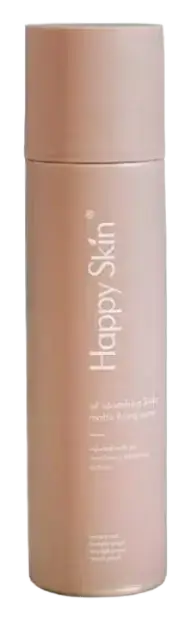
Happy Skin Cosmetics Oil Absorbing 24-HR Matte Fixing Spray
A setting spray & powder with 14 ingredients, including exfoliants.
Setting spray & powder with 14 ingredients that contains exfoliants
We independently verify ingredients, backed by peer-reviewed research. Suggest an update.
What's inside
Ingredients List
Butane
Isobutane
Propane
Alcohol
Antimicrobial




Water
Skin ConditioningAcrylates/Lauryl Acrylate/Stearyl Acrylate/Ethylamine Oxide Methacrylate Copolymer
Silica
Abrasive


Butylene Glycol
Humectant

Parfum
Masking

Chrysanthellum Indicum Extract
Skin Conditioning
Opuntia Streptacantha Stem Extract
HumectantScutellaria Baicalensis Root Extract
Astringent
Paeonia Suffruticosa Root Extract
Skin ProtectingPortulaca Oleracea Extract
Skin Conditioning
Butane, Isobutane, Propane, Alcohol, Water, Acrylates/Lauryl Acrylate/Stearyl Acrylate/Ethylamine Oxide Methacrylate Copolymer, Silica, Butylene Glycol, Parfum, Chrysanthellum Indicum Extract, Opuntia Streptacantha Stem Extract, Scutellaria Baicalensis Root Extract, Paeonia Suffruticosa Root Extract, Portulaca Oleracea Extract
Key Ingredients
Benefits
Concerns
Ingredients Explained
Butane is a gas derived from petroleum and natural gas. It is used as an aerosol propellant.
This ingredient is a low-molecular weight gas using as a propellant in foams, sprays, and mousses.
It is not intended to interact with skin in a meaningful way as it evaporates almost immediately after dispensing and only leaving behind the actual product formula.
If it does somehow make it onto your skin, it is chemically inert and does not penetrate or get absorbed into skin. Safety assessments note that adverse skin reactions to this ingredient are uncommon.
Learn more about IsobutanePropane is a gas derived from petroleum and natural gas. In cosmetics, its only used as an aerosol propellant (it pushes your product out of the can when you press the nozzle).
That's why you'll find it in hair sprays, dry shampoos, deodorants, mousses, shaving foams, and sunscreen sprays.
It is volatile, meaning it only remains on skin for less than 10 seconds before evaporating. It doesn't really linger long enough on skin to act as a skincare ingredient in any meaningful way.
Hairspray concentrations are between 6-17%.
The CIR Expert Panel concluded it to be safe as a cosmetic ingredient under present concentration and usage.
Learn more about PropaneThis ingredient is also called ethanol or ethyl alcohol. It is denatured, meaning made undrinkable for cosmetic use.
In formulas, it:
Is it bad for your skin?
The answer comes down to concentration. Patch and wash studies have found highly concentrated alcohol-based hand rubs (60-100%) cause less barrier disruption than washing with a basic detergent like SLS. The only measurable effect in these studies was a temporary dip in skin hydration.
Concentrations below 12-15% in leave-on cosmetics is generally well-tolerated. Concentrations above start to see increased transepidermal water loss (TEWL) and reduced hydration.
In concentrations about 58%, it creates temporary channels in your skin's lipid layers to become more permeable and allow other ingredients to slip through easily.
This ingredient can be up to 80% of the formula in alcohol-based perfumes.
Overall, this ingredient is probably harmless if found lower down an ingredients list but worth side-eyeing if it's high up (especially if your barrier is already struggling).
Alcohol can worsen dry skin, eczema, and oily skin, especially at higher concentrations. This is because it can increase transepidermal water loss and decrease hydration to disrupt the skin barrier.
According to the National Rosacea Society based in the US, you should be mindful of products with these alcohols in the top half of ingredients.
True allergic contact dermatitis to ethanol is uncommon, but be sure to patch test if you have dry or sensitive skin.
Learn more about AlcoholWater. It's the most common cosmetic ingredient of all. You'll usually see it at the top of ingredient lists, meaning that it makes up the largest part of the product.
So why is it so popular? Water most often acts as a solvent - this means that it helps dissolve other ingredients into the formulation.
You'll also recognize water as that liquid we all need to stay alive. If you see this, drink a glass of water. Remember to stay hydrated!
Learn more about WaterWe don't have a description for Acrylates/Lauryl Acrylate/Stearyl Acrylate/Ethylamine Oxide Methacrylate Copolymer yet.
Silica, also known as silicon dioxide, is a naturally occurring mineral. It is used as a fine, spherical, and porous powder in cosmetics.
Though it has exfoliant properties, the function of silica varies depending on the product.
The unique structure of silica enhances the spreadability and adds smoothness, making it a great texture enhancer.
It is also used as an active carrier, emulsifier, and mattifier due to its ability to absorb excess oil.
In some products, tiny microneedles called spicules are made from silica or hydrolyzed sponge. When you rub them in, they lightly polish away dead skin layers and enhance the penetration of active ingredients.
Learn more about SilicaButylene Glycol (or BG) is used within cosmetic products for a few different reasons:
Overall, Butylene Glycol is a safe and well-rounded ingredient that works well with other ingredients.
Though this ingredient works well with most skin types, some people with sensitive skin may experience a reaction such as allergic rashes, closed comedones, or itchiness.
Learn more about Butylene GlycolParfum is a catch-all term for an ingredient or more that is used to give a scent to products.
Also called "fragrance", this ingredient can be a blend of hundreds of chemicals or plant oils. This means every product with "fragrance" or "parfum" in the ingredients list is a different mixture.
For instance, Habanolide is a proprietary trade name for a specific aroma chemical. When used as a fragrance ingredient in cosmetics, most aroma chemicals fall under the broad labeling category of “FRAGRANCE” or “PARFUM” according to EU and US regulations.
The term 'parfum' or 'fragrance' is not regulated in many countries. In many cases, it is up to the brand to define this term.
For instance, many brands choose to label themselves as "fragrance-free" because they are not using synthetic fragrances. However, their products may still contain ingredients such as essential oils that are considered a fragrance by INCI standards.
One example is Calendula flower extract. Calendula is an essential oil that still imparts a scent or 'fragrance'.
Depending on the blend, the ingredients in the mixture can cause allergies and sensitivities on the skin. Some ingredients that are known EU allergens include linalool and citronellol.
Parfum can also be used to mask or cover an unpleasant scent.
The bottom line is: not all fragrances/parfum/ingredients are created equally. If you are worried about fragrances, we recommend taking a closer look at an ingredient. And of course, we always recommend speaking with a professional.
Learn more about ParfumThis ingredient is also known as golden chamomile extract. It is rich in antioxidants and has skin conditioning properties.
It has an interesting effect on capillary health and has been shown to strengthen capillaries/improve blood flow in the skin. A 2005 study using a cream with this ingredient significantly reduced redness and rosacea severity over 12 weeks with minimal side effects.
French patent research also backs up the anti-inflammatory and circulation supporting properties at concentrations of 0.01-2%.
Learn more about Chrysanthellum Indicum ExtractWe don't have a description for Opuntia Streptacantha Stem Extract yet.
Scutellaria Baicalensis Root Extract comes from the Baikal skullcap or Chinese skullcap plant. This plant is native to Northeast Asia and can be found in China, Mongolia, Korea, and Siberia.
In cosmetics, Scutellaria Baicalensis Root Extract provides antioxidant and anti-inflammatory benefits. This is due to the flavonoid composition of Scutellaria Baicalensis Root Extract.
In Chinese traditional folk medicine, Scutellaria Baicalensis Root Extract is used to help treat lung issues and hypertension.
Learn more about Scutellaria Baicalensis Root ExtractPaeonia Suffruticosa Root Extract comes Peony plant. It has anti-inflammatory and antioxidant properties.
Emerging studies also show peony root may help reduce hyperpigmentation.
Ancient Chinese medicine has used peony root to treat dark spots, but studies are looking into this claim more.
Learn more about Paeonia Suffruticosa Root ExtractThis extract comes from Purslane, a succulent. It has anti-inflammatory, antioxidant, and hydrating properties.
Purslane is very nutritious. It contains omega-3 fatty acids, NMFs, many vitamins, minerals, and antioxidants. The vitamins found in purslane include: Vitamin C, Vitamin A, and Vitamin E.
Fun fact: Purslane is a succulent with an extensive habitat. It is used in traditional Korean medicine to treat irritated skin.
Nowadays, purslane is becoming a superfood due to its highly nutritious content.
Learn more about Portulaca Oleracea ExtractReviews
No written reviews yet. Be the first to review this product.
Recent searches
Search reviews by skin type, ingredient, or keyword.
Where it's from
Happy Skin Cosmetics is a Filipino brand


We're dedicated to providing you with the most up-to-date and science-backed ingredient info out there.
The data we've presented on this page has been verified by a member of the SkinSort Team.
Read more about us· Published August 23, 2026 • Added by rachaelraydejesus


