Anai Rui Bakuchiol Serum
A serum with 18 ingredients, including hyaluronic acid, peptides, and bakuchiol.
This anti-aging serum is formulated around Bakuchiol and Acetyl Hexapeptide-8 to soften the look of wrinkles and refine skin texture.
Worth noting
Contains Lavandula Angustifolia Flower Extract, an EU-listed fragrance allergen.
We independently verify ingredients, backed by peer-reviewed research. Suggest an update.
What's inside
Ingredients List
Water
Skin ConditioningBakuchiol
Antimicrobial









Carbomer
Emulsion StabilisingButylene Glycol
Humectant

Sodium Hyaluronate
Humectant
Hydrolyzed Sodium Hyaluronate
Skin Conditioning
Arginine
Masking
Oligopeptide-1
Skin Conditioning
Hydrolyzed Hibiscus Esculentus Extract
Skin ConditioningAcetyl Hexapeptide-8
Humectant
Arginine/Lysine Polypeptide
Skin Conditioning
Hydroxyphenyl Propamidobenzoic Acid
Skin ConditioningRosa Hybrid Flower Extract
Skin ConditioningGardenia Florida Fruit Extract
Skin ConditioningLavandula Angustifolia Flower Extract
Cleansing

Tremella Fuciformis Extract
Humectant
1,2-Hexanediol
Skin Conditioning
Pentylene Glycol
Skin Conditioning
Water, Bakuchiol, Carbomer, Butylene Glycol, Sodium Hyaluronate, Hydrolyzed Sodium Hyaluronate, Arginine, Oligopeptide-1, Hydrolyzed Hibiscus Esculentus Extract, Acetyl Hexapeptide-8, Arginine/Lysine Polypeptide, Hydroxyphenyl Propamidobenzoic Acid, Rosa Hybrid Flower Extract, Gardenia Florida Fruit Extract, Lavandula Angustifolia Flower Extract, Tremella Fuciformis Extract, 1,2-Hexanediol, Pentylene Glycol
Key Ingredients
Benefits
Concerns
Ingredients Explained
Water. It's the most common cosmetic ingredient of all. You'll usually see it at the top of ingredient lists, meaning that it makes up the largest part of the product.
So why is it so popular? Water most often acts as a solvent - this means that it helps dissolve other ingredients into the formulation.
You'll also recognize water as that liquid we all need to stay alive. If you see this, drink a glass of water. Remember to stay hydrated!
Learn more about WaterBakuchiol is a plant-derived antioxidant from the seeds of the Psoralea corylifolia plant. It has antimicrobial, emollient, skin conditioning, and antioxidant properties.
You'll likely see it called a "retinol replacement" but the two are technically not related. This is because bakuchiol is able to flip many of the same switches in your skin cells to tell them to:
1) produce more collagen (type I, III, and IV)
2) activate the same genes retinoids do
Unlike retinoids, this ingredient will not increase photosensitivity and is safe to use during pregnancy (but please still check in with your doctor!).
The flagship clinical trial from Dhaliwal et al. 2019 found 0.5% bakuchiol (twice daily) and 0.5% retinol (once daily) reduced wrinkles and hyperpigmentation equally, but bakuchiol had significantly less irritation.
Systematic reviews also back this up:
Bakuchiol is comparable to retinol for photoaging but with better tolerability. It also has mild antibacterial properties against Cutibacterium acnes and antifungal activity in vitro against Candida and dermatophytes.
The reason bakuchiol works well is due to its structure; it is a meroterpene phenol, or a hybrid molecule. The phenol half acts as an antioxidant while the terpene half is fat-loving. This helps the molecule slip through the skin barrier.
This ingredient is usually used between 0.5-2%. Only one case of contact dermatitis has ever been reported for this ingredient.
Learn more about BakuchiolCarbomer is a synthetic thickening and gelling agent. It's basically the ingredient that gives a lot of serums, gels, creams, and sunscreens their smooth, non-sticky texture.
Although legally permitted at very high levels, carbomers are normally used at concentrations below 1%.
It also needs to be neutralized to actually thicken, and because it is a large molecule, it doesn't really penetrate the skin barrier.
Allergy-wise, the risk is very low. Clinical studies show carbomers have low potential for skin irritation/sensitization even at concentrations up to 100%.
A 2024 UK study patch-tested 1,302 patients and found true allergy to the parent group of carbomer to be rare with no confirmed relevant reactions.
Learn more about CarbomerButylene Glycol (or BG) is used within cosmetic products for a few different reasons:
Overall, Butylene Glycol is a safe and well-rounded ingredient that works well with other ingredients.
Though this ingredient works well with most skin types, some people with sensitive skin may experience a reaction such as allergic rashes, closed comedones, or itchiness.
Learn more about Butylene GlycolSodium Hyaluronate is the salt form of hyaluronic acid. It is a long sugar chain that is naturally found in your skin, joints, and connective tissue that maintains hydration and elasticity.
In skincare, it works as a humectant. It pulls water from the environment and deeper layers of skin and binds it to the surface.
Interestingly, the size of the molecule affects its behavior:
Some clinical evidence links low molecular weight versions to improved wrinkle depth, elasticity, anti-inflammatory effects, and barrier repair.
Many serums use a blend of both weights so you can get surface hydration plus longer-lasting and deeper effects.
You'll typically see concentrations between 0.1-2% for this ingredient.
Learn more about Sodium HyaluronateThis ingredient is created by putting sodium hyaluronate through hydrolysis.
You might know this as 'mini' or 'ultra low-molecular weight' hyaluronic acid. The small molecule size means it is able to travel deeper in the skin.
According to studies, low molecular-weight hyaluronic acid can:
One study from 2011 found ultra-low weight HA to show pro-inflammatory properties. Another study from 2022 found it to downregulate UV-B induced inflammation.
Hydrolysis is a process of changing a molecule using water or enzymes.
This ingredient is water-soluble.
Learn more about Hydrolyzed Sodium HyaluronateArginine is a semi-essential amino acid. This just means our bodies can product a bit on its own, but sometimes needs a little boost from food sources.
It is a part of your skin's natural moisturizing factor (NMF), or the water-loving molecules in your outermost layer of skin (stratum corneum) that keeps everything hydrated and happy.
Here's an interesting thing about Arginine: your skin converts it into urea through the Krebs-Henseleit urea cycle. Urea is one of the most effective humectants your skin naturally produces.
A clinical study showed applying 2.5% arginine hydrochloride to atopic dermatitis skin showed significant urea levels in the stratum corneum and improved moisture in just four weeks.
Arginine is also a precursor to nitric oxide; nitric oxide improves microcirculation and supports wound healing and collagen synthesis.
One study found that an amino acid complex containing Arginine reduced skin irritation, improved hydration, and accelerated skin repair in clinical / in-vivo studies.
Arginine itself is an amino acid and not a fatty acid, oil, or ester. On its own, it's not a direct food source for Malassezia, or the yeast that causes fungal acne.
Learn more about ArginineOligopeptide-1 is another name for Epidermal Growth Factor (EGF). In a formula, EGF works as a signaling ingredient.
EGF binds to receptors on your skin cells and tells keratinocytes/fibroblasts to divide, move, and rebuild the skin's support structure.
A 2012 open-label study on a barley-derived EGF serum reported statistically significant improvements in fine-lines, skin texture, pore size, and uneven skin tone, with changes showing up within the first month of 2x/daily use.
And a 2023 review found generally positive but modest results for growth factor products while pointing out that most trials are small, often industry-funded, and rarely test EGF on its own.
So, a fair summary of this ingredient would be "promising with real mechanistic backing, but not yet large-scale proof".
Concentration-wise, EGF is biologically active at very tiny amounts so finished products use it at low levels (think parts per million).
Raw material supplies usually sell a pre-diluted EGF solution and recommend adding roughly 1-5% of that solution to a formula.
Another practical catch: EGF is a fragile protein so it reacts badly to heat and the wrong pH. This just means it relies heavily on good packaging and a solid delivery system to stay active in a bottle.
Oligopeptide-1 and Sh-Oligopeptide-1. The "sh-" prefix just means "synthetic human" and it tells you that it's the lab grown version.
Learn more about Oligopeptide-1We don't have a description for Hydrolyzed Hibiscus Esculentus Extract yet.
Acetyl Hexapeptide-8 (also known as Argireline) is a synthetic hexapeptide that is often called a "topical Botox alternative".
It works by mimicking how Botox relaxes muscles; it interferes with the signaling process that tells your facial muscles to contract. This can help soften expression lines like forehead wrinkles or crow's feet over time.
The comparison to Botox does have limits because the molecule is water-loving and relatively large.
Acetyl Hexapeptide-8 has a hard time absorbing deeply enough through the skin's outer barrier to actually reach the muscles.
So whether it truly works the way Botox does at a biological level is still up for debate, but early clinical outcomes are fairly encouraging.
A 12 week human study of a multi-ingredient regimen containing this ingredient saw:
While some studies have observed improvements in wrinkle appearance, it is important to note that more consistent results are seen in multi-ingredient formulations (vs just Acetyl Hexapeptide-8 alone).
Some research studies also used higher concentrations (up to 10%) while this ingredient is usually found in concentrations up to 0.005% in leave-on formulations.
Learn more about Acetyl Hexapeptide-8Arginine/Lysine Polypeptide is a peptide.
We don't have a description for Hydroxyphenyl Propamidobenzoic Acid yet.
We don't have a description for Rosa Hybrid Flower Extract yet.
This ingredient comes from the evergreen flowering plant, gardenia. It has skin conditioning properties.
Lavandula Angustifolia Flower Extract comes from the lavender plant.
Many components of lavender flowers are antioxidants, such as ferulic acid, caffeic acid, and several flavonoids.
Traditional Iranian folk medicine uses Lavender extract to help treat inflammation.
Lavender extract may have a scent.
It contains linalool, a known allergen. However, lavender extract contains less linalool than lavender essential oil.
Learn more about Lavandula Angustifolia Flower ExtractTremella Fuciformis Extract comes from the tremella fuciformis mushroom, also known as snow mushroom or white jelly mushroom.
The snow mushroom has moisturizing and antioxidant properties.
Snow mushroom is rich in polysaccharides, giving it moisturizing benefits. As a humectant, snow mushroom helps draw moisture from the air to the skin. Polysaccharides are able to mimic our skin's natural carbohydrates to help the skin retain water.
Snow mushroom has been shown to help with anti-aging due to its antioxidants. It increases the presence of superoxide dismutase in our brain and liver. Superoxide is a by-product of oxygen metabolism. It left unregulated, superoxide causes cell damage. Thus, superoxide dismutase acts as an antioxidant to protect our living cells.
Another study from 2016 showed snow mushroom extract blocks the skin from creating melanin when exposed to UVB. Thus, it may help protect against the signs of aging from sun exposure. However, more studies are needed to confirm this. Another study from 2021 found snow mushroom to protect against UVA damage as well.
This white mushroom is native to Asian countries such as China, Korea, Japan, and Thailand. It is a common ingredient in traditional Chinese cuisine and medicine.
Learn more about Tremella Fuciformis Extract1,2-Hexanediol is a synthetic liquid and another multi-functional powerhouse.
It is a:
- Humectant, drawing moisture into the skin
- Emollient, helping to soften skin
- Solvent, dispersing and stabilizing formulas
- Preservative booster, enhancing the antimicrobial activity of other preservatives
Pentylene Glycol (1,2-pentanediol) is a multitasking little diol with three main roles in a formula:
Research on alkanediols (the family pentylene glycol belongs to) show they work by disrupting microbial cell membranes. This disruption helps the primary preservative system in a product work more effectively at lower doses.
On the safety side, the Cosmetic Ingredient Review Expert Panel has concluded this ingredient to be safe as used in current cosmetic practices + concentrations.
Typical use levels in a formula run about 1-5%.
Learn more about Pentylene GlycolReviews
Recent searches
Search reviews by skin type, ingredient, or keyword.
Where it's from
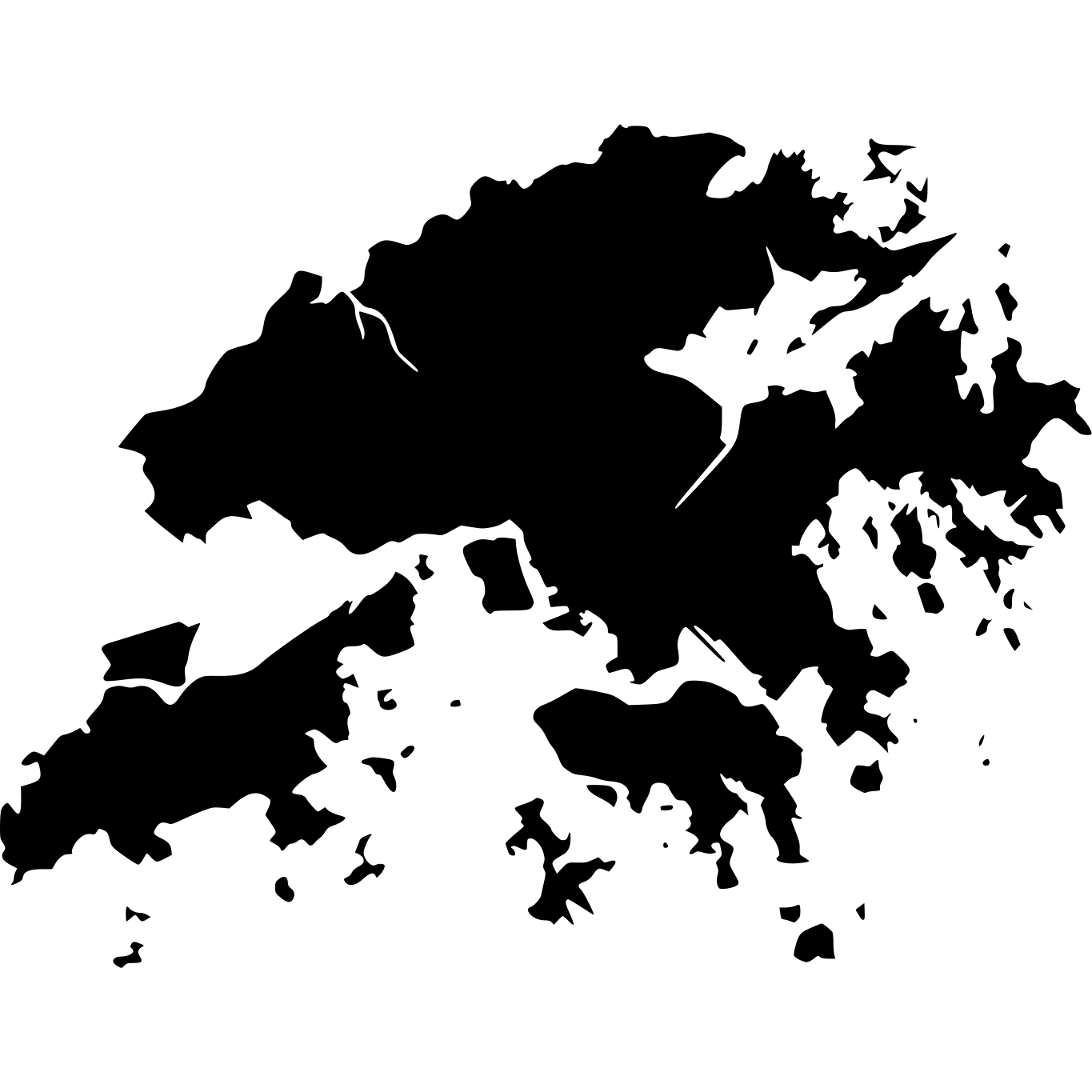
Anai Rui is a Hong Kongese brand
Often compared with

We're dedicated to providing you with the most up-to-date and science-backed ingredient info out there.
The data we've presented on this page has been verified by a member of the SkinSort Team.
Read more about us· Updated March 24, 2026 • Added by julianjc


