Dua Bright+ Radiance Renewal Serum
A serum with 13 ingredients, including tranexamic acid and arbutin.
This brightening serum is formulated around Tranexamic Acid and Arbutin to fade the look of dark spots and brighten dull-looking skin.
We independently verify ingredients, backed by peer-reviewed research. Suggest an update.
What's inside
Ingredients List
Water
Skin ConditioningSaccharide Isomerate
Humectant


Tranexamic Acid
Astringent



Glycerin
Humectant
Arbutin
Antioxidant

Glycyrrhiza Glabra Root Extract
Bleaching
Calendula Officinalis Extract
Skin Conditioning
Phenoxyethanol
Preservative
Sodium Polyacrylate Starch
AbsorbentSparassis Crispa Extract
Emulsion StabilisingBeta-Glucan
Skin Conditioning
Ethylhexylglycerin
Skin ConditioningStreptococcus Thermophilus Ferment
Humectant

Key Ingredients
Benefits
Ingredients Explained
Water. It's the most common cosmetic ingredient of all. You'll usually see it at the top of ingredient lists, meaning that it makes up the largest part of the product.
So why is it so popular? Water most often acts as a solvent - this means that it helps dissolve other ingredients into the formulation.
You'll also recognize water as that liquid we all need to stay alive. If you see this, drink a glass of water. Remember to stay hydrated!
Learn more about WaterSaccharide Isomerate comes from sugars found in corn. It is a skin hydrator.
The structure of this ingredient can be altered to be more similar to the carbohydrates found in our skin. This ability to mimic our skin gives it hydrating properties.
Specifically, saccharide Isomerate is a humectant. Humectants draw moisture from the air to our skin.
Research shows Saccharide Isomerate to be an effective moisturizer.
Learn more about Saccharide IsomerateTranexamic Acid (TXA) is a synthetic lysine derivative that is becoming one of the most exciting brightening ingredients in skincare.
Originally used in medicine as an anti-hemorrhagic agent, its skin brightening potential was discovered by accident; patients taking it orally started noticing their melasma was fading.
Unlike most brighteners that target tyrosinase (the enzyme that synthesizes melanin), TXA works further upstream. It basically blocks your cells from receiving the signal to produce pigment.
This makes it one of the rare actives that works on three pathways at once:
This makes it effective for treating melasma, post-inflammatory hyperpigmentation (PIH), and sun-induced dark spots.
The most effective cosmetic concentration sits between 2-5% and going higher doesn't boost results.
Side effects are generally mild; occasional irritation, flaking, or dryness have been reported at the start of use. Overall, this ingredient is pretty well tolerated, even by sensitive skin types.
Another perk of this ingredient is that it does not cause photosensitivity, so it's safe to use in the AM and PM.
Learn more about Tranexamic AcidGlycerin (or glycerol) is a compound naturally found in your skin. It's a powerhouse humectant that pulls water into the stratum corneum.
Topically, glycerin does several things at once:
Your skin makes glycerin on its own (mostly from sebaceous oil breakdown) and shuttles it to your outermost layer of skin, or your epidermis, via aquaporin-3.
Aquaporin-3 is a transporter that is essential for normal skin hydration, elasticity, and repair. Interestingly, mice lacking in AQP3 have dry and less elastic skin that can be fully corrected with glycerin.
This ingredient is non-irritating, plays well with almost every ingredient, and works across all skin types. Typical use is anywhere between 3-10% but can go up to 79% in some leave-on products.
Just know very high concentrations (>40%) can feel tacky in low humidity.
Glycerin is the name for this ingredient in American English. British English uses Glycerol/Glycerine.
Learn more about GlycerinArbutin is a naturally occurring molecule (found in bearberry, cranberry, and blueberry) that is used in skincare as a gentle brightening agent to fade dark spots, melasma, and post-inflammatory hyperpigmentation.
Chemically, it is a sugar-bound form of hydroquinone.
It works mainly by inhibiting tyrosinase, the enzyme your skin uses to make melanin. This means less new pigment gets produced over time.
There are two forms you'll see on labels: beta-arbutin (listed as just "Arbutin") and alpha-arbutin (the more stable and effective of the two).
The evidence behind this is solid: it's less cytotoxic to melanocytes than hydroquinone and comparably effective with kojic acid for hyperpigmentation.
One human study using a 10% solution reduced UVR-induced hyperpigmentation by 43.5% (jumping to 63.3% when paired with aloesin).
More recent clinical work backs it up too; a 2025 study on a 5% alpha-arbutin + 2% kojic acid cream found it comparable to triple combination prescription formulas but with lower recurrence for melasma.
Typical usage in cosmetics serums land in the 1-2% range.
It's a well-tolerated, non-irritating, and non-photoreactive ingredient that also gives some antioxidant benefits too.
Learn more about ArbutinGlycyrrhiza Glabra Root Extract is an extract of the roots of Licorice. It has been found to have several benefits such as skin hydrating, conditioning, and soothing.
One component, glabridin, has extra potent antioxidant and soothing properties. It has also been found to block pigmentation from UVB rays in guinea pigs.
Licorice Root also contains a flavonoid. Flavonoids are a natural substance from in plants. Flavonoids also have antioxidant properties.
Another component, glycyrrhizin, has been found to have anti-inflammatory and antimicrobial benefits. This may make licorice root extract effective at treating acne. However, more research is needed to support this.
Liquiritin is one of the flavone compounds found in licorice. It has been found to help lighten skin by preventing tyrosinase from reacting with tyrosine. When the two react, protein is converted to melanin. Melanin is the substance in your body that gives your features pigmentation.
Learn more about Glycyrrhiza Glabra Root ExtractCalendula Officinalis Extract comes from the common Marigold plant.
Marigold flowers contain flavonoids. Flavonoids are a group of substances found naturally in plants. They possess antioxidant and inflammation properties.
This ingredient may help soothe your skin by reducing inflammation. Emerging studies show it inhibits nitrous oxide production safely, therefore reducing inflammation.
Marigolds have been used in traditional medicine throughout Asia and Europe.
Learn more about Calendula Officinalis ExtractPhenoxyethanol is one of the most widely used preservatives in skincare (and for good reason!).
It has a large spectrum of antimicrobial activity and especially effective bacteria, yeast, and mold while only having a weak effect on your skin's natural microbiome.
On a cellular level, it disrupts the cell membranes of microbes by poking holes that make the cell leak. This shuts down the chemical reactions the microbe needs to make energy so it can no longer survive.
Another perk of this ingredient is that it stays functional across a wide pH range (3-10).
You'll often see it paired with boosters like Ethylhexylglycerin; one study showed that a 1:9 ratio of Ethylhexylglycerin to Phenoxyethanol damages bacterial membranes as effectively as doubling the Phenoxyethanol concentration on its own.
Typical use concentrations range from 0.3-1% depending on the formula, and this ingredient is capped at 1% int the EU.
Safety-wise, the fear mongering does not hold up to the evidence. The EU's Scientific Committee on Consumer Safety and FDA consider it safe as a preservative at up to 1%, including for children of all ages.
Adverse systemic effects only showed up in animal studies at exposures roughly 200x higher than what people get from cosmetics. And despite its very widespread use, this ingredient is a rare sensitizer and allergic reactions are uncommon.
Learn more about PhenoxyethanolWe don't have a description for Sodium Polyacrylate Starch yet.
We don't have a description for Sparassis Crispa Extract yet.
Beta-Glucan is a soluble polysaccharide (a chain of glucose sugars) sourced from the cells walls of oats, baker's yeast, mushrooms, and seaweed.
It's a rare ingredient that pulls double-duty as a heavy-duty hydrator and skin-soothing repair agent.
On the surface, it acts as a humectant that holds water in place and reduces moisture loss for a plumper, smoother feel, while its anti-inflammatory and antioxidant properties make it a great pick for calming redness or sensitive skin
The more interesting story is underneath:
Despite its large molecular size, oat beta-glucan has been shown to penetrate the epidermis and reach the dermis by slipping between skin cells. Here, it interacts with fibroblasts and macrophages to nudge collagen synthesis and support wound repair.
A small 2005 split-face clinical study of 27 subjects found topical beta-glucan produced measurable reductions in wrinkle depth, height, and roughness after 8 weeks of use.
It is worth noting the trial was small and the penetration testing used frozen, irradiated skin so the anti-aging data is encouraging rather than definitive.
This ingredient gets along with pretty much everything and is typically used around 0.1-1%.
Fungal acne: This ingredient is not a food source for the Malassezia yeast because it is a glucose polysaccharide with no fatty acid or ester component.
Learn more about Beta-GlucanEthylhexylglycerin is created from glycerin. It is a multitasker ingredient that:
The CIR Expert Panel found minimal skin absorption or sensitization of any kind in a safety assessment. Though this ingredient is considered well-tolerated, a small number of cases of allergic dermatitis have been published since 2002. Just be sure to patch test if you are unsure.
Industry-reported use ranges from 8% in rinse-off products and 2% in leave-on formulations.
Learn more about EthylhexylglycerinStreptococcus Thermophilus Ferment is created by fermenting Streptococcus thermophilus, the same lactic acid bacteria used to make yogurt. It has humectant and skin conditioning properties.
A study from 2003 found that applying a cream containing this ingredient to human skin significantly increased ceramide levels in the stratum corneum in just 7 days. This result applied to both healthy volunteers and those with atopic dermatitis.
Ceramides are the lipids that hold your skin barrier together so they play a role in moisture retention and contribute to a stronger barrier.
The cream also improved scaling and itchiness for the group with atopic dermatitis.
How does Streptococcus Thermophilus Ferment work? Your skin naturally contains a fatty substance called sphingomyelin. S. thermophilus comes packed with enzymes that snip the sphingomyelin apart and turn it into ceramides.
So it's not adding ceramides from the outside but helping your skin make more of its own.
On top of that, a 2022 lab study found that S. thermophilus extract could calm down the overactive scarring process in skin cells. It tells cells to chill out instead of producing excess scar tissue. There's also some early stage research that hints at possible wound healing perks as well.
Last but not least, the type of ceramides that S. thermophilus creates (phytosphingosine), also happens to fight the bacteria that causes breakouts.
This ingredient may not be fungal acne safe, but not everyone will react to it.
This is because your skin contains ceramidases that break ceramides down into their components (free sphingosines and fatty acids) which can theoretically be used by Malassezia.
If this ferment can drive ceramide synthesis via sphingomyelin hydrolysis, it could generate the substrate that ceramidases could convert to Malassezia-available fatty acids.
Learn more about Streptococcus Thermophilus FermentReviews
No written reviews yet. Be the first to review this product.
Recent searches
Search reviews by skin type, ingredient, or keyword.
Where it's from
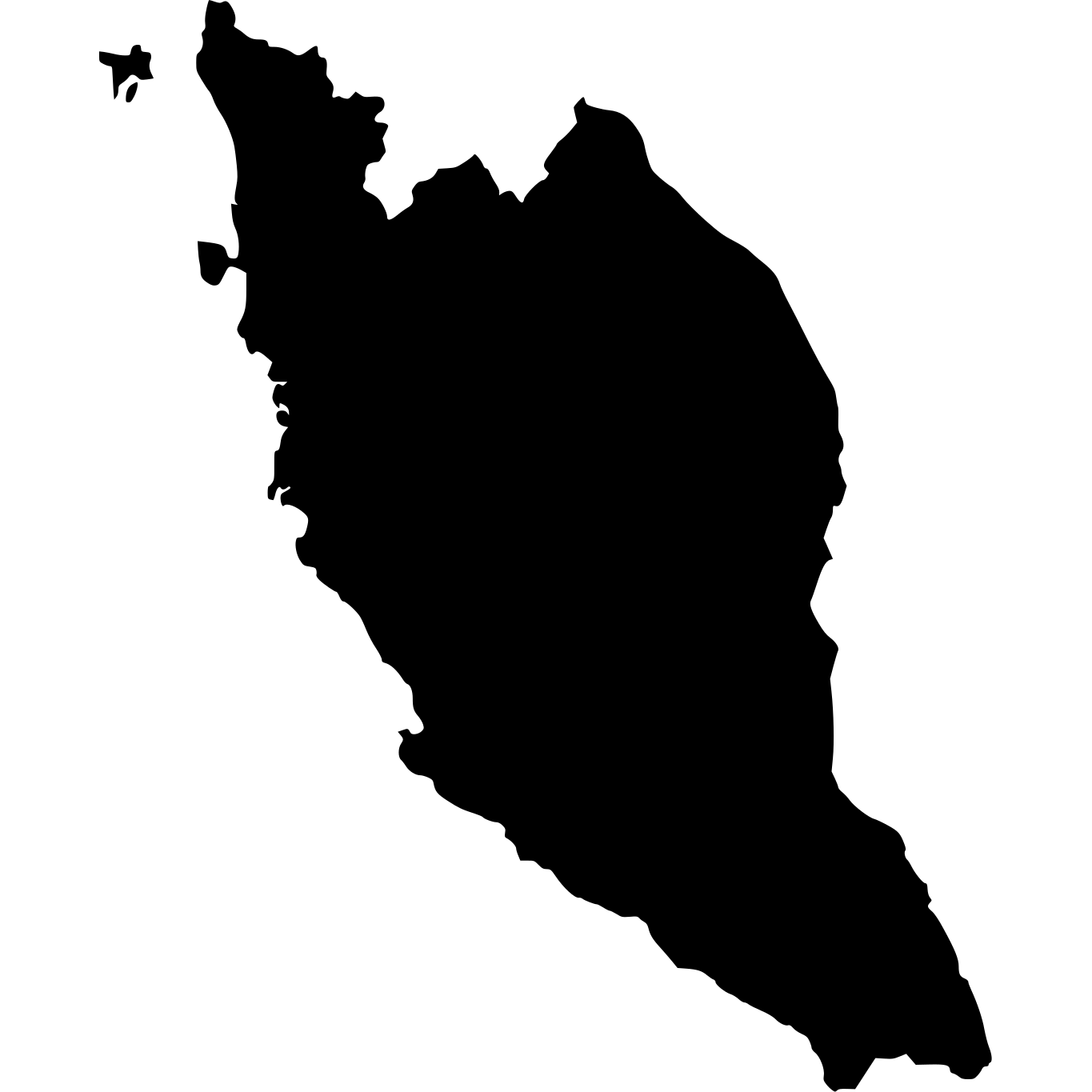
Dua is a Malaysian brand
Often compared with

We're dedicated to providing you with the most up-to-date and science-backed ingredient info out there.
The data we've presented on this page has been verified by a member of the SkinSort Team.
Read more about us· Updated October 6, 2025 • Added by afiqahahmadfirdaus


