DemoSkin Лосьйон для обличчя й повік (Face And Eyelid Lotion)
A toner with 12 ingredients.
This calming toner is formulated around Aloe Barbadensis Leaf Extract and Panthenol to calm redness and hydrate skin.
We independently verify ingredients, backed by peer-reviewed research. Suggest an update.
What's inside











Benefits
Concerns
Ingredients Explained
Water. It's the most common cosmetic ingredient of all. You'll usually see it at the top of ingredient lists, meaning that it makes up the largest part of the product.
So why is it so popular? Water most often acts as a solvent - this means that it helps dissolve other ingredients into the formulation.
You'll also recognize water as that liquid we all need to stay alive. If you see this, drink a glass of water. Remember to stay hydrated!
Learn more about WaterAloe Barbadensis Leaf Extract is a botanical extract pulled from the leaves of aloe vera and one of the most studied plant ingredients in cosmetics.
The inner leaf gel it comes from is mostly water (~99-99.5%) and the remaining fraction is made up of pretty good stuff: polysaccharides, vitamins, phenolics, and enzymes.
Its headline job is hydration.
The star polysaccharide in aloe, acemannan, is a humectant that retains moisture and helps reduce trans-epidermal water loss.
Aloe also has real soothing credentials; it contains anti-inflammatory compounds like bradykinase and C-glucosyl chromone that help calm irritation and redness.
On the repair side, lab work shows that acemannan wakes up your skin's repair cells (fibroblasts), prompting them to multiply and speed up healing.
There's some human data for cosmetic benefit too: a cream containing 10% Aloe Barbadensis leaf extract improved skin hydration and elasticity in a real-use study.
Safety-wise, this ingredient is well-regarded with just one rare downside; there have been some case reports of acute eczema, contact urticaria, and dermatitis in people who applied aloe-derived ingredients topically. Those with a known aloe or Liliaceae sensitivity should patch test.
Typical use levels range widely, from under 1% up to 90%+ depending on the format and the effect you are after.
Learn more about Aloe Barbadensis Leaf ExtractCalendula Officinalis Extract comes from the common Marigold plant.
Marigold flowers contain flavonoids. Flavonoids are a group of substances found naturally in plants. They possess antioxidant and inflammation properties.
This ingredient may help soothe your skin by reducing inflammation. Emerging studies show it inhibits nitrous oxide production safely, therefore reducing inflammation.
Marigolds have been used in traditional medicine throughout Asia and Europe.
Learn more about Calendula Officinalis ExtractThis ingredient comes from the Chamomile flower.
Chamomile is rich in antioxidants and has anti-inflammatory properties. Several compounds found in chamomile help with soothing, such as bisbolol.
Antioxidant components in chamomile help fight free-radical molecules. These unstable molecules may damage your skin cells. By stabilizing them, antioxidants may help reduce the signs of aging.
Ancient Greeks, Romans, and Egyptians used Chamomile to treat skin redness and dryness. Chamomile has also been used to help with stomach issues.
Learn more about Chamomilla Recutita ExtractPanthenol is a common ingredient that helps hydrate and soothe the skin. It is found naturally in our skin and hair.
There are two forms of panthenol: D and L.
D-panthenol is also known as dexpanthenol. Most cosmetics use dexpanthenol or a mixture of D and L-panthenol.
Panthenol is famous due to its ability to go deeper into the skin's layers. Using this ingredient has numerous pros (and no cons):
Like hyaluronic acid, panthenol is a humectant. Humectants are able to bind and hold large amounts of water to keep skin hydrated.
This ingredient works well for wound healing. It works by increasing tissue in the wound and helps close open wounds.
Once oxidized, panthenol converts to pantothenic acid. Panthothenic acid is found in all living cells.
This ingredient is also referred to as pro-vitamin B5.
Learn more about PanthenolPropylene Glycol is a synthetic, colorless, odorless liquid that has been a staple in cosmetics for decades. It is a skin conditioning agent, humectant, and solvent.
As a humectant, it draw water to the skin to reduce flaking and restore suppleness. It's also a solvent that helps dissolve other actives and keeps formulas stable across temperature changes.
The CIR Expert Panel has confirmed this ingredient to be nontoxic and clinical studies show no sensitization at cosmetic use concentrations.
True allergic reactions are quite rare: a 15-year retrospective study of 6,751 patients found only 0.31% had a positive reaction (and less than half were considered clinically relevant).
It seemed that when sensitization does occur, it's most commonly linked to topical medication (like corticosteroids) and not cosmetics. Allergic contact dermatitis also appears largely limited to individuals with underlying skin conditions.
Overall, propylene glycol is a well-studied ingredient that most people can tolerate without issue.
Learn more about Propylene GlycolDiazolidinyl Urea is an antimicrobial preservative. It is commonly used to prevent bacterial, yeast, and mold growth.
Diazolidinyl Urea slowly breaks down into formaldehyde, an effective microbe killer but also a known allergen/carcinogen.
Some people who are allergic to imidazolidinyl urea also react to diazolidinyl urea. It ranked as the 14th most common allergen in patch tests from 2005–06.
Safety reviews show that at concentrations under 0.5%, the formaldehyde released remains below the accepted safety limit, making it considered safe for cosmetic use.
Ultimately, its safety depends on individual skin sensitivity and personal comfort with formaldehyde-releasing preservatives.
Learn more about Diazolidinyl UreaMethylparaben is a synthetic preservative and one of the most widely used in the world. It has a simple, but important job: prevent your products from going bad by stopping bacteria, yeast, and mold from growing.
Typical use levels are low, often 0.1-0.3%.
This is also one of the most heavily studied preservatives out there and major regulatory bodies have repeatedly given it the green light.
In 2023, the EU's Scientific Committee on Consumer Safety (SCCS) confirmed that this ingredient is safe up to 0.4% on its own, of up to 0.8% when mixed with other paraben esters.
Here's the science behind the noise behind parabens/hormones as well:
Methylparaben shows very weak estrogen-like activity in vitro tests (more than 1,000x weaker than your body's own estradiol). In vivo (live-organism) studies don't support a meaningful endocrine-disrupting effect either.
You get a stronger estrogenic effect from eating tofu, actually.
It's also a low sensitizer and allergic reactions are uncommon; they usually happen on damage or broken skin.
There is a caveat: France has proposed to formally re-examine its endocrine classification in 2025 so the regulatory conversation isn't fully closed as of yet.
But as it stands today, this ingredient is considered safe at permitted levels.
Learn more about MethylparabenPropylparaben is a preservative and one of the most widely used members of the paraben family (it's been used in cosmetics for over a century now).
It works by disrupting microbial cell membranes and enzymes, and is a broad-spectrum protector that works exceptionally well against molds, yeasts, and gram-positive bacteria.
You'll likely see it paired with methylparaben to cover the full range (including gram-negative bacteria).
This ingredient is effective at low concentrations (~0.2-0.5%) and stable across a wide pH range (4.5-7.5 pH). It's effectiveness drops off above pH 8 and it can lose potency when combined with non-ionic surfactants like polysorbate 80 due to micellization.
The regulatory bodies have concluded this ingredient to be safe as used in cosmetics. The EU has capped it at 0.14% and combined parabens are not to exceed 0.8%.
While parabens do cross the stratum corneum, only about 1% remains for absorption into the body. This is because most of it is metabolized within living skin.
Learn more about PropylparabenAllantoin is a soothing ingredient known for its protective and moisturizing properties; it's basically a quiet workhorse ingredient you can find in a huge range of cosmetics.
Though it can be derived from the comfrey plant, allantoin is produced synthetically for cosmetic products to ensure purity.
Research shows it can encourage your skin cells to turn over and renew by stimulating keratinocyte and fibroblast proliferation.
It also has mild keratolytic properties to help loosen and shed dead skin cells without being harsh.
Studies also suggest allantoin can help calm inflammation by dialing down some of the chemical signals your skin sends out when it is irritated.
This ingredient is typically used in the 0.1-0.5% range, and the FDA recognizes it as a skin protectant in OTC products up to 2%.
Overall, allantoin is a wonderful addition to most routines; it is stable across a wide pH range (~4-8), works well with other ingredients, and is considered non-sensitizing/non-irritating.
Fun fact: Allantoin is naturally occurring in comfrey root, beets, chamomile, and wheat sprouts. Our bodies even produce it as a byproduct of uric acid metabolism.
Learn more about AllantoinCiclopirox is not an INCI ingredient; it is a medication used to treat fungus and can be used for treating seborrheic dermatitis.
We recommend speaking with a medical professional about using this ingredient.
We don't have a description for Silver Citrate yet.
Reviews
No written reviews yet. Be the first to review this product.
Recent searches
Search reviews by skin type, ingredient, or keyword.
Where it's from
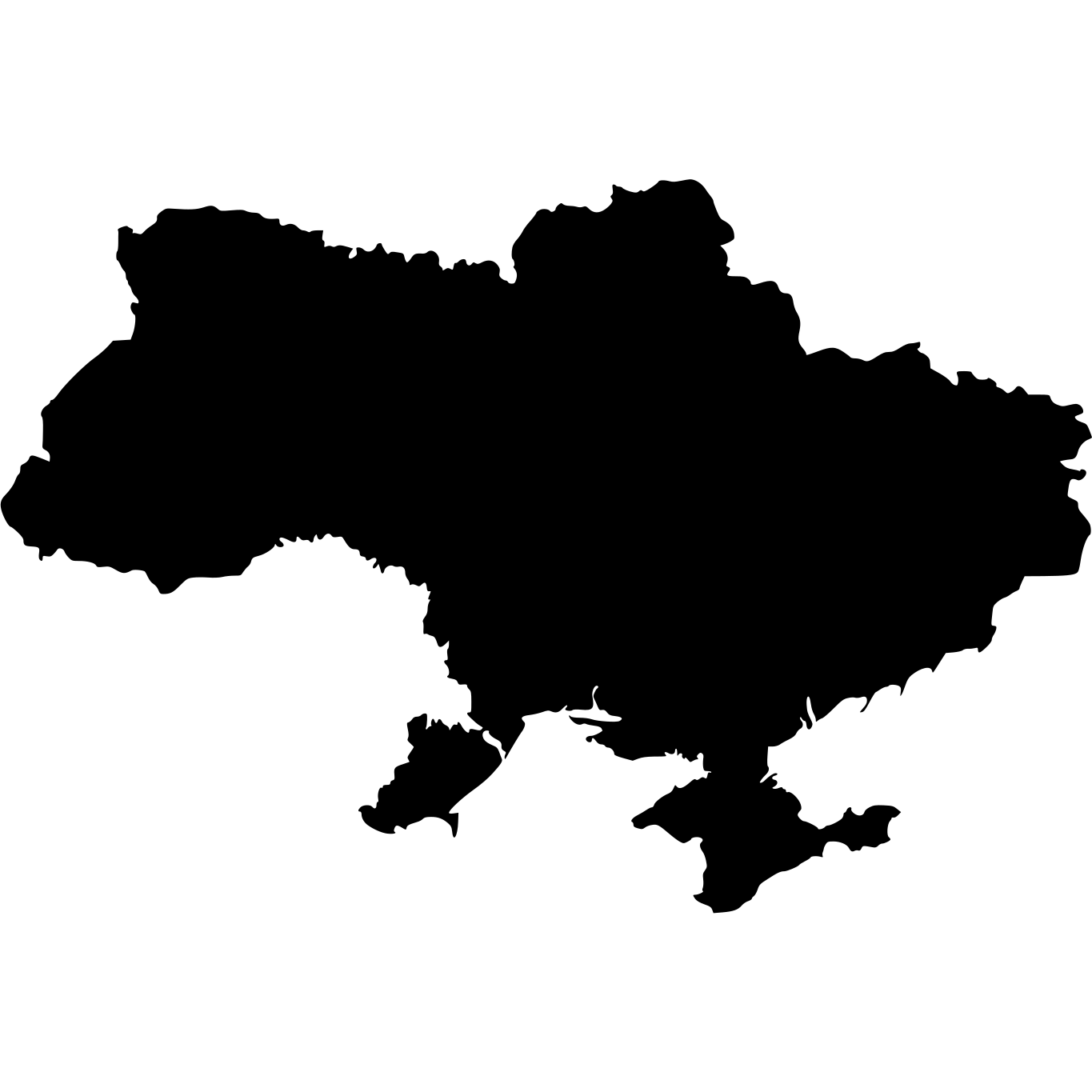
DemoSkin is a Ukrainian brand

We're dedicated to providing you with the most up-to-date and science-backed ingredient info out there.
The data we've presented on this page has been verified by a member of the SkinSort Team.
Read more about us· Updated December 22, 2025 • Added by vt3


