Jamjoom Pharma HiQuin 4%
A prescription with 11 ingredients.
Prescription with 11 ingredients
We independently verify ingredients, backed by peer-reviewed research. Suggest an update.
What's inside
Ingredients List
Hydroquinone 4%
Stabilising

Paraffinum Liquidum
Emollient


Methylparaben
Preservative



PEG-40 Stearate
Emulsifying
Propylene Glycol
Humectant




Active Ingredients:
Hydroquinone 4%
Inactive Ingredients:
Paraffinum Liquidum, Methylparaben, PEG-40 Stearate, Propylene Glycol, Propylparaben, Sodium Lauryl Sulfate, Sodium Metabisulfite, Stearic Acid, Stearyl Alcohol, Water
Key Ingredients
Benefits
Concerns
Ingredients Explained
Hydroquinone is a classic ingredient dermatologists use to fade dark spots (things like melasma, acne marks, sun spots, and freckles).
It works in two ways:
1. By blocking an enzyme called tyrosinase; your skin uses this to make melanin, or the pigment that causes dark spots.
2. By interfering with the pigment making cells themselves so less pigment shows up over time
Just know this ingredient fades spots near the surface of skin and not the deeper ones. It's usually used at 2-4% / twice a day for 3 months, and ALWAYS with sunscreen.
This ingredient is usually well tolerated with short-term use under medical guidance. But possible reactions include irritation, contact dermatitis, and lightening of the skin around the spot you're treating.
You might hear hydroquinone called "cancer-causing". That concern comes from studies where rats were fed high oral doses; no skin cancer cases have been linked to it after more than 50 years of people putting it on their skin.
Long-term, high-strength, and unsupervised use can lead to a condition called ochronosis. This is where the skin turns blue-grey color and sometimes causes nails to turn dark as well.
The rules around it vary by country.
The EU bans it in regular cosmetics and it is prescription only in the US, EU, Japan, Canada, and Australia. Anything you see on the shelf without a prescription is technically not allowed.
Check out the European alternative to hydroquinone here.
SkinSort would like to remind friends from around the world that all skin tones are beautiful!
Learn more about HydroquinoneParaffinum Liquidum is a highly-refined cosmetic-grade mineral oil. It is also known as liquid paraffin.
Despite its controversial reputation, the science is pretty clear: it's one of the most well-studied and effective moisturizing ingredients out there.
As an occlusive, it forms a protective layer on the skin that locks in moisture and prevents transepidermal water loss (TEWL). This makes it especially great for compromised skin barriers.
The "it clogs your pores" myth has been around for decades; a study found that industrial-grade mineral oil may be comedogenic but cosmetic-grade mineral oil is not (these two are very, very different).
A 2017 review concluded that cosmetic use of mineral oils and waxes does not present a risk to consumers due to absorption.
Mineral oil got a bad rap from the old rabbit ear studies. When tested on actual human skin, cosmetic-grade mineral oil showed no comedogenic activity. The rating of 0 is a correction of outdated science.
Mineral oil is an inert substance with no fatty acids so there's nothing to feed Malassezia. This ingredient is fungal acne safe.
Learn more about Paraffinum LiquidumMethylparaben is a synthetic preservative and one of the most widely used in the world. It has a simple, but important job: prevent your products from going bad by stopping bacteria, yeast, and mold from growing.
Typical use levels are low, often 0.1-0.3%.
This is also one of the most heavily studied preservatives out there and major regulatory bodies have repeatedly given it the green light.
In 2023, the EU's Scientific Committee on Consumer Safety (SCCS) confirmed that this ingredient is safe up to 0.4% on its own, of up to 0.8% when mixed with other paraben esters.
Here's the science behind the noise behind parabens/hormones as well:
Methylparaben shows very weak estrogen-like activity in vitro tests (more than 1,000x weaker than your body's own estradiol). In vivo (live-organism) studies don't support a meaningful endocrine-disrupting effect either.
You get a stronger estrogenic effect from eating tofu, actually.
It's also a low sensitizer and allergic reactions are uncommon; they usually happen on damage or broken skin.
There is a caveat: France has proposed to formally re-examine its endocrine classification in 2025 so the regulatory conversation isn't fully closed as of yet.
But as it stands today, this ingredient is considered safe at permitted levels.
Learn more about MethylparabenPEG-40 Stearate is a nonionic emulsifier and surfactant made from stearic acid.
It's water-soluble and good at coaxing oil + water to mix to keep everything stable.
The CIR Expert Panel has repeatedly concluded this ingredient to be safe at current cosmetic use levels with minimal skin/eye irritation when tested at 100%.
Your skincare also won't be containing 100% of this ingredient: the supplier recommends using 1-5% in a formula.
Broader reviews back this up: PEGs and their fatty-acid esters produce little or no skin/eye irritation, don't readily penetract intact skin, and rarely cause sensitization.
Because this ingredient is a PEG ester of stearic acid, it may not be fungal acne, or Malassezia, safe. Stearic acid (C18) sits in the C11-24 "edible window" that Malassezia lipases can cleave and metabolize.
Learn more about PEG-40 StearatePropylene Glycol is a synthetic, colorless, odorless liquid that has been a staple in cosmetics for decades. It is a skin conditioning agent, humectant, and solvent.
As a humectant, it draw water to the skin to reduce flaking and restore suppleness. It's also a solvent that helps dissolve other actives and keeps formulas stable across temperature changes.
The CIR Expert Panel has confirmed this ingredient to be nontoxic and clinical studies show no sensitization at cosmetic use concentrations.
True allergic reactions are quite rare: a 15-year retrospective study of 6,751 patients found only 0.31% had a positive reaction (and less than half were considered clinically relevant).
It seemed that when sensitization does occur, it's most commonly linked to topical medication (like corticosteroids) and not cosmetics. Allergic contact dermatitis also appears largely limited to individuals with underlying skin conditions.
Overall, propylene glycol is a well-studied ingredient that most people can tolerate without issue.
Learn more about Propylene GlycolPropylparaben is a preservative and one of the most widely used members of the paraben family (it's been used in cosmetics for over a century now).
It works by disrupting microbial cell membranes and enzymes, and is a broad-spectrum protector that works exceptionally well against molds, yeasts, and gram-positive bacteria.
You'll likely see it paired with methylparaben to cover the full range (including gram-negative bacteria).
This ingredient is effective at low concentrations (~0.2-0.5%) and stable across a wide pH range (4.5-7.5 pH). It's effectiveness drops off above pH 8 and it can lose potency when combined with non-ionic surfactants like polysorbate 80 due to micellization.
The regulatory bodies have concluded this ingredient to be safe as used in cosmetics. The EU has capped it at 0.14% and combined parabens are not to exceed 0.8%.
While parabens do cross the stratum corneum, only about 1% remains for absorption into the body. This is because most of it is metabolized within living skin.
Learn more about PropylparabenSodium Lauryl Sulfate (SLS) is a surfactant, cleansing agent, and foaming agent. You'll find it in a wide range of products from shampoos to face cleansers.
SLS has two main roles:
The Cosmetic Ingredient Review Panel has assessed it in 1983, 2002, and 2005 and found it to be safe in formulations at low concentrations.
SLS is a well-documented skin irritant at higher concentrations or with prolonged exposure. It's actually the gold standard positive control used in dermatological patch testing, meaning doctors use it because they know it will cause a reaction in people.
In one large study of 43,000 patiences tested with 0.25% SLS, about 22% showed some level of reactivity. It increases transepidermal water loss that disrupts your outermost layer of skin.
Face cleansers often pair this ingredient with mild co-surfactants like Cocamidopropyl Betaine to buffer its harshness.
Just so you know, SLS does not trigger true allergic contact dermatitis. This just means it can irritate your skin but doesn't cause your immune system to develop a lasting allergy to it.
Despite internet rumors, SLS is not considered a carcinogen by any major regulatory body.
Learn more about Sodium Lauryl SulfateSodium metabisulfite is also known as Sodium Pyrosulfite. It is a preservative, antioxidant, and disinfectant.
As a preservative, it helps stabilize cosmetic formulas without affecting their color or scent.
Stearic Acid is a fatty acid that is already found in your skin. It's one of the free fatty acids that works alongside ceramides and cholesterols to maintain your barrier.
In cosmetics, it is a multitasker:
Safety-wise, the CIR Expert Panel has concluded it to be safe in cosmetics when formulated to be non-irritating and non-sensitizing.
Free stearic acid is a C18 fatty acid that the Malassezia yeast can substrate, so this ingredient may not be fungal acne safe.
This ingredient does have a comedogenic rating of 2-3, but this doesn't mean a formula with this ingredient will clog pores.
Human testing has proved that any finished product with this ingredient won't automatically make you break out; it really comes down to concentration, formula, and your skin.
Learn more about Stearic AcidStearyl Alcohol is a type of fatty alcohol from stearic acid. It is a white, waxy compound used to emulsify ingredients used as an emollient or to thicken a product.
Emollients help soothe and hydrate the skin by trapping moisture.
Fatty alcohols are usually derived from natural fats and oils and therefore do not have the same drying or irritating effect as solvent (ethanol) alcohols.
The FDA allows products labeled "alcohol-free" to have fatty alcohols.
This ingredient may not be fungal acne safe. It is a primary fatty alcohol with a chain length above 12 carbons. A study from 2019 show Malassezia can feed on fatty alcohols in this range, so it may trigger fungal acne in those prone to it.
Learn more about Stearyl AlcoholWater. It's the most common cosmetic ingredient of all. You'll usually see it at the top of ingredient lists, meaning that it makes up the largest part of the product.
So why is it so popular? Water most often acts as a solvent - this means that it helps dissolve other ingredients into the formulation.
You'll also recognize water as that liquid we all need to stay alive. If you see this, drink a glass of water. Remember to stay hydrated!
Learn more about WaterReviews
No written reviews yet. Be the first to review this product.
Recent searches
Search reviews by skin type, ingredient, or keyword.
Where it's from
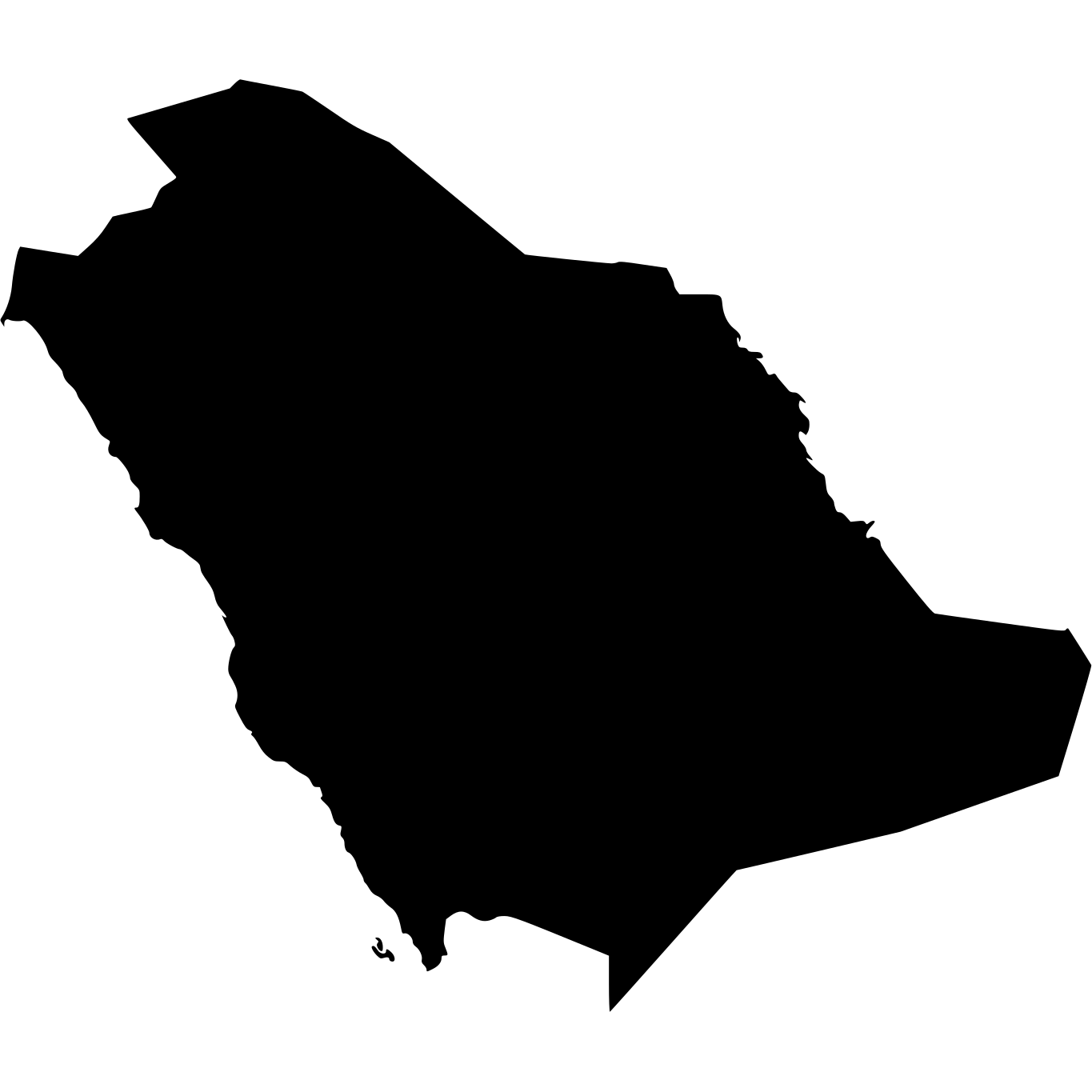
Jamjoom Pharma is a Saudi Arabian brand
Often compared with

We're dedicated to providing you with the most up-to-date and science-backed ingredient info out there.
The data we've presented on this page has been verified by a member of the SkinSort Team.
Read more about us· Updated December 10, 2024 • Added by sidimhamedvall
Brands reformulate often, so always check the packaging before use. SkinSort is for reference only, not medical advice. Talk to a doctor or pharmacist about any skin or health concerns.


