Beauty Glazed Stereo Contour Sculpt Liquid Concealer
Contour with 17 ingredients
We independently verify ingredients, backed by peer-reviewed research. Suggest an update.
What's inside
Ingredients List
Water
Skin ConditioningCyclopentasiloxane
Emollient
Propylene Glycol
Humectant


Cyclohexasiloxane
Emollient
Synthetic Fluorphlogopite
Isododecane
EmollientCetyl PEG/PPG-10/1 Dimethicone
Emulsifying
Polyglyceryl-3 Diisostearate
Emulsifying


Magnesium Sulfate
Disteardimonium Hectorite
StabilisingAroma


Diazolidinyl Urea
Preservative

Iodopropynyl Butylcarbamate
Preservative
CI 77492
Cosmetic ColorantCI 77499
Cosmetic ColorantCI 77491
Cosmetic ColorantCI 77891
Cosmetic ColorantWater, Cyclopentasiloxane, Propylene Glycol, Cyclohexasiloxane, Synthetic Fluorphlogopite, Isododecane, Cetyl PEG/PPG-10/1 Dimethicone, Polyglyceryl-3 Diisostearate, Magnesium Sulfate, Disteardimonium Hectorite, Aroma, Diazolidinyl Urea, Iodopropynyl Butylcarbamate, CI 77492, CI 77499, CI 77491, CI 77891
Benefits
Concerns
Ingredients Explained
Water. It's the most common cosmetic ingredient of all. You'll usually see it at the top of ingredient lists, meaning that it makes up the largest part of the product.
So why is it so popular? Water most often acts as a solvent - this means that it helps dissolve other ingredients into the formulation.
You'll also recognize water as that liquid we all need to stay alive. If you see this, drink a glass of water. Remember to stay hydrated!
Learn more about WaterCyclopentasiloxane (D5) is a lightweight silicone that mostly acts as an emollient and solvent in cosmetics. Its the reason your products feel silky, fast-spreading, and non-greasy.
Since D5 is volatile, it does its thing and then evaporates off the skin quickly.
The safety profile of this ingredient is reassuring; the US CIR Expert Panel concluded D5 is safe as used in cosmetics and Health Canada concluded that D5 is not harmful to human health or the environment as currently used in cosmetics
There's a study that people mention about D5 in a rat study showing tumors. This study is related to long-term inhalation of high D5 levels.
Regulatory bodies have judged this study to be not applicable in topical skincare since skin absorption of D5 is very low and we're not really inhaling huge amounts of D5.
The only restriction for this ingredient is environmental. The European Chemicals Agency (ECHA) restricted D5 in wash-off cosmetics at or above 0.1% due to their persistence in water.
Learn more about CyclopentasiloxanePropylene Glycol is a synthetic, colorless, odorless liquid that has been a staple in cosmetics for decades. It is a skin conditioning agent, humectant, and solvent.
As a humectant, it draw water to the skin to reduce flaking and restore suppleness. It's also a solvent that helps dissolve other actives and keeps formulas stable across temperature changes.
The CIR Expert Panel has confirmed this ingredient to be nontoxic and clinical studies show no sensitization at cosmetic use concentrations.
True allergic reactions are quite rare: a 15-year retrospective study of 6,751 patients found only 0.31% had a positive reaction (and less than half were considered clinically relevant).
It seemed that when sensitization does occur, it's most commonly linked to topical medication (like corticosteroids) and not cosmetics. Allergic contact dermatitis also appears largely limited to individuals with underlying skin conditions.
Overall, propylene glycol is a well-studied ingredient that most people can tolerate without issue.
Learn more about Propylene GlycolCyclohexasiloxane is a type of silicone more commonly known as D6. It is an emollient and solvent.
Cyclohexasiloxane is used to evenly distribute ingredients throughout the product. When applied to the skin, Cyclohexasiloxane evaporates and leaves behind a silky feel.
As an emollient, it can help the skin feel soft and hydrated. It is also used to reduce frizz in hair products.
Learn more about CyclohexasiloxaneSynthetic Fluorphlogopite is the synthethic version of mica. It consists of fluorine, aluminum and silicate.
Synthetic Fluorphlogopite is used to add volume to products.
It is considered non-irritating on the skin.
Learn more about Synthetic FluorphlogopiteIsododecane is a fragrance, emollient, and solvent.
As an emollient, it helps your skin stay soft and hydrated. Emollients help trap moisture into your skin.
Isododecane's role as a solvent makes it a great texture enhancer. It spreads smoothly on skin and does not leave a sticky feeling behind. Isododecane also helps prevent color transfer in makeup products.
Isododecane is not absorbed into skin.
The chemical name for this ingredient is 2,2,4,6,6-PENTAMETHYLHEPTANE.
Learn more about IsododecaneThis ingredient is a silicone-based emulsifer that helps the water and oil phases play nicely together.
It's pretty effective because one end of the molecule loves oil and the other one loves water.
Besides holding formulas together, it also leaves a silky and lightweight feel on skin without the greasiness. A manufacturer also claims it can help with the controlled release of active ingredients.
The CIR Expert Panel found this ingredient to not be sensitizing in concentrations up to 15% in human maximazation testing and dimethicone-based compounds were not comedogenic.
It has a high molecular weight well above 1,000 g/mol which means it limits meaningful skin penetration.
A 2019 study specifically tested this ingredient and found no observable Malassezia growth in its presence.
Learn more about Cetyl PEG/PPG-10/1 DimethiconePolyglyceryl-3 Diisostearate is a plant-derived, oil-soluble emulsifier. It keeps water-in-oil emulsions stable to prevent the ingredients from separating.
On the safety front, it's considered non-irritating and well-tolerated (it can even be found in formulations for baby skin).
This ingredient may not be fungal acne safe because research has shown that the Malassezia species can grow in the presence of fatty acid esters with chain lengths above C12 (and this one is C18).
While it does have a comedogenic rating of 4, the comedogenic rating scale was developed from rabbit ear models which has limited clinical relevance to human skin. Studies also show that comedogenic ingredients cannot predict how the overall formula will behave on human skin.
Learn more about Polyglyceryl-3 DiisostearateMagnesium Sulfate is a salt. More specifically, it is an epsom salt, or the bath salt used to help relieve muscle aches.
Despite having ‘sulfate’ in the name, it isn’t a surfactant or cleansing agent like sodium lauryl sulfate. Unlike those sulfates, magnesium sulfate doesn’t have the same cleansing or foaming properties (it's simply a type of salt).
In cosmetics, Magnesium Sulfate is used to thicken a product or help dilute other solids. It is a non-reactive and non-irritating ingredient.
One study shows magnesium deficiency may lead to inflammation of the skin. Applying magnesium topically may help reduce inflammation.
You can find this ingredient in sea water or mineral deposits.
Learn more about Magnesium SulfateDisteardimonium Hectorite comes from the clay mineral named hectorite. It is used to add thickness to a product.
It can also help stabilize a product by helping to disperse other ingredients.
Hectorite is a rare, white clay mineral.
Learn more about Disteardimonium HectoriteAroma refers to an ingredient, or mixture of ingredients, that impart or mask a flavor.
The name is slightly confusing. This is because INCI associates aroma with flavor instead of smell.
Here is the official definition from the The International Cosmetic Ingredient Dictionary and Handbook:
“Aroma is a term for ingredient labeling used to identify that a product contains a material or combination of materials normally added to a cosmetic to produce or to mask a particular flavor.”
INCI shows the only purpose of aroma to be "flavouring".
However, due to regulation differences, some companies may use aroma in place of parfum.
In Canada, this ingredient only has to be listed in concentrations above 1%.
Learn more about AromaDiazolidinyl Urea is an antimicrobial preservative. It is commonly used to prevent bacterial, yeast, and mold growth.
Diazolidinyl Urea slowly breaks down into formaldehyde, an effective microbe killer but also a known allergen/carcinogen.
Some people who are allergic to imidazolidinyl urea also react to diazolidinyl urea. It ranked as the 14th most common allergen in patch tests from 2005–06.
Safety reviews show that at concentrations under 0.5%, the formaldehyde released remains below the accepted safety limit, making it considered safe for cosmetic use.
Ultimately, its safety depends on individual skin sensitivity and personal comfort with formaldehyde-releasing preservatives.
Learn more about Diazolidinyl UreaIodopropynyl Butylcarbamate (IPBC) is a preservative that is especially good at getting fungi and mold out of your cosmetics.
IPBC works by leveraging the antimicrobial properties of its iodine containing structure. Iodine has been used as a germicide since the late 1800s and IPBC is a more refined and stable derivative of it.
It is typically used at very low levels in cosmetics, with most formulations using 0.0125% or less (well below its approved maximum).
In the EU, IPBC concentration limits are set at 0.02% in rinse-off products and 0.01% in leave-on products.
Though IPBC is a relatively uncommon contact allergen, patch testing studies show positive reaction rates ranging from 0.3%-0.9% of patients tested. This is still quite low compared to preservatives like methylisothiazolinone which sits at around 4-5%.
Researchers note that existing iodine sensitives or rubber allergies may be the cause of this as IPBC shares a structure with both thiuram (used in rubber) and iodine.
Be sure to patch test if you are unsure and speak with a medical professional about using this ingredient.
Learn more about Iodopropynyl ButylcarbamateCI 77492 is also hydrated iron III oxide. It's sole purpose is to give a yellow hue to products.
Iron III oxides are classified as inorganic chemicals for coloring.
Synthetically created CI 77492 is considered safer than those naturally found. This is because the synthetically created version may contain less impurities. Iron oxides are generally non-toxic and non-allergenic.
Learn more about CI 77492Ci 77499 is also hydrated iron III oxide. It is created from mixing red and black iron oxides. This helps give shades of darkness to a product.
Iron III oxides are classified as inorganic chemicals for coloring.
Ci 77491 is also hydrated iron III oxide. It's sole purpose is to give a red/pink hue to products.
Iron III oxides are classified as inorganic chemicals for coloring.
Synthetically created Ci 77491 is considered safer than those naturally found. This is because the synthetically created version may contain less impurities. Iron oxides are generally non-toxic and non-allergenic.
Learn more about CI 77491Ci 77891 is a white pigment from Titanium dioxide. It is naturally found in minerals such as rutile and ilmenite.
It's main function is to add a white color to cosmetics. It can also be mixed with other colors to create different shades.
Ci 77891 is commonly found in sunscreens due to its ability to block UV rays.
Learn more about CI 77891Reviews
No written reviews yet. Be the first to review this product.
Recent searches
Search reviews by skin type, ingredient, or keyword.
Where it's from
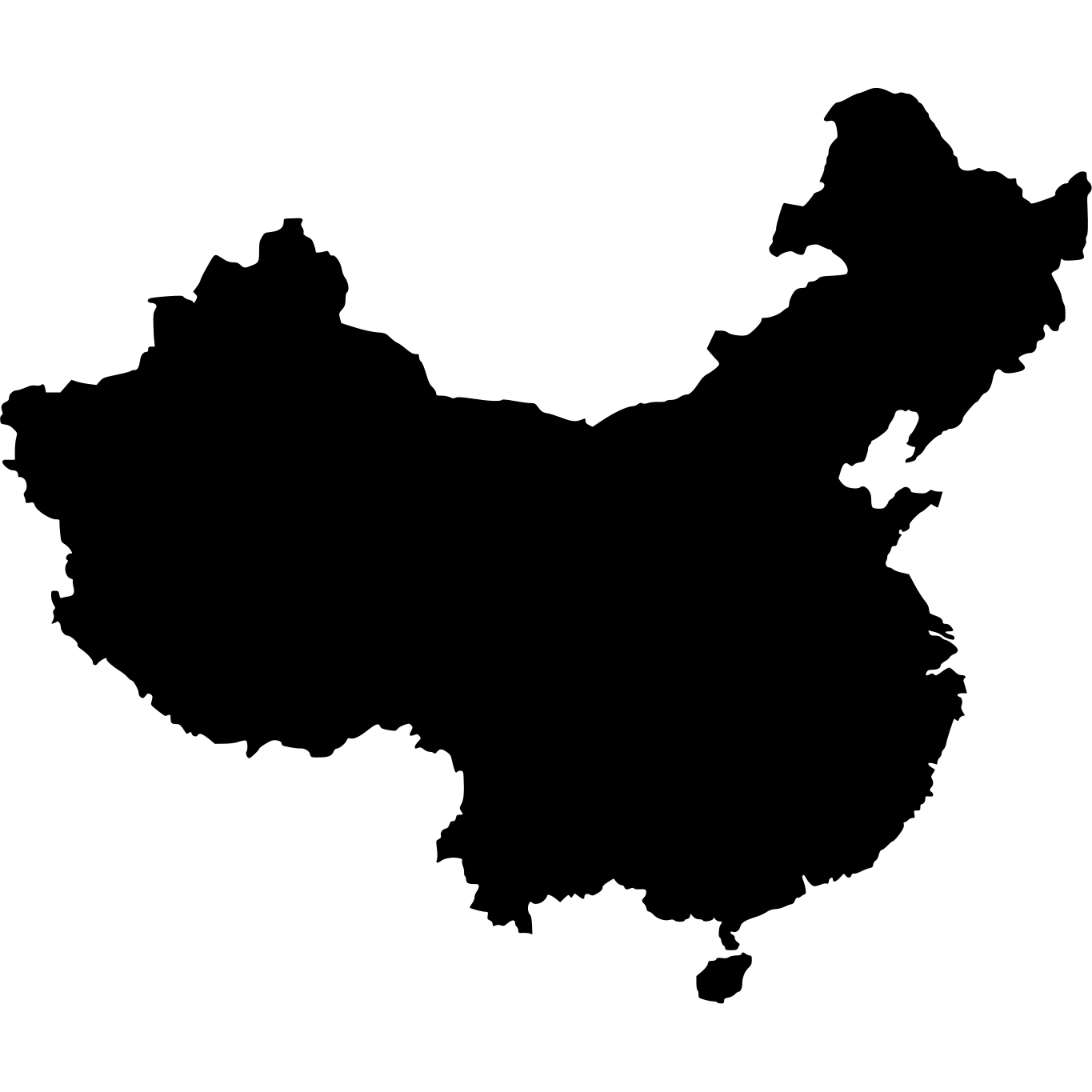
Beauty Glazed is a Chinese brand

We're dedicated to providing you with the most up-to-date and science-backed ingredient info out there.
The data we've presented on this page has been verified by a member of the SkinSort Team.
Read more about us· Updated February 9, 2026 • Added by ayamokri


