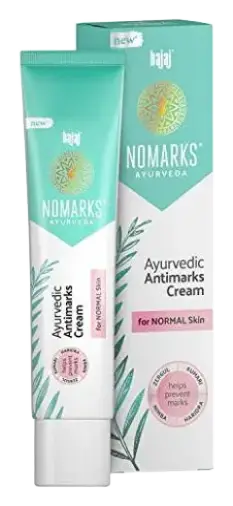
Bajaj Consumer Care Nomarks Ayurvedic Cream
A facial treatment with 11 ingredients.
This brightening treatment is formulated around Aloe Barbadensis Extract and Glycyrrhiza Glabra Root Extract to fade the look of dark spots and calm redness.
We independently verify ingredients, backed by peer-reviewed research. Suggest an update.
What's inside
Ingredients List
Aloe Barbadensis Extract 5%
Skin Conditioning


Azadirachta Indica Leaf Extract 2%
Skin ConditioningGlycyrrhiza Glabra Root Extract 2%
Bleaching



Citrus Limon Fruit Extract 1%
Masking
Triticum Aestivum Germ Oil 1%
Emollient








Active Ingredients:
Aloe Barbadensis Extract 5%, Azadirachta Indica Leaf Extract 2%, Glycyrrhiza Glabra Root Extract 2%, Citrus Limon Fruit Extract 1%, Triticum Aestivum Germ Oil 1%, Santalum Album Extract 1%, Curcuma Longa Root Extract 0.05%
Inactive Ingredients:
Cream, Calendula Officinalis Extract, Methylparaben, Propylparaben
Key Ingredients
Benefits
Concerns
Ingredients Explained
Aloe Barbadensis Extract is the extract of the whole Aloe plant. It has anti-inflammatory, moisturizing, antiseptic, and healing properties.
Aloe contains the antioxidants Vitamins A, C, and E. . These vitamins neutralize free radicals.
It also contains sugars in the form of monosaccharides and polysaccharides, folic acid, choline, many common minerals such as calcium, 12 anthraquinones, fatty acids, amino acids, and Vitamin B12.
The polysaccharides in aloe help moisturize your skin.
Despite helping with sunburn, aloe should not replace your sunscreen.
Learn more about Aloe Barbadensis ExtractAzadirachta Indica is a tree commonly known as neem, nimtree, or Indian Lilac.
The leaves of this tree contain flavonoids and polyphenols. These two compounds are antioxidants, anti-inflammatory, and antibacterial.
Antioxidants help fight free-radicals. Free-radicals are molecules that may damage your skin cells, such as pollution.
A 2017 study found neem oil was effective at treating wrinkles and dry skin in mice. The study also found higher levels of elastin and procollagen.
Learn more about Azadirachta Indica Leaf ExtractGlycyrrhiza Glabra Root Extract is an extract of the roots of Licorice. It has been found to have several benefits such as skin hydrating, conditioning, and soothing.
One component, glabridin, has extra potent antioxidant and soothing properties. It has also been found to block pigmentation from UVB rays in guinea pigs.
Licorice Root also contains a flavonoid. Flavonoids are a natural substance from in plants. Flavonoids also have antioxidant properties.
Another component, glycyrrhizin, has been found to have anti-inflammatory and antimicrobial benefits. This may make licorice root extract effective at treating acne. However, more research is needed to support this.
Liquiritin is one of the flavone compounds found in licorice. It has been found to help lighten skin by preventing tyrosinase from reacting with tyrosine. When the two react, protein is converted to melanin. Melanin is the substance in your body that gives your features pigmentation.
Learn more about Glycyrrhiza Glabra Root ExtractCitrus Limon Fruit Extract comes from lemons. While lemon extract is exfoliating and antimicrobial, it can also cause skin sensitivity.
Lemons contains antioxidants, which may help with anti-aging. They are also rich in citric acid, an AHA.
And of course, lemons are rich in Vitamin C. Vitamin C helps with skin-brightening and increasing collagen production.
The acidity of lemons may work as an astringent for acne.
However, lemons can also cause skin sensitivity due to its limonene content. It can also increase photosensitivity, or sensitivity to the sun.
This ingredient is also used to add a lemon scent to products.
Learn more about Citrus Limon Fruit ExtractTriticum Aestivum Germ Oil is an oil and isn't fungal acne safe.
We don't have a description for Santalum Album Extract yet.
Curcuma Longa Root Extract comes from the rhizome (underground stem) of the turmeric plant.
While the official EU Cosing Database lists this ingredient as a fragrance, it actually does more than give products a scent.
This ingredient contains a group of yellow pigments called curcuminoids (mostly curcumin) that give it genuine antioxidant and anti-inflammatory activity in skin.
Reviews of topical clinical studies have found turmeric/curcumin to be generally well-tolerated and useful across conditions like eczema and mild inflammation.
One thing working in its favor is that curcumin barely penetrates; in lab skin-permeation testing, the curcuminoids mostly stayed in the outermost layer of skin. This is a good thing because its soothing and antioxidant activity is a surface-level job anyway.
At this time, industry data shows there's no single "correct" cosmetic percentage. It's used across a wide range depending on the product and varies from tiny fractions of a percent up to a few percent.
Allergy-wise, curcumin is a documented (but uncommon) contact allergen. It can also cross react with related plants, so anyone with a turmeric/ginger/cinnamon allergy or reactive skin should patch test first.
Learn more about Curcuma Longa Root ExtractWe don't have a description for Cream yet.
Calendula Officinalis Extract comes from the common Marigold plant.
Marigold flowers contain flavonoids. Flavonoids are a group of substances found naturally in plants. They possess antioxidant and inflammation properties.
This ingredient may help soothe your skin by reducing inflammation. Emerging studies show it inhibits nitrous oxide production safely, therefore reducing inflammation.
Marigolds have been used in traditional medicine throughout Asia and Europe.
Learn more about Calendula Officinalis ExtractMethylparaben is a synthetic preservative and one of the most widely used in the world. It has a simple, but important job: prevent your products from going bad by stopping bacteria, yeast, and mold from growing.
Typical use levels are low, often 0.1-0.3%.
This is also one of the most heavily studied preservatives out there and major regulatory bodies have repeatedly given it the green light.
In 2023, the EU's Scientific Committee on Consumer Safety (SCCS) confirmed that this ingredient is safe up to 0.4% on its own, of up to 0.8% when mixed with other paraben esters.
Here's the science behind the noise behind parabens/hormones as well:
Methylparaben shows very weak estrogen-like activity in vitro tests (more than 1,000x weaker than your body's own estradiol). In vivo (live-organism) studies don't support a meaningful endocrine-disrupting effect either.
You get a stronger estrogenic effect from eating tofu, actually.
It's also a low sensitizer and allergic reactions are uncommon; they usually happen on damage or broken skin.
There is a caveat: France has proposed to formally re-examine its endocrine classification in 2025 so the regulatory conversation isn't fully closed as of yet.
But as it stands today, this ingredient is considered safe at permitted levels.
Learn more about MethylparabenPropylparaben is a preservative and one of the most widely used members of the paraben family (it's been used in cosmetics for over a century now).
It works by disrupting microbial cell membranes and enzymes, and is a broad-spectrum protector that works exceptionally well against molds, yeasts, and gram-positive bacteria.
You'll likely see it paired with methylparaben to cover the full range (including gram-negative bacteria).
This ingredient is effective at low concentrations (~0.2-0.5%) and stable across a wide pH range (4.5-7.5 pH). It's effectiveness drops off above pH 8 and it can lose potency when combined with non-ionic surfactants like polysorbate 80 due to micellization.
The regulatory bodies have concluded this ingredient to be safe as used in cosmetics. The EU has capped it at 0.14% and combined parabens are not to exceed 0.8%.
While parabens do cross the stratum corneum, only about 1% remains for absorption into the body. This is because most of it is metabolized within living skin.
Learn more about PropylparabenReviews
No written reviews yet. Be the first to review this product.
Recent searches
Search reviews by skin type, ingredient, or keyword.
Where it's from
Bajaj Consumer Care is a Indian brand


We're dedicated to providing you with the most up-to-date and science-backed ingredient info out there.
The data we've presented on this page has been verified by a member of the SkinSort Team.
Read more about us· Updated September 2, 2026 • Added by reteshbarnwal


